The China Mail - Menstrual periods an ordeal, health risk for Gaza women and girls

USD -
AED 3.672504
AFN 65.000123
ALL 81.757752
AMD 363.060451
ANG 1.790365
AOA 917.999729
ARS 1520.079178
AUD 1.434085
AWG 1.8
AZN 1.687314
BAM 1.745081
BBD 2.014187
BDT 123.310283
BGN 1.683441
BHD 0.377783
BIF 2992.192728
BMD 1
BND 1.280571
BOB 11.845639
BRL 4.990799
BSD 1.000045
BTN 96.679902
BWP 13.757752
BYN 3.042248
BYR 19600
BZD 2.011332
CAD 1.427575
CDF 2310.000091
CHF 0.83005
CLF 0.024814
CLP 976.969769
CNY 6.69215
CNH 6.69435
COP 3214.008476
CRC 456.301584
CUC 1
CUP 24.001785
CVE 98.38501
CZK 21.780502
DJF 178.086103
DKK 6.677565
DOP 60.611198
DZD 134.724069
EGP 52.48502
ERN 15
ETB 162.480749
EUR 0.89362
FJD 2.24725
FKP 0.755711
GBP 0.755775
GEL 2.589926
GGP 0.755711
GHS 11.755521
GIP 0.755711
GMD 73.499696
GNF 8797.680125
GTQ 7.645773
GYD 209.172429
HKD 7.847715
HNL 26.843631
HRK 6.725597
HTG 130.956948
HUF 326.282958
IDR 17891.4
ILS 3.06346
IMP 0.755711
INR 96.775502
IQD 1515.056882
IRR 1779470.000071
ISK 122.150205
JEP 0.755711
JMD 158.724069
JOD 0.708991
JPY 158.276
KES 129.698862
KGS 87.450113
KHR 4060.673656
KMF 440.000146
KPW 900.000318
KRW 1340.879742
KWD 0.31096
KYD 0.833371
KZT 454.436761
LAK 22426.053982
LBP 89555.476244
LKR 330.885568
LRD 171.010484
LSL 16.545706
LTL 2.95274
LVL 0.60489
LYD 6.430515
MAD 9.82021
MDL 17.93085
MGA 4459.513718
MKD 54.940888
MMK 2099.813295
MNT 3595.111531
MOP 8.083426
MRU 39.963417
MUR 47.45991
MVR 15.449743
MWK 1734.106625
MXN 18.429741
MYR 4.085503
MZN 63.909964
NAD 16.545706
NGN 1329.000254
NIO 36.80571
NOK 9.58262
NPR 154.687486
NZD 1.781898
OMR 0.384742
PAB 1.000045
PEN 3.429668
PGK 4.534464
PHP 62.745006
PKR 276.931162
PLN 3.917235
PYG 5688.155253
QAR 3.65532
RON 4.766027
RSD 104.733437
RUB 85.293524
RWF 1474.102164
SAR 3.75677
SBD 8.078071
SCR 14.675014
SDG 601.489851
SEK 9.98321
SGD 1.280155
SHP 0.755572
SLE 24.66969
SLL 20969.491881
SOS 571.492304
SRD 37.692501
STD 20697.981008
STN 21.860361
SVC 8.75039
SYP 13002.000254
SZL 16.542494
THB 33.553039
TJS 9.200535
TMT 3.51
TND 2.984609
TOP 2.40776
TRY 49.32138
TTD 6.793665
TWD 31.961401
TZS 2640.285523
UAH 44.916529
UGX 4089.225965
UYU 40.169529
UZS 11900.959179
VES 875.701604
VND 25899.5
VUV 119.371348
WST 2.785507
XAF 586.176071
XAG 0.016442
XAU 0.000238418806
XCD 2.702551
XCG 1.802364
XDR 0.707052
XOF 586.176071
XPF 106.410886
YER 236.202436
ZAR 16.55245
ZMK 9001.198055
ZMW 19.875976
ZWL 321.999592
SSP 5757.531856
MXV 2.082126
  • RYCEF

    0.4000

    19.71

    +2.03%

  • CMSC

    0.0000

    20.4

    0%

  • BTI

    0.4200

    56.05

    +0.75%

  • BP

    0.2800

    44.43

    +0.63%

  • RBGPF

    1.6000

    67

    +2.39%

  • RIO

    -0.1500

    94.41

    -0.16%

  • AZN

    -0.4300

    166.15

    -0.26%

  • GSK

    0.4600

    49.7

    +0.93%

  • BCE

    -0.4100

    20.56

    -1.99%

  • NGG

    -0.2500

    75.24

    -0.33%

  • VOD

    -0.0400

    16.58

    -0.24%

  • RELX

    -0.4500

    33.07

    -1.36%

  • BCC

    -0.5500

    76.59

    -0.72%

  • CMSD

    -0.0300

    20.27

    -0.15%

  • JRI

    -0.2500

    10.77

    -2.32%

Menstrual periods an ordeal, health risk for Gaza women and girls
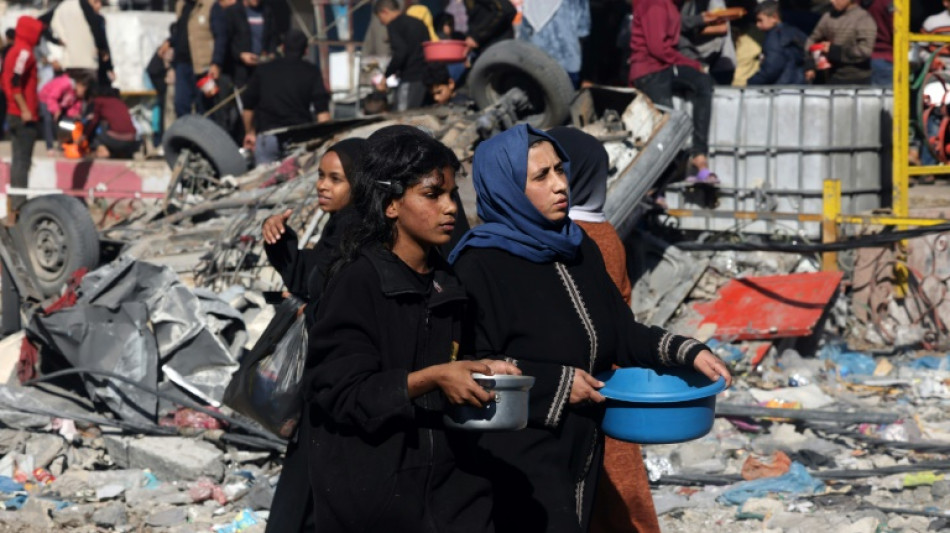
Menstrual periods an ordeal, health risk for Gaza women and girls / Photo: © AFP

Menstrual periods an ordeal, health risk for Gaza women and girls

Women and girls getting their periods in Gaza face humiliating conditions and infections, forced to use diapers or scraps of cloth after more than two months of war.

Text size:

Food, water and sanitary items are in desperately short supply across Gaza as around 80 percent of its 2.4 million people have been displaced by the conflict between Israel and Hamas.

"I cut up my kid's clothes or any piece of cloth I find, and I use them like sanitary towels for my period," said 25-year-old Hala Ataya in the southern city of Rafah where many have fled.

"I barely shower every two weeks," she added.

Forced to leave her home in Jabalia refugee camp in northern Gaza, she came with her three children to a United Nations-run school, sharing a toilet and shower with hundreds of others.

The stench is nauseating in the toilet, which is filled with flies.

The streets of Rafah, adjacent to the Egyptian border, have been transformed into open-air latrines.

Piles of rubbish cover the city, which has become a vast refugee camp as most Gazans have been prevented from leaving the territory.

"We've gone back to the Stone Age. There's no security, no food, no water, no hygiene. I'm ashamed, I feel humiliated," said Samar Shalhoub, 18, who was displaced from Gaza City.

She has been surviving in various makeshift shelters which she described as overflowing with "filth".

The war was triggered by the unprecedented October 7 attacks by Hamas militants who killed around 1,200 people in Israel, mostly civilians, according to local officials.

Retaliation by the Israeli military has killed around 18,000 Palestinians, also mostly civilians, according to the latest toll by the health ministry in Hamas-run Gaza.

- 'She started to cry' -

Unable to obtain sanitary products, Shalhoub has been using rags when she gets her period which have caused "chafing and skin infections".

Requests for contraceptive pills have quadrupled as women seek to control their periods, said Marie-Aure Perreaut Revial, of Doctors Without Borders (MSF).

ActionAid said there was little water for washing, and that some shelters had only one shower for every 700 people and one toilet for every 150.

"There's absolutely nothing: no privacy, no soap to keep themselves clean, no menstrual supplies," the NGO said.

Ahlam Abu Barika, facing her third month of displacement, described personal hygiene as a "daily battle".

"Women wear diapers or baby swaddling cloths. There's not enough water," said Abu Barika.

She has been eating and drinking less -- to give more to her five children and to limit her trips to the toilet.

"I've lost 15 kilos," she said.

Action Against Hunger, another NGO, said many women's clothes were stained with menstrual blood and they were "using period products for longer than anticipated, increasing the risk of infection."

In a classroom serving as a bedroom for displaced Gazans, Umm Saif said her five daughters were "all using Pampers" for their periods.

Diaper prices have almost doubled since the war so they cut each one in two, but one daughter still needed to use scraps of cloth.

"She started to cry, but I can't do anything," said Saif.

J.Liv--ThChM