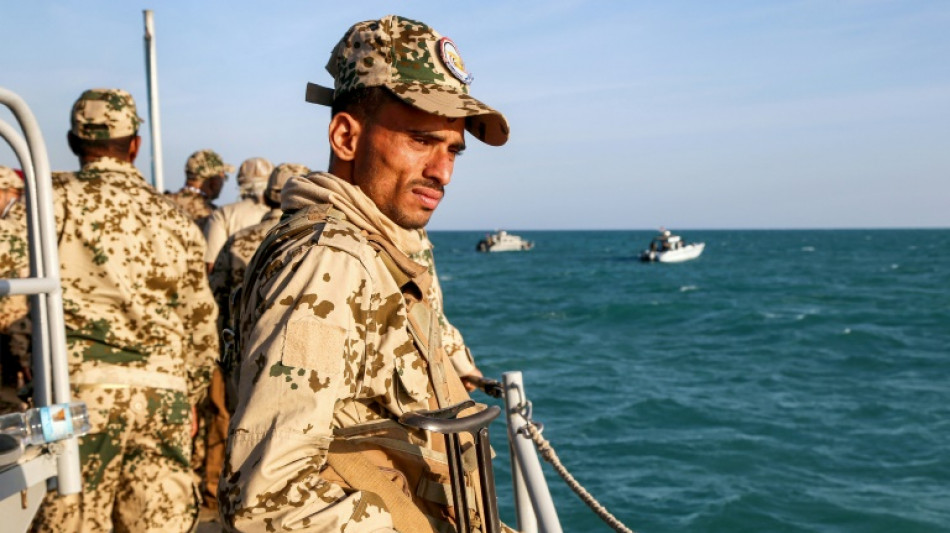
'Gate of Tears': Iran-aligned Huthis a growing threat in the Red Sea / Photo: © AFP

The spike in attacks claimed by Iran-backed Huthi rebels in the Red Sea is dangerously increasing tensions in a bottleneck for international maritime trade and fuelling fears of an uncontrolled regional spillover of Yemen's longstanding conflict.
Since the start of the war between Israel and Hamas militants in Gaza, Yemen's Huthi rebels have threatened to attack any ship heading to Israeli ports and stepped up their raids.
On Tuesday, Huthi rebels claimed responsibility for a missile strike on a Norwegian-flagged tanker, an attack the Iran-backed group said was part of its military campaign against Israel.
Last month, they seized an Israel-linked cargo vessel, the Galaxy Leader, and its 25 international crew.
The Huthis, who control much of Yemen but are not recognised internationally, are part of the Iran-backed so-called "axis of resistance" arrayed against Israel.
They say they are defending the Palestinians from an Israeli bombardment of the Gaza Strip, and have launched a series of drones and missiles towards Israel. US and French warships patrolling the Red Sea have shot down Huthi missiles and drones several times since the militants began the attacks.
A vital link between the Indian Ocean and the Mediterranean Sea, the Red Sea is a key trade route for global shipping and energy supplies.
Some 40 percent of international trade passes through the Strait of Bab-el-Mandeb, or the "Gate of Tears", a narrow waterway which separates the Arabian Peninsula from the Horn of Africa.
"This is a rather dangerous moment for the stability of this strategic region," said Camille Lons, a researcher at the European Council on Foreign Relations.
Fabian Hinz of the International Institute for Strategic Studies added: "The Huthis have the capacity to cause considerable damage."
While warships passing through the Red Sea are well equipped and can retaliate, commercial vessels do not have the same protections. "The US Navy cannot escort every civilian vessel in the Red Sea," said Hinz.
- Iran influence -
In recent years ties have grown between the Huthi rebels and Iran but the extent of their cooperation and coordination remains a major question.
Saudi Arabia and the United States have accused Iran of supplying the Huthis with drones, missiles and other weapons, a charge Tehran denies.
The Huthis say they manufacture their drones domestically, although analysts say they contain smuggled Iranian components.
"The big question of course is the exact nature of Iranian involvement in these strikes," said Hinz.
"Huthi equipment is mostly Iranian technology, but we know very little about Tehran's involvement in decision-making."
Many experts insist on the degree of autonomy of the Yemeni rebels.
Lons said that Huthis "don't answer to Tehran like the Lebanese Hezbollah does, the jewel in the crown of Iranian proxies in the region."
"The Huthis would exist with or without Iran," Franck Mermier, a Yemen expert at the French National Centre for Scientific Research, told AFP.
"They have a religious and ideological closeness to Iran, but they are Yemeni fighters first and foremost", he said.
"I'm not sure the Iranians push the button on every attack," added Mermier.
In contrast to Hezbollah's creation during Lebanon's 1975-1990 civil war, Iran had had no role in the birth of the Huthi movement.
The rebels adhere to a branch of Shia Islam known as Zaidism.
Yemen erupted into conflict in 2014 when the Iran-backed rebels seized Sanaa, prompting a Saudi-led military coalition to intervene the following year to prop up the internationally-recognised government.
- 'Unpredictable and dangerous' -
At the weekend Israeli National Security Adviser Tzachi Hanegbi urged the international community to rein in the Yemeni rebels.
"If the world does not take care of it," Hanegbi warned, "we will take action."
Analysts said that the tensions could get out of hand quickly.
"The Huthis are totally unpredictable and dangerous. And the processes that trigger war are always unpredictable," said Mermier.
"So far the Huthis have struck without attracting massive retaliation, but it can get out of hand," added Mermier.
Lons said that so far Iran has demonstrated it has no interest in letting the situation escalate regionally.
"However, Tehran has less leverage over groups like the Huthis," added Lons.
Noam Raydan, an analyst at the Washington Institute for Near East Policy, said in a note to clients that since the capture of the Galaxy Leader some companies have been re-routing their ships around the Cape of Good Hope, opting for a longer and costlier route.
"The risk of major disruption to global trade will remain high as long as commercial ships operated by various nationalities are being targeted," she said.
M.Zhou--ThChM