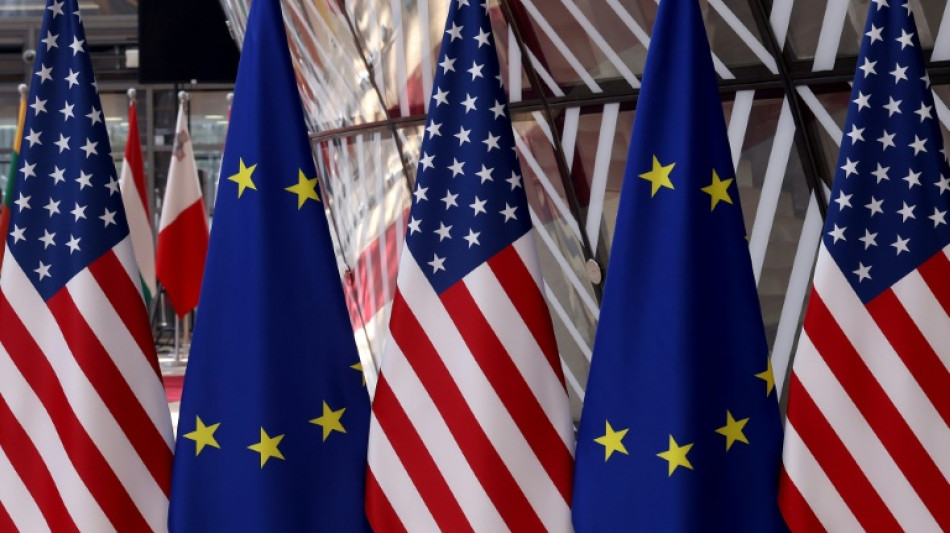
US-EU steel talks in limbo as elections loom / Photo: © AFP/File

The United States and the European Union remain far from resolving a gridlock on their trade in metals, even as both sides agreed to extend a truce this week ahead of a year-end deadline.
US President Joe Biden paused Trump-era tariffs on most European steel and aluminum two years ago, but this was due to expire if both parties did not agree on a path forward before January 1.
For now, the EU is extending its suspension of retaliatory tariffs on US products until March 2025, in exchange for similar moves by Washington, the European Commission said.
A US official told AFP on condition of anonymity that they expect to extend their existing tariff-rate quotas by two years as talks continue.
Why are both sides struggling to reconcile their differences?
- What are the talks about? -
In 2018, then-US president Donald Trump imposed 25 percent tariffs on imports of steel and 10 percent on aluminum from many countries, citing national security reasons and sweeping up EU exports in the process. This triggered EU retaliation.
The duties have since been paused and tariff-rate quotas were introduced, enabling European steel and aluminum to enter the United States without levies -- up to a level aligned with historical trends.
But the two sides missed a self-imposed October deadline to find a way forward. EU Commission vice president Valdis Dombrovskis earlier said the main obstacle was US unwillingness to provide a clear pathway towards withdrawing these quotas.
The talks are complicated as they aim to go beyond settling the trade spat.
They also push for decarbonization of the steel and aluminum industries, and to combat non-market practices from parties like China.
- Why a stalemate? -
"The US and EU have fundamentally different approaches," said Emily Benson, senior fellow at the Center for Strategic and International Studies.
Washington has sought a "green steel" club with a common external tariff imposed on third countries -- meaning those with more polluting industries or deemed to overproduce.
The EU wants to replace tariffs with a global arrangement that would place levies on carbon-intensive products, with member states adopting a "Carbon Border Adjustment Mechanism."
Washington aims to "take a more protective stance against Chinese products entering the US market," Benson told AFP.
But the EU wants to permanently remove Trump-era tariffs and speed up decarbonization.
- What happens next? -
Both sides are "too far apart" on the components of a green steel deal, said Inu Manak, fellow for trade policy at the Council on Foreign Relations.
A continuation of the truce merely "limits the economic harm from the reimposition of tariffs," Manak said.
With the United States heading into a presidential election next year, analysts expect policymakers to steer clear of tariff removal.
"The Biden administration may be reluctant to drop the tariffs to avoid being accused of risking blue-collar jobs," said Brookings senior fellow Sanjay Patnaik.
The EU also faces bloc-wide elections next year that will usher in a new European Commission.
- What are the repercussions? -
"If the United States wants to maintain global influence in setting the rules of international trade, it needs partners on its side," Manak noted.
"The United States continues to frustrate its trading partners, which bodes ill for future economic cooperation as well as many global collective action problems, such as fighting climate change," she said.
An issue with tariff-rate quotas is how they are constructed, as they are organized by product and by EU member state, meaning exporters still come up against tariffs.
These amount to some $350 million annually, said Rupert Schlegelmilch of the European Commission previously.
Dombrovskis sought to improve how quotas are handled, but analysts said US concessions are unlikely.
"I think what would result in a deal more immediately would be the US recognition of EU carbon accounting methodologies," Benson of CSIS added.
But there may be reluctance, given the US "doesn't want to be under the yoke of foreign government standard setting."
S.Davis--ThChM