What's next for Taiwan after the election? / Photo: © AFP

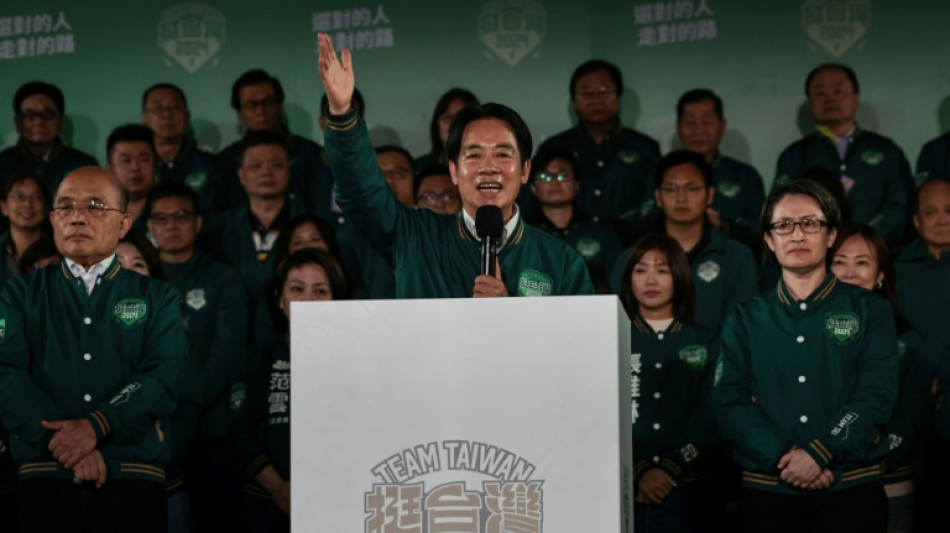
President-elect Lai Ching-te may have won the top job in Taiwan's elections, but he must now chart an uneasy path on the doorstep of an increasingly assertive China.
Despite Beijing's warnings that Lai's win would bring "war and decline" to Taiwan, he won comfortably with more than 40 percent of the vote Saturday.
In the face of China's rhetoric on Lai, here is what experts are saying is to come:
- Military pressures -
Ahead of the poll, Beijing warned voters to make the "correct" choice, blasting Lai as a "severe danger" who would threaten peace by following the "evil path" of Taiwan independence.
In a stinging repudiation of China's threats, Lai and his running mate Hsiao Bi-khim received a clear vote of confidence from more than 40 percent of the 14 million who voted.
"Beijing needs to carefully calibrate its action plans," said Alexander Huang, a military expert at Tamkang University in Taipei.
"Harsh military pressure may not be immediate given the current US-China relations and the American election cycle... However, Beijing will escalate pressures other than war toward Taiwan."
Taiwan already sees a near-daily presence of Chinese warplanes and naval vessels around it, which have upped global worries of an accidental conflict, particularly after Beijing cut off communications with President Tsai Ing-wen's administration.
These "grey zone" tactics -- manoeuvres that stop short of an outright act of war -- will increase to "ratchet up tension", said political scientist Wen-ti Sung.
A visiting US delegation right on the heels of the election is likely to anger Beijing -- two former senior officials are set to meet "leading political figures" Monday to extend the United States' congratulations.
In 2022, a Taiwan visit by then-US House speaker Nancy Pelosi triggered China's biggest-ever military exercises around the island, involving warships, missiles and fighter jets
- Economic squeezes -
Taiwan is home to the world's leading semiconductor industry, producing tiny chips used in everything from Bluetooth headphones to missile systems.
These silicon wafers are the lifeblood of the modern global economy, placing great responsibility on Lai to maintain a careful balance on tensions as the United States and China tussle over technology exports.
Speaking to reporters after his victory Saturday, Lai said his incoming administration would provide "strong support for the semiconductor industry" to facilitate the development of "a more complete industry link".
China leans on Taiwanese semiconductor imports, while the mainland remains the island's largest export market.
Sung said Beijing could apply an economic squeeze on Taiwan, which would "set the terms of interaction for the next four years of cross-strait relations".
The slowdown of China's economy could also force Taiwanese companies in China to "look elsewhere", said Raymond Kuo, Taiwan Policy Initiative director at RAND Corporation.
One of the largest employers in China is Taiwan-based Foxconn -- a leader in producing Apple products -- which has in recent years looked to diversify its manufacturing chain outside of the mainland.
- 'Obstructionist' legislature -
Voters may have chosen Lai as president, but the vote for legislature positions saw his party lose its majority.
DPP now has one less seat in Taiwan's legislature than main opposition group Kuomintang (KMT) -- which makes the small Taiwan People's Party "the kingmaker", said Kuo.
But for big-ticket issues -- like bolstering national defence -- "there is burgeoning consensus among the Taiwan public" for it.
"Being obstructionist in those issues will hurt (the opposition camps)", he said.
Any legislation regarding cross-strait relations would be difficult to pass, said Sarah Liu of the University of Edinburgh.
"It's likely the DPP won't achieve much," she said.
- Preserving status quo -
With Lai's win, the DPP secured an unprecedented third consecutive term in power, signifying that the majority of Taiwanese stand behind the party's values of preserving democracy.
Taiwanese "are voting regardless of this sense of crisis... put up by the opposition parties", said Ivy Kwek of International Crisis Group.
With younger generations no longer identifying with being Chinese, preserving the status quo in the flashpoint region "has become harder".
"What we are seeing is that Taiwanese are increasingly having a very distinctive identity different from the mainland China, and... we are seeing a Beijing that is increasingly more powerful," Kwek said.
"Lastly, we also have a Washington that is... becoming more anxious about China's intent on Taiwan."
All this means that an already tense situation on the strait will be amplified.
"Breakthrough will be hard but it does not mean that things cannot improve," she said.
X.Gu--ThChM