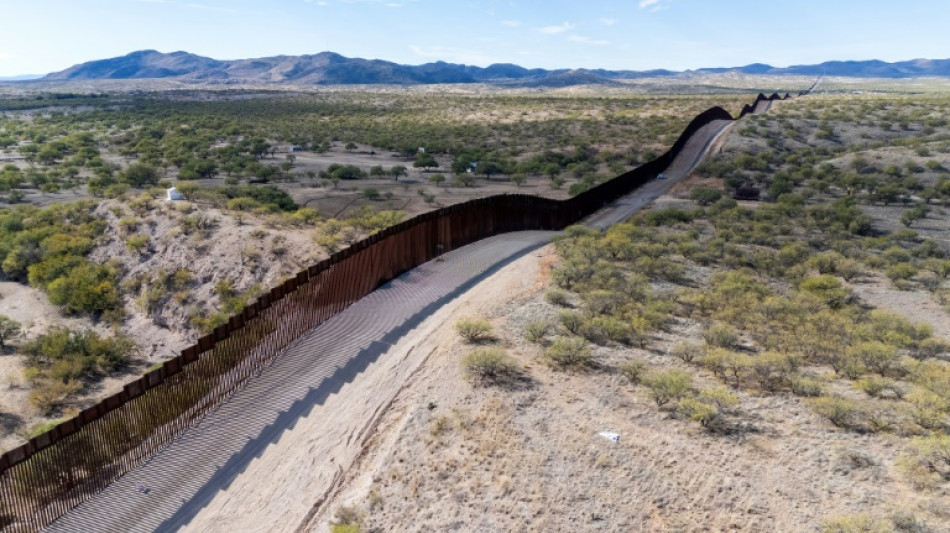
US southern border becomes a global entry point for asylum seekers / Photo: © AFP

As political and racial persecution grew worse in his native Mauritania, Barry looked for a way out.
Scouring discussion groups on social media for tips on clandestine migration, he soon found that the longtime standby of risky sea voyages in leaky open boats to Europe wasn't the only option. There was the United States -- via Mexico.
The journey of Barry -- who asked only to be identified by his first name -- by land from Mexico in July reflects the growing reality of the southern US border becoming a global way station for asylum seekers, rather than only Latin American migrants.
Barry bypassed not only Europe but also the United States' traditionally immigrant-heavy coastal cities, making his way to the midwestern capital of Columbus, Ohio -- home to a suddenly growing Mauritanian diaspora.
"I just want to get back my freedom of speech, my freedom of expression," the former NGO and government worker said, citing crackdowns last year on activists and protesters by authorities in a West African country known for discrimination against its black citizens.
As rich countries struggle to adjust to an era of mass migration, authorities there often focus on lethal sea routes out of Africa to Europe and the long-standing flow north from impoverished Latin American countries.
But of the nearly 2.5 million crossings recorded by Customs and Border Protection in fiscal year 2023, 1.26 million people originated from outside of the usual source-countries Mexico, Honduras, Guatemala and El Salvador.
That represents a 234 percent increase from 2021, when some 378,000 "other" country nationals crossed the southern border.
For Africans specifically, more than 58,000 crossings were recorded by the Border Patrol in 2023 -- a 346 percent jump compared to the year before.
About 15,000 of them were Mauritanians like Barry -- more than the 13,000 Africans from the entire continent who had crossed the year before.
- 'Quasi-legal' routes via Turkey -
There isn't one specific driver for the arrival of tens of thousands of people from as far away as China, India and Russia on the Mexican-US border.
Much of the migration is at least initially legal: Barry flew to Turkey first, then South America, before making his way north overland. The ever-evolving routes are widely shared on social media -- and, according to US border officials, via "pseudo-legitimate travel agencies" in West Africa.
In November, the United States sanctioned a Mexican charter plane operator known to carry Cubans and Haitians to Nicaragua, whose lax visa policies mean people often enter there before heading overland toward the United States.
Efforts by Europe to block routes across the Sahara and the Mediterranean -- including by funding the Libyan coast guard to intercept migrants at sea -- might be pushing more people toward the United States, some experts say.
"You've seen the way they patrol that area, and now individuals are taking a different route," says Dauda Sesay, national network director for the US nonprofit African Communities Together.
- 'Wanted to come legally' -
Columbus, Ohio, has had a Mauritanian community for two decades, but they were originally composed of refugees, like the family of Houleye Thiam, president of the Mauritanian Network for Human Rights.
She told AFP that the city's Mauritanian population has possibly doubled, from 4,000 to 7-8,000.
"You don't really know they're coming until they get here," said the 42-year-old, who sometimes wakes up with 25 different voice messages on What'sApp from people asking immigration questions.
Meanwhile, immigration is increasingly roiling domestic US politics ahead of the November 2024 elections.
The Texas National Guard and federal Border Patrol are squabbling over control over the US-Mexico border and leading Republican presidential candidate Donald Trump is making fears over illegal immigration the centerpiece of his hard-right campaign.
Ibrahima, another recent Mauritanian arrival in Ohio's Cincinnati -- another city with a large, and now growing, diaspora -- said he "wanted to come legally."
The 38-year-old had been searching unsuccessfully for scholarships to study in Europe when he got caught up in anti-government protests at home and says he was arrested and tortured.
He has an older brother who is already a US citizen. But rather than going through the lengthy process of seeking regular immigration, he crossed through Mexico and claimed asylum.
"I want to participate in the development of the American economy," Ibrahima said.
He's waiting for a work permit to come through while his asylum case works through the creaking, backlogged system.
For now, "we don't have the right to work... but we accept that."
A.Kwok--ThChM