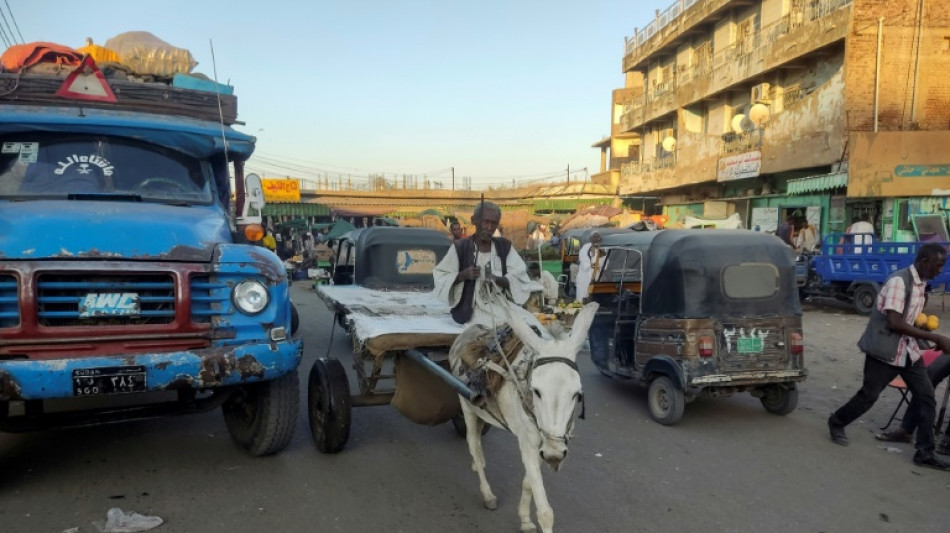
Economy another victim of war in impoverished Sudan / Photo: © AFP

Before the Sudanese army and paramilitary fighters turned their guns on each other last year, Ahmed used to sell one of Sudan's main exports: gum arabic, a vital ingredient for global industry.
Now he's out of business, and his story encapsulates the broader economic collapse of Sudan during 10 months of war.
Since combat between two rival generals began on April 15, Ahmed has been at the fighters' mercy.
"When the war began, I had a stock of gum arabic in a warehouse south of Khartoum that was intended for export," Ahmed told AFP, asking to use only his first name for fear of retaliation.
"To get it out I had to pay huge sums to the Rapid Support Forces," the paramilitaries commanded by Mohamed Hamdan Daglo who are at war with the Sudanese Armed Forces led by Abdel Fattah al-Burhan.
"I had to pay multiple times in areas under their control, before my cargo got to areas controlled by the government," Ahmed said.
But the government -- loyal to the army -- "then demanded I pay taxes" on the product, an emulsifying agent used in everything from soft drinks to chewing gum.
When the trucks finally made it to Port Sudan for export on the Red Sea, "authorities again asked for new taxes, and I had to pay storage fees six times more than before the war", Ahmed said.
His gum arabic -- like many other Sudanese products -- never made it onto a ship. According to Sudan's port authorities, international trade fell 23 percent last year.
- 'Decades' to recover -
The finance ministry, which didn't set a national budget for 2023 or 2024 and has foregone quarterly reports, recently raised the exchange rate for imports and exports from 650 Sudanese pounds to 950.
But that is still far below the currency's real value.
With most banks out of service, the only exchange rate that matters to ordinary Sudanese is on the black market, where the dollar currently goes for around 1,200 Sudanese pounds.
"It's a sign of the destruction of the Sudanese economy," former Sudanese Chamber of Commerce head al-Sadiq Jalal told AFP.
To make matters worse, a communications blackout since early February has hampered online transactions -- which Sudanese relied on to survive.
The war has led industries to cease production. Others were destroyed. Businesses and food stocks have been looted.
The World Bank in September said "widespread destruction of Sudan's economic foundations has set the country's development back by several decades".
The International Monetary Fund has predicted that even after the fighting ends, "years of reconstruction" await the northeast African country.
Sudan suffered under a crippled economy for decades and was already one of the world's poorest countries before the war.
- From farming to famine -
Under the Islamist-backed regime of strongman Omar al-Bashir, international sanctions throttled development, corruption was rampant, and South Sudan split in 2011 with most of the country's oil production.
Bashir's ouster by the military in 2019 following mass protests led to a fragile transition to civilian rule accompanied by signs of economic renewal and international acceptance.
A 2021 coup by Burhan and Daglo, before they turned on each other, began a new economic collapse when the World Bank and the United States suspended vital international aid.
More than six million of Sudan's 48 million people have been internally displaced by the war, and more than half the population needs humanitarian aid to survive, according to the United Nations.
Thousands of people have been killed, including between 10,000 and 15,000 in a single city in the western Darfur region, according to UN experts.
Now the indirect death toll is also rising.
Aid agencies have long warned of impending famine, and the UN's World Food Programme is "already receiving reports of people dying of starvation", the agency's Sudan director Eddie Rowe said in early February.
The Sudanese state "is completely absent from the scene" in all sectors, economist Haitham Fathy told AFP.
Chief among those is agriculture, which could have helped stave off hunger.
Before the war, agriculture generated 35-40 percent of Sudan's gross domestic product, according to the World Bank, and employed 70-80 percent of the workforce in rural areas, the International Fund for Agricultural Development said.
But the war has left more than 60 percent of the nation's agricultural land out of commission, according to Sudanese research organisation Fikra for Studies and Development.
In the wheat-growing state of al-Jazira, where RSF fighters took over swathes of farmland south of Khartoum, farmers have been unable to tend their crops. They saw their livelihoods wither away.
From the wheat fields to Ahmed's gum arabic warehouse, the story is the same.
His savings spent, his stock gone and his future bleak, Ahmed -- like much of Sudan's business class -- has closed up shop.
R.Yeung--ThChM