Why would the US defend the Philippines? / Photo: © GETTY IMAGES NORTH AMERICA/AFP

Relations between the United States and the Philippines have been in overdrive since President Ferdinand Marcos took power in June 2022, fuelled by China's growing assertiveness in the Asia-Pacific region.
A key concern has been the South China Sea, where repeated confrontations between Chinese and Philippine vessels near disputed reefs have raised fears of a wider conflict involving the United States and other allies.
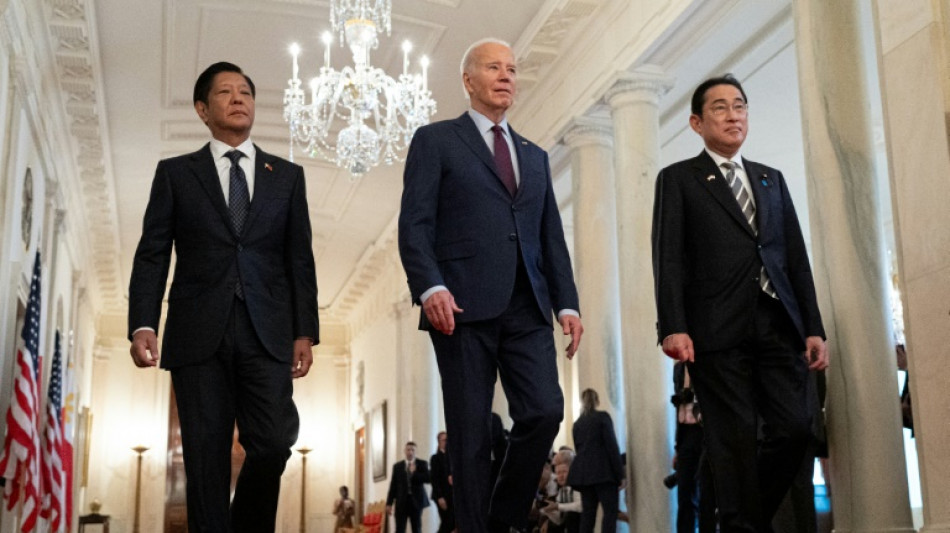
The issue was high on the agenda of Thursday's first trilateral summit between the United States and treaty allies Japan and the Philippines.
AFP looks at the deepening of defence ties between the Philippines and the United States, and why Washington could go to war for Manila.
- Does the US have to defend the Philippines? -
The Philippines is a major focus of US efforts to strengthen regional alliances due to its close proximity to the South China Sea and self-ruled Taiwan, which China claims as part of its territory.
While Manila and Washington have a complex history that has seen relations see-saw in recent years, they have remained bound by a 1951 Mutual Defence Treaty.
Top Biden administration officials have repeatedly said that "an armed attack" against Philippine public vessels, aircraft, armed forces and coastguard anywhere in the South China Sea would invoke the treaty.
In 2014, a defence cooperation agreement between the two countries gave US troops access to five Philippine military bases.
That pact became dormant under former president Rodrigo Duterte, who was pro-China, but was revived and expanded after Marcos came to power and now includes four additional sites.
"Given the geopolitical situation now... the messaging of the US commitment to the Philippines is more clarified and more coherent," said Andrea Wong, a non-resident research fellow at the Institute for Indo-Pacific Affairs in New Zealand.
- Why does the South China Sea matter? -
The South China Sea covers more than three million square kilometres and is the main maritime link between the Pacific and Indian oceans, giving it enormous trade and military value.
Its shipping lanes connect East Asia with Europe and the Middle East, with trillions of dollars in ship-borne trade passing through the sea annually.
Huge unexploited oil and gas deposits are believed to lie under the seabed, though estimates vary greatly.
Tensions over the waterway have turned it into a powder keg and many fear a miscalculation or accident could ignite a military conflict.
- What is the dispute over? -
For decades, various countries have had competing claims to the South China Sea and its hundreds of reefs and islands.
China and Taiwan both claim nearly all of the sea, while Vietnam, the Philippines, Malaysia and Brunei each have overlapping stakes to parts of it.
The US has no territorial claim over the waters or features, but regularly conducts patrols there.
"The US government's interest is freedom of trade and unimpeded commerce in the South China Sea... another interest of the US is freedom of navigation and overflight," said Wong.
If a big country like China were to control the whole South China Sea, "then most likely other countries who want to pass through there will have to ask permission," she said.
Beijing argues it has "historic rights" to the South China Sea, based largely on Chinese maps dating back to the 1940s that show a U-shaped dashed line that approaches the coasts of other countries.
The Hague-based Permanent Court of Arbitration ruled in 2016 that those claims had no legal basis.
China has ignored the decision. Of all the claimants, it has been the most assertive in pressing its claims.
- How are US-Philippine relations? -
The Duterte years were a rocky time for US-Philippine ties as Manila pivoted away from Washington and towards Beijing in the hope of extracting investment and trade.
Duterte also set aside the international ruling rejecting China's claims to most of the South China Sea, and threatened to axe the 2014 defence agreement allowing US troops on Philippine soil.
Marcos dramatically changed course when he took office, publicly standing up to Chinese actions in the waterway and giving the United States access to more Philippine military bases.
President Joe Biden on Thursday reiterated the United States' "ironclad" commitment to defend the Philippines -- a superlative multiple US officials have used in talks with their Philippine counterparts in the past two years.
F.Jackson--ThChM