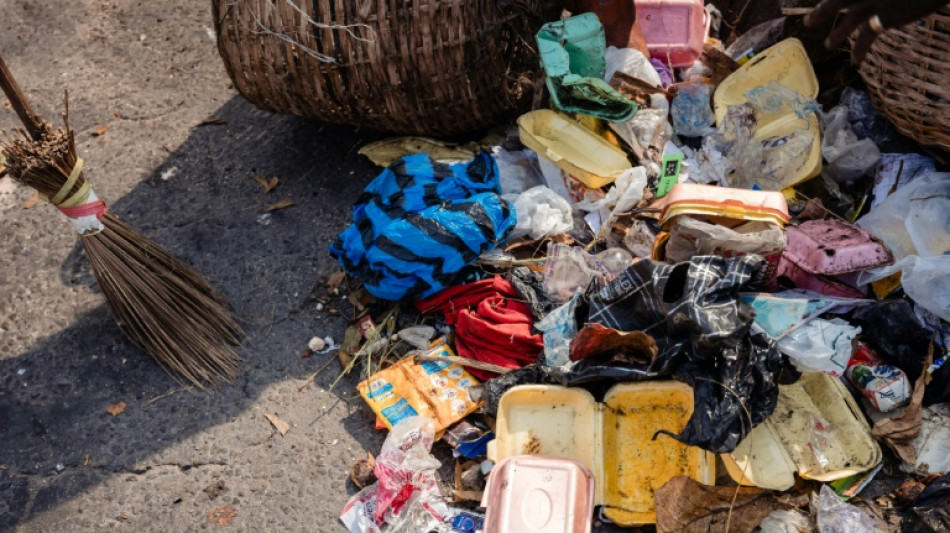
Negotiations on global plastic treaty to resume in Canada / Photo: © AFP/File

Negotiators from 175 countries are meeting from Tuesday in Canada to nail down a binding global treaty to end plastic pollution with many sticking points to be resolved five months after the last round of talks in Kenya.
Nations in 2022 agreed to finalize by the end of this year a world-first UN treaty to address the scourge of plastics found everywhere from mountain tops to ocean depths, and within human blood and breast milk.
Negotiators have already met three times and are expected, after the Ottawa talks, to hold a final round of negotiations in South Korea.
The previous meeting in Nairobi last November was the first opportunity to debate a draft treaty that outlined pathways to tackling the problem. It ended with disagreements over its scope and environmental non-governmental organizations panning a lack of firm progress.
"We have a text, it is a basis even if there remains a lot of work to be done on it," Canadian Environment Minister Steven Guilbeault and host of the Ottawa talks told AFP.
According to him, the goal this round is to "achieve a text with 60 to 70 percent of the elements endorsed" by delegates who are meeting through April 29.`
The stakes are high, with widespread plastic pollution having potentially grave impacts on oceans and climate.
Although there is a broad consensus on the need for a treaty, environmental activists pleading for a 75 percent cut in plastic production by 2040 are at odds with oil-producing nations and the plastics industry itself that favor recycling.
- 'Watered-down agreement' -
"This treaty presents a monumental opportunity in a time of urgency," said oceans scientist Neil Nathan of the University of California Santa Barbara. "Legally binding and specific measures are necessary to avoid a watered-down agreement that fails to meet the moment."
Annual plastics production has more than doubled in 20 years to 460 million tonnes, and is on track to triple within four decades.
Only 9 percent is recycled, and according to the OECD, its contribution to global warming could more than double by 2060 -- having accounted for 3.4 percent of global emissions in 2019.
"We are at a crossroads," said Eirik Lindebjerg of World Wildlife Fund International. He noted that "an overwhelming majority of countries have already called for the adoption of the necessary binding global rules -- our leaders must now transform these calls into action."
The NGO Ocean Conservancy reckons the Ottawa talks will signal whether or not an agreement can be reached by year's end.
Some are worried.
The Tara Ocean Foundation pointed to the draft text ballooning from 31 to 70 pages, a sign of how major provisions of the treaty "are yet to be defined," forcing negotiators to cover all options.
Countries including France are calling for the creation of intersessional working groups to tackle outstanding issues, in particular: identifying which plastic products are problematic and avoidable, which polymers and substances should be banned, and firming eco design criteria.
Several North American organizations have recently called on President Joe Biden to become more engaged on the subject.
Anja Brandon from Ocean Conservancy said: "The United States is the largest producer of plastic waste in the world, both per capita and in total by volume or absolute weight."
Along with China, Saudi Arabia and members of OPEC, it is among the countries reluctant to consider a reduction in production.
Manufacturers insist they are bringing solutions and expertise to the talks, as well as "innovating, investing and driving smart policies to help end plastic pollution," according to Chris Jahn of the International Council of Chemical Associations.
At the same time, he warned of "wide-reaching consequences a cap on plastic production would have on society," advocating for a more gradual approach.
Other countries are calling for ambitious measures, notably 65 members of a so-called "high ambition" coalition, chaired by Rwanda and Norway, which includes the majority of European Union countries.
C.Fong--ThChM