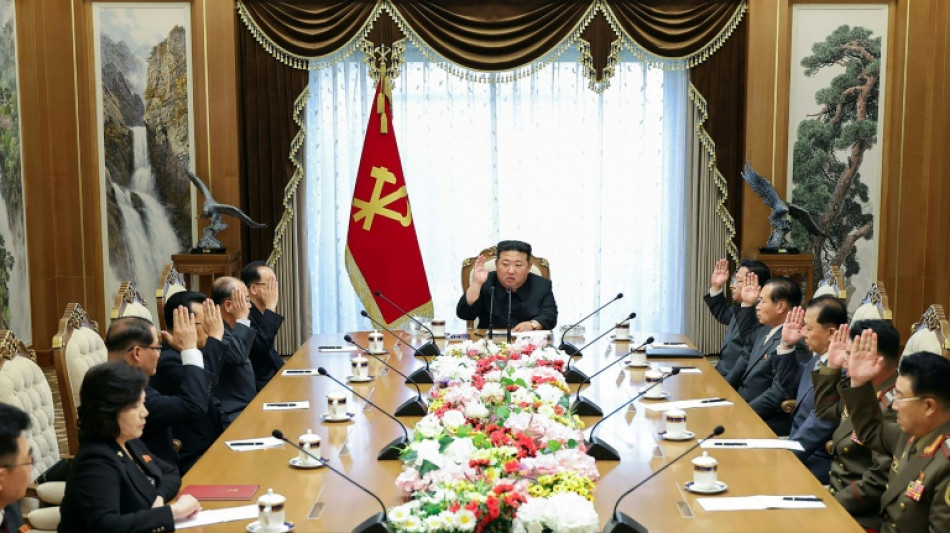
N Korea says spy satellite launch ends in failure / Photo: © KCNA VIA KNS/AFP/File

North Korea's latest attempt to put a spy satellite into orbit ended in a mid-air explosion, Pyongyang said late Monday, hours after its announcement of a planned launch was criticised by Seoul and Tokyo.
Putting a spy satellite into orbit has long been a top priority for Kim Jong Un's regime, and it claimed to have succeeded in November, after two failed attempts last year.
Seoul claims Kim received Russian technical assistance for that launch, in return for sending containers of weapons to Moscow for use in Ukraine.
But its attempt Monday to launch the "Malligyong-1-1" reconnaissance satellite ended in failure after it "exploded in the air during the first flight stage and failed to launch," the North's National Aerospace Technology Administration said in a statement.
An "expert review concluded that the cause of the accident was the operational reliability of the newly developed liquid oxygen and oil engine," the statement, carried by the official Korean Central News Agency, added.
Japanese broadcaster NHK ran footage of what appeared to be a flaming projectile in the night sky, which then exploded into a fireball, saying it had filmed it from northeast China at the same time as the attempted launch.
Pyongyang had notified Japan earlier Monday that it was planning to put another satellite into orbit, prompting criticism from both Seoul and Tokyo, which urged Kim to call it off.
South Korea's military said it had detected the launch but that the satellite "is presumed to have exploded in the air".
"The South Korean and US intelligence authorities are analysing it in detail in close cooperation," the Joint Chiefs of Staff said.
Nuclear-armed North Korea is barred by multiple UN resolutions from tests using ballistic technology, and analysts say there is significant technological overlap between space launch capabilities and the development of ballistic missiles.
The launch "is a provocative act that clearly violates the UN Security Council resolution prohibiting the use of ballistic missile technology," South Korea's military said.
Japan briefly issued an alert warning residents of southern Okinawa prefecture to take cover in shelters, but it was lifted minutes later.
- Hours after trilateral -
The attempted launch came just hours after Seoul, Beijing and Tokyo wrapped up their first trilateral summit since 2019.
South Korea's President Yoon Suk Yeol said Monday that another satellite launch -- North Korea's fourth attempt -- would "undermine regional and global peace and stability".
The South Korean military conducted attack formation flight and strike training on Monday to demonstrate "the strong capabilities and will of our military" after North Korea notified Japan of its plans to launch a satellite by June 4.
Experts say that spy satellites could improve North Korea's intelligence-gathering capabilities, particularly over South Korea, and provide crucial data in any military conflict.
Kim met President Vladimir Putin in Russia last September, and Putin suggested afterwards that his nation could help Pyongyang build satellites.
Seoul and Washington have both subsequently accused Pyongyang of shipping weapons to Moscow, with South Korea saying earlier this year that Pyongyang had sent thousands of containers of weapons to Russia for use in Ukraine.
A group of Russian engineers entered North Korea to help with the launch preparations, Yonhap reported Sunday, citing a government official.
North Korea claims the "Malligyong-1" satellite it put into orbit in November is successfully functioning, but Seoul's intelligence agency has cast down on this claim.
The North's two failed attempts last year included one in May which failed due to the "abnormal" startup of its second-stage engine, Pyongyang state media said at the time, and one in August which was attributed to an error in the "emergency blasting system".
Seoul's National Intelligence Service collected and analysed debris from one of Pyongyang's failed launches earlier last year, finding it had no military utility.
C.Smith--ThChM