The China Mail - Nuclear arms more prominent amid geopolitical tensions: researchers

USD -
AED 3.672501
AFN 64.999681
ALL 82.034985
AMD 361.533286
ANG 1.790365
AOA 917.999726
ARS 1520.093698
AUD 1.435956
AWG 1.8
AZN 1.701083
BAM 1.742904
BBD 2.010239
BDT 122.889097
BGN 1.683441
BHD 0.376508
BIF 3006.180073
BMD 1
BND 1.277987
BOB 11.979329
BRL 4.998499
BSD 0.99808
BTN 96.060705
BWP 13.768151
BYN 3.050737
BYR 19600
BZD 2.007298
CAD 1.426769
CDF 2320.000388
CHF 0.831498
CLF 0.024645
CLP 973.129925
CNY 6.704602
CNH 6.70464
COP 3209.6
CRC 457.334325
CUC 1
CUP 23.95391
CVE 98.260951
CZK 21.79835
DJF 177.729458
DKK 6.66459
DOP 59.97389
DZD 134.412988
EGP 52.388899
ERN 15
ETB 161.019506
EUR 0.89164
FJD 2.132504
FKP 0.755628
GBP 0.756565
GEL 2.595016
GGP 0.755628
GHS 11.731786
GIP 0.755628
GMD 74.00022
GNF 8780.426946
GTQ 7.629894
GYD 208.775002
HKD 7.84718
HNL 26.830137
HRK 6.717098
HTG 130.694957
HUF 327.429728
IDR 17902.65
ILS 3.053898
IMP 0.755628
INR 96.34315
IQD 1310
IRR 1798277.49797
ISK 122.159692
JEP 0.755628
JMD 158.35602
JOD 0.709031
JPY 157.938498
KES 129.739776
KGS 87.449457
KHR 4054.999849
KMF 439.00006
KPW 900.000318
KRW 1344.914992
KWD 0.309406
KYD 0.831703
KZT 456.630323
LAK 22470.000237
LBP 89377.046843
LKR 329.909861
LRD 170.67161
LSL 16.630433
LTL 2.95274
LVL 0.60489
LYD 6.417117
MAD 9.989499
MDL 17.930678
MGA 4450.000347
MKD 54.872343
MMK 2099.456706
MNT 3596.082114
MOP 8.06746
MRU 40.042597
MUR 47.550596
MVR 15.455
MWK 1742.000147
MXN 18.078596
MYR 4.085397
MZN 63.910284
NAD 16.630182
NGN 1323.180081
NIO 36.670141
NOK 9.59905
NPR 153.697127
NZD 1.78739
OMR 0.384503
PAB 0.998084
PEN 3.446499
PGK 4.486972
PHP 62.646497
PKR 276.949881
PLN 3.90752
PYG 5849.459299
QAR 3.6437
RON 4.763204
RSD 104.735042
RUB 84.826147
RWF 1474
SAR 3.74637
SBD 8.058541
SCR 14.059582
SDG 601.498534
SEK 10.041065
SGD 1.279865
SHP 0.75643
SLE 24.650252
SLL 20969.491881
SOS 571.497874
SRD 37.666011
STD 20697.981008
STN 21.833088
SVC 8.733196
SYP 13002.000254
SZL 16.630019
THB 33.710014
TJS 9.187233
TMT 3.51
TND 2.98236
TOP 2.40776
TRY 49.151401
TTD 6.765554
TWD 31.765898
TZS 2639.663973
UAH 44.981888
UGX 4011.887735
UYU 40.40404
UZS 11790.000168
VES 870.279502
VND 25993
VUV 119.46017
WST 2.788611
XAF 584.877538
XAG 0.016416
XAU 0.000241878038
XCD 2.70255
XCG 1.798771
XDR 0.707052
XOF 584.877538
XPF 106.649694
YER 236.249949
ZAR 16.65114
ZMK 9001.201745
ZMW 19.68712
ZWL 321.999592
SSP 5712.591527
MXV 2.044218
  • RYCEF

    0.4000

    19.71

    +2.03%

  • CMSC

    0.0000

    20.4

    0%

  • BTI

    0.4200

    56.05

    +0.75%

  • BP

    0.2800

    44.43

    +0.63%

  • RBGPF

    1.6000

    67

    +2.39%

  • RIO

    -0.1500

    94.41

    -0.16%

  • AZN

    -0.4300

    166.15

    -0.26%

  • GSK

    0.4600

    49.7

    +0.93%

  • BCE

    -0.4100

    20.56

    -1.99%

  • NGG

    -0.2500

    75.24

    -0.33%

  • VOD

    -0.0400

    16.58

    -0.24%

  • RELX

    -0.4500

    33.07

    -1.36%

  • BCC

    -0.5500

    76.59

    -0.72%

  • CMSD

    -0.0300

    20.27

    -0.15%

  • JRI

    -0.2500

    10.77

    -2.32%

Nuclear arms more prominent amid geopolitical tensions: researchers
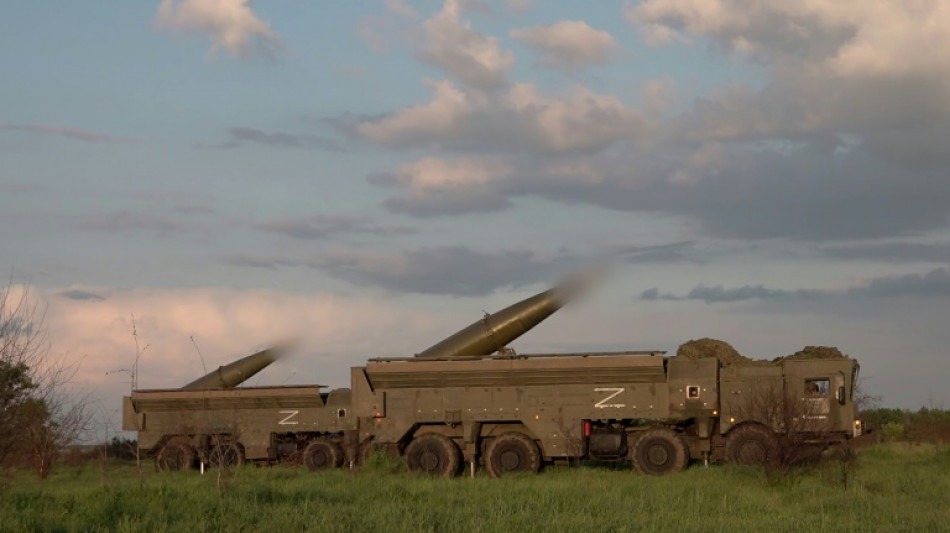
Nuclear arms more prominent amid geopolitical tensions: researchers / Photo: © Russian Defence Ministry/AFP

Nuclear arms more prominent amid geopolitical tensions: researchers

The role of atomic weapons has become more prominent and nuclear states are modernising arsenals as geopolitical relations deteriorate, researchers said Monday, urging world leaders to "step back and reflect".

Text size:

Diplomatic efforts to control nuclear arms also suffered major setbacks amid strained international relations over the conflicts in Ukraine and Gaza, the Stockholm International Peace Research Institute (SIPRI) said in its annual yearbook.

"We have not seen nuclear weapons playing such a prominent role in international relations since the Cold War," Wilfred Wan, director of SIPRI's Weapons of Mass Destruction Programme, said in a statement.

The research institute noted that in February 2023 Russia announced it was suspending participation in the 2010 New START treaty -- "the last remaining nuclear arms control treaty limiting Russian and US strategic nuclear forces".

SIPRI also noted that Russia carried out tactical nuclear weapon drills close to the Ukrainian border in May.

Russian President Vladimir Putin has upped his nuclear rhetoric since the Ukraine conflict began, warning in his address to the nation in February there was a "real" risk of nuclear war.

In addition, an informal agreement between the United States and Iran reached in June 2023 was upended after the start of the Israel-Hamas war in October, SIPRI said.

- 'Extremely concerning' -

According to SIPRI, the world's nine nuclear-armed states also "continued to modernise their nuclear arsenals and several deployed new nuclear-armed or nuclear-capable weapon systems in 2023".

The nine countries are the United States, Russia, the UK, France, China, India, Pakistan, North Korea and Israel.

In January, of the estimated 12,121 nuclear warheads around the world about 9,585 were in stockpiles for potential use, according to SIPRI.

Around 2,100 were kept in a state of "high operational alert" on ballistic missiles.

Nearly all of these warheads belong to Russia and the United States -- which together possess almost 90 percent of all nuclear weapons -- but China was for the first time believed to have some warheads on high operational alert.

"While the global total of nuclear warheads continues to fall as Cold War-era weapons are gradually dismantled, regrettably we continue to see year-on-year increases in the number of operational nuclear warheads," SIPRI director Dan Smith said.

He added that this trend would likely continue and "probably accelerate" in the coming years, describing it as "extremely concerning."

Researchers also stressed the "continuing deterioration of global security over the past year", as the impact from the wars in Ukraine and Gaza could be seen in "almost every aspect" of issues relating to armaments and international security.

"We are now in one of the most dangerous periods in human history," Smith said, urging the world's great powers to "step back and reflect. Preferably together."

Q.Moore--ThChM