Are Israel and Lebanon's Hezbollah on the brink of war? / Photo: © AFP

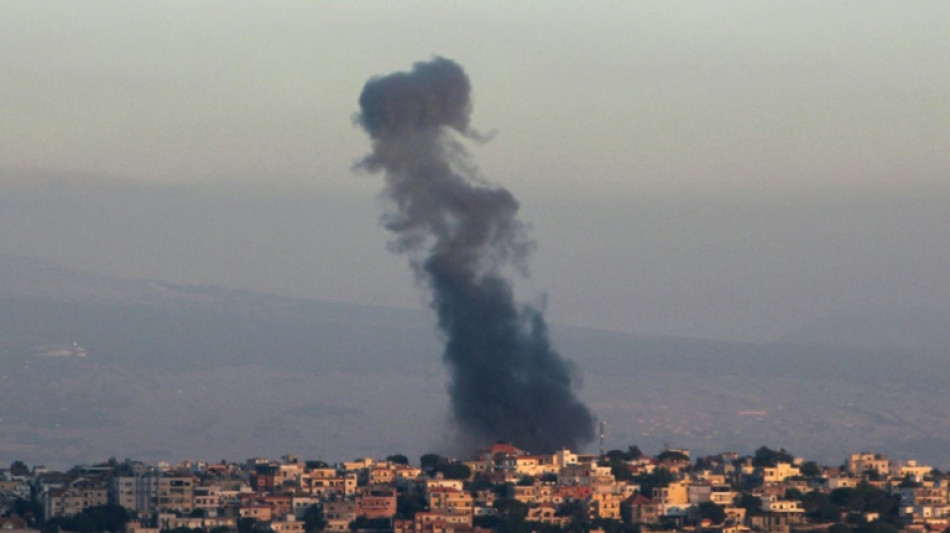
An escalating cross-border tit-for-tat between Israel and Lebanon's Hezbollah raised fears Wednesday of a full-blown war, but experts are divided on the prospect of a wider conflict.
The United States was working behind the scenes to ease tensions, a day after Israel's top diplomat warned the Iran-backed Hezbollah that it would be destroyed in the event of a "total war" and the Israeli army said its operational plans for an offensive in Lebanon had been signed off.
- Is conflict around the corner? -
The last war between Israel and Hezbollah broke out in July 2006, causing nearly 1,400 deaths over 34 days, including 1,200 on the Lebanese side, most of them civilians.
Following months of cross-border exchanges prompted by the eruption of the Gaza war in October, renewed violence is threatening to intensify between the region's most powerful army and most influential paramilitary movement -- which carries the might of a military.
"I believe that within a few weeks, we will see the Israeli operation in Lebanon," Nitzan Nuriel, former director of Israel's Counter Terrorism Bureau, told AFP.
"It's going to take months... then it very much depends on the world intervention and the Iranian response," Nuriel, who also served as an army commander during the 2006 war, added.
He said the operation would aim to push Hezbollah behind the Litani river in southern Lebanon, the northern limit of the de-militarised zone agreed with Israel at the end of the 2006 war.
It would be coupled with air strikes across Lebanon "to show them what are the prices", he said.
Hezbollah has fired thousands of projectiles at Israeli territory already while Israel has killed several Hezbollah fighters and launched a barrage of strikes against targets in Lebanon.
Others say there is little appetite for a broader battle.
"It's more of the same. Nobody wants an escalation," said Eyal Zisser, an expert on Hezbollah at Tel Aviv University.
"On both sides, you can see warnings and threats. But I don't think it's real," he added.
Sarit Zehavi, a former Israeli army intelligence official specialising on the northern border, predicted Israel was "more interested in a ceasefire than a state of war" especially if confronted with a campaign on multiple fronts "engineered by Iran".
- What does the escalating rhetoric mean? -
The Israeli military's announcement it green-lit plans for an offensive came after Foreign Minister Israel Katz threatened Hezbollah with destruction.
But while those plans would need political approval, experts said it was a serious warning to Hezbollah and its allies.
"It was a message to all players: we lost our patience and if you don't reach an agreement that we can live with, this is our next step," said Nuriel.
Hezbollah leader Hassan Nasrallah has vowed to carry on attacks against Israel while US special envoy Amos Hochstein has shuttled between Jerusalem and Beirut this week calling for "urgent" de-escalation.
But Israeli Prime Minister Netanyahu is happy for the war talk to continue as "he thinks he can contain it", said Zisser.
"You hear threats, you see some escalation, then the day that follows you see things calm down. That's what I think will happen."
- Why are tensions building? -
Hezbollah says it is fighting on behalf of its ally Hamas in Gaza, where Israel has fought an eight-month war after the Palestinian militants' unprecedented October 7 attack on Israel.
The Lebanese movement got involved in the war on Hamas's side by launching projectiles into northern Israel, but experts say it does not want a broader conflict.
"It would like to end this conflict but there is the linkage to Gaza, so this is what makes things problematic," said Zisser.
Israel says Hezbollah fired first after Hamas's October 7 attack. Many of the subsequent exchanges have been tit-for-tat attacks.
The violence has left at least 473 people dead in Lebanon, most of them fighters but also 92 civilians, according to an AFP tally.
Israeli authorities say at least 15 soldiers and 11 civilians have been killed in the country's north.
- Why is September important? -
Tens of thousands in Israel's northern border communities have been evacuated and fires have burned swathes of land in blazes started by Hezbollah rockets. Many of those displaced have yet to return.
But centrist politician Benny Gantz -- before his resignation from Israel's unity government last week -- called for border calm to be restored by September because it's the start of the school year for displaced families who are only accommodated until August.
"People, especially after October 7, are afraid of two scenarios: a ground attack or direct anti-tank missiles into their houses," said Nuriel.
But any conflict could be dragged out longer by the Israeli leader who finds himself under fire within his cabinet and domestically over his handling of the Gaza war and the hostage crisis.
"I don't think September is sacred," said Zisser.
"It starts and ends with Netanyahu."
A.Zhang--ThChM