The China Mail - Bangladeshi protesters demand end to civil service job quotas

USD -
AED 3.673056
AFN 65.000237
ALL 82.130758
AMD 361.810074
ANG 1.790365
AOA 917.00009
ARS 1520.622502
AUD 1.434978
AWG 1.8
AZN 1.694452
BAM 1.745962
BBD 2.013775
BDT 123.109062
BGN 1.683441
BHD 0.377168
BIF 2998
BMD 1
BND 1.280235
BOB 12.002428
BRL 4.995299
BSD 0.999835
BTN 96.229211
BWP 13.792611
BYN 3.056102
BYR 19600
BZD 2.01082
CAD 1.425565
CDF 2310.000397
CHF 0.83113
CLF 0.024696
CLP 975.130076
CNY 6.70455
CNH 6.704575
COP 3240.56
CRC 458.138611
CUC 1
CUP 23.996036
CVE 98.438149
CZK 21.80595
DJF 177.719966
DKK 6.664198
DOP 60.079362
DZD 134.411891
EGP 52.391204
ERN 15
ETB 163.313009
EUR 0.891701
FJD 2.24975
FKP 0.755628
GBP 0.75665
GEL 2.604979
GGP 0.755628
GHS 11.752471
GIP 0.755628
GMD 73.498022
GNF 8796.182637
GTQ 7.643653
GYD 209.145892
HKD 7.84709
HNL 26.839317
HRK 6.720396
HTG 130.924803
HUF 327.649027
IDR 17937
ILS 3.0539
IMP 0.755628
INR 96.320899
IQD 1309.783652
IRR 1746539.504372
ISK 122.159736
JEP 0.755628
JMD 158.634511
JOD 0.708987
JPY 158.023957
KES 129.760172
KGS 87.449721
KHR 4056.635778
KMF 437.999798
KPW 900.000318
KRW 1341.829778
KWD 0.309396
KYD 0.833181
KZT 457.431329
LAK 22465.831689
LBP 89533.829083
LKR 330.501855
LRD 170.974812
LSL 16.652844
LTL 2.95274
LVL 0.60489
LYD 6.428517
MAD 9.981119
MDL 17.962532
MGA 4439.425455
MKD 54.966098
MMK 2099.456706
MNT 3596.082114
MOP 8.081756
MRU 40.114449
MUR 48.049792
MVR 15.460169
MWK 1733.723743
MXN 18.080595
MYR 4.085698
MZN 63.901804
NAD 16.652249
NGN 1326.270269
NIO 36.798807
NOK 9.590105
NPR 153.967425
NZD 1.78822
OMR 0.384498
PAB 0.99983
PEN 3.449821
PGK 4.529771
PHP 62.675997
PKR 276.936022
PLN 3.90745
PYG 5859.851004
QAR 3.654551
RON 4.763007
RSD 104.710977
RUB 84.828001
RWF 1476.746729
SAR 3.74637
SBD 8.078071
SCR 13.803685
SDG 601.498266
SEK 10.042855
SGD 1.279685
SHP 0.75503
SLE 24.598139
SLL 20969.491881
SOS 571.42347
SRD 37.665989
STD 20697.981008
STN 21.871387
SVC 8.748867
SYP 13002.000254
SZL 16.648143
THB 33.688977
TJS 9.203473
TMT 3.5
TND 2.987632
TOP 2.40776
TRY 49.155799
TTD 6.777452
TWD 31.734967
TZS 2639.664015
UAH 45.063005
UGX 4019.122524
UYU 40.47618
UZS 11771.690272
VES 865.47815
VND 25993
VUV 119.46017
WST 2.788611
XAF 584.917409
XAG 0.016351
XAU 0.000241587034
XCD 2.70255
XCG 1.801926
XDR 0.707052
XOF 584.917409
XPF 106.468359
YER 236.296989
ZAR 16.6474
ZMK 9001.200973
ZMW 19.721654
ZWL 321.999592
SSP 5712.591527
MXV 2.044443
  • RYCEF

    0.4000

    19.71

    +2.03%

  • CMSC

    0.0000

    20.4

    0%

  • BTI

    0.4200

    56.05

    +0.75%

  • BP

    0.2800

    44.43

    +0.63%

  • RBGPF

    1.6000

    67

    +2.39%

  • RIO

    -0.1500

    94.41

    -0.16%

  • AZN

    -0.4300

    166.15

    -0.26%

  • GSK

    0.4600

    49.7

    +0.93%

  • BCE

    -0.4100

    20.56

    -1.99%

  • NGG

    -0.2500

    75.24

    -0.33%

  • VOD

    -0.0400

    16.58

    -0.24%

  • RELX

    -0.4500

    33.07

    -1.36%

  • BCC

    -0.5500

    76.59

    -0.72%

  • CMSD

    -0.0300

    20.27

    -0.15%

  • JRI

    -0.2500

    10.77

    -2.32%

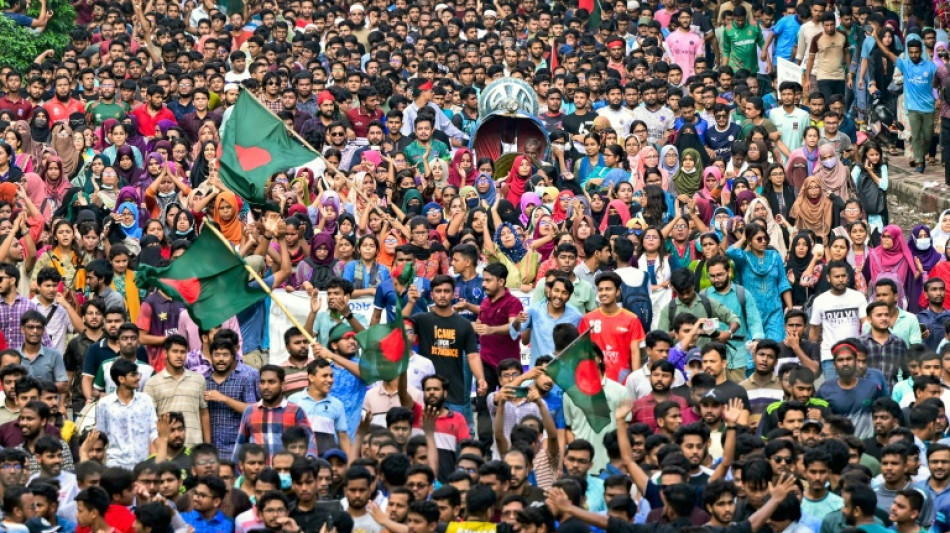
Bangladeshi protesters demand end to civil service job quotas
Bangladeshi protesters demand end to civil service job quotas / Photo: © AFP

Bangladeshi protesters demand end to civil service job quotas

Thousands of Bangladeshi university students threw roadblocks across key highways on Sunday, demanding the end of "discriminatory" quotas for coveted government jobs, including reserving posts for children of liberation heroes.

Text size:

Students in almost all major universities took part, demanding a merit-based system for well-paid and massively over-subscribed civil service jobs.

"It's a do-or-die situation for us," protest coordinator Nahidul Islam told AFP, during marches at Dhaka University.

"Quotas are a discriminatory system," the 26-year-old added. "The system has to be reformed".

The current system reserves more than half of posts, totalling hundreds of thousands of government jobs.

That includes 30 percent reserved for children of those who fought to win Bangladeshi independence in 1971, 10 percent for women, and 10 percent set aside for specific districts.

Students said only those quotas supporting ethnic minorities and disabled people -- six percent of jobs -- should remain.

Critics say the system benefits children of pro-government groups, who back Prime Minister Sheikh Hasina.

Her father, Sheikh Mujibur Rahman, was Bangladesh's founding leader.

Hasina, 76, won her fourth consecutive general election in January, in a vote without genuine opposition parties, with a widespread boycott and a major crackdown against her political opponents.

Critics accuse Bangladeshi courts of rubber-stamping decisions made by her government.

The system was initially abolished after weeks of student protests in 2018.

But in June, Dhaka's High Court rolled that back, saying the cancellation had been invalid.

- 'Wasting their time' -

Hasina has condemned the protests, saying the matter had been settled by the court.

"Students are wasting their time," Hasina told female activists from her party on Sunday, Bangladeshi newspapers reported.

"After the court's verdict, there is no justification for the anti-quota movement."

Protests began earlier in July and have grown in size.

"We will bury the quota system", students chanted on Sunday in Bangladesh’s second city Chittagong, where hundreds of protesters marched.

In Dhaka, hundreds of students disrupted traffic for hours, police said.

At the elite Jahangirnagar University, at least 500 students blocked the highway connecting the capital with southeastern Bangladesh "for two hours", local police chief A.F.M. Shahed told AFP.

Bin Yamin Molla, a protest leader, said at least 30,000 students participated in the protests, although the number could not be verified.

Bangladesh was one of the world's poorest countries when it gained independence in 1971, but it has grown an average of more than six percent each year since 2009.

Hasina has presided over that breakneck economic growth, with per capita income in the country of 170 million people overtaking India in 2021.

But much of that growth has been on the back of the mostly female factory workforce powering its garment export industry, and economists say there is an acute crisis of jobs for millions of university students.

G.Fung--ThChM