What is a 'multipolar' world? Experts aren't so sure / Photo: © POOL/AFP

The leaders of Russia, India and China often wax poetic about establishing a "multipolar" world -- though it is far from clear what such a system would entail.
The three countries along with Iran and North Korea regularly lead calls for a new world order that sees a reduced role for the United States and its Western allies.
But beyond their shared desire to see a reduction in Western domination in global affairs, proponents offer few strands that actually bind their vision of the future, according to experts.
Regardless, the term -- and the sentiment -- is likely to be here to stay.
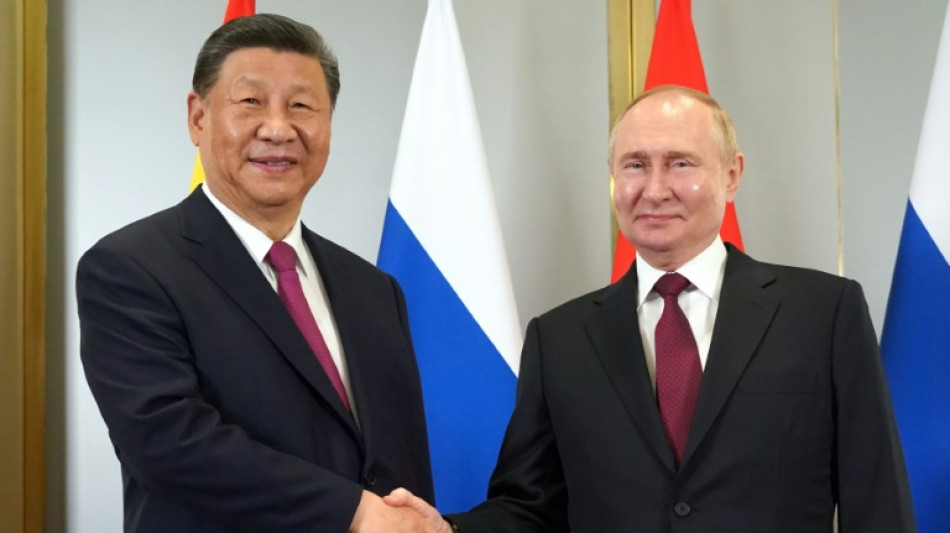
"We must jointly advocate for an equal and orderly multipolar world," China's President Xi Jinping said during a summit of the Shanghai Cooperation Organisation (SCO) this month.
"All participants... are committed to the formation of a fair multipolar world order," Russian President Vladimir Putin said at the same summit.
And in late 2023, India's Narendra Modi declared: "The new world order is multipolar".
- 'Contradictory interests' -
In speeches, Putin often frames the invasion of Ukraine as less a war of conquest and more a fight to beat back American hegemony in Europe.
The idea is likely to strike a chord with Beijing, which has been steadily expanding its footprint across the Asia-Pacific region where the US has long been dominant.
"There is the common vision of pushing for the end of the Western age," said French political analyst Jean-Marc Balencie.
But how exactly that will be achieved remains largely undefined, and "this allows for several scenarios, because leaders often have contradictory interests", Balencie said.
"Many of the BRICS and SCO countries say they wish to build a multipolar world and are taking significant actions to that end," Stephen Wertheim from the Carnegie Endowment for International Peace told AFP, referring to groupings of countries from the so-called Global South.
"I doubt that these countries know exactly what kind of order, especially what kind of institutional forms, they seek to realise in 20 years' time," Wertheim said.
Official doctrines published by the Kremlin, New Delhi and China are often full of striking promises about shaking up geopolitics.
"We must build partnerships in which countries treat each other on an equal footing" reads one statement from China in 2023, framing its proposals "for a shared future".
Russia, meanwhile, says it wants to promote "the world majority" against the so-called "golden billion" of the West -- a conspiracy theory, popular in Russia, that a secret global elite hoards the world's resources.
Russian political scientist Sergei Karaganov says developing more institutions like BRICS and SCO for countries representing the majority of the global population is vital.
Increased cooperation across tech platforms and deepening ties in the education and scientific fields were also necessary, he adds.
But such simplistic formulas often ignore geopolitical fault lines across the globe.
In Southeast Asia, China's growing influence has worried its smaller neighbours, while the West has increasingly turned to India to act as a hedge against Beijing's growing boldness.
In the former Soviet states, Russia's influence is also a source of anxiety for many.
And while Russia has chosen a total break with Washington and Europe after invading Ukraine, no other power has been as keen to follow its path.
The "Global South encompasses so many countries and blocs with their own interests", said Yun Sun, a co-director of the China and East Asia programme at the Stimson Center in Washington.
- Tricky alternatives -
What a multipolar world looks like in practice is fraught with unknowns.
On the economic front, the Kremlin and China remain keen to see a new currency replace the dollar as the primary vehicle for trade.
But will New Delhi be eager to exchange greenbacks for the yuan? And is there any country ready to build substantial reserves with the unstable Russian ruble?
For many countries, multipolarity offers "alternatives to going head-to-head with the West", Balencie said.
"Small countries want to maintain their sovereignty while obtaining security and economic assistance from larger powers," Wertheim added.
Faced with joining competing Cold War-style alliances, they "may be able to play the blocs off each other, but they will also be vulnerable to falling under the control of their patron", he said.
Yun noted that "the word multipolarity suggests equality, but it is misleading".
China, India and Russia "might be unhappy with certain aspects of the US dominance, but it doesn't mean they share the exact same vision as for what the alternative should look like".
W.Cheng--ThChM