Saving the vanishing forests of Iraq's Kurdistan / Photo: © AFP

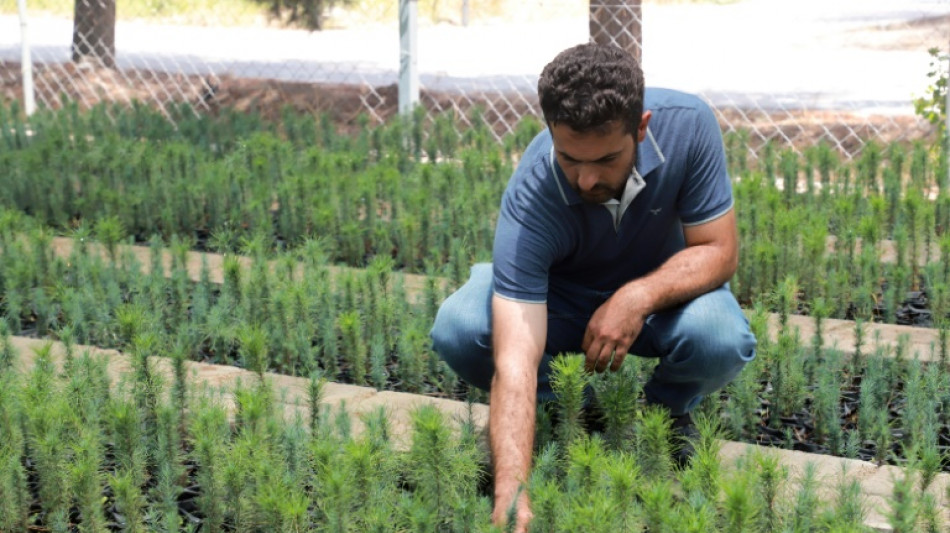
In a plant nursery in northern Iraq's autonomous Kurdistan region, hundreds of pine, eucalyptus, olive and pomegranate saplings grow under awnings protecting them from the fierce summer sun.
The nursery in Sarchinar in the Kurdish city of Sulaimaniyah is part of efforts to battle the destructive effects of deforestation in the region.
"Almost 50 percent of forests have been lost in Kurdistan in 70 years," said Nyaz Ibrahim of the UN's World Food Programme (WFP).
She attributed the loss to "water scarcity, rising temperatures, irregular decreasing rainfall and also fire incidents".
The loss is catastrophic, as the Kurdistan region is home to 90 percent of forests in Iraq, which has been among the hardest hit globally by climate change and desertification.
Much of this comes down to illegal tree felling and forest fires -- intensified by summer droughts -- as well as military operations on Iraq's northern border.
In the nursery -- the oldest in Iraq -- workers are busy unloading young saplings from a trailer which they then line up on a patch of land.
Here, some 40 varieties are developed to later be planted in forests or given to farmers, among them pines, cypresses, junipers and oaks -- the emblematic tree of the Kurdish forest.
"Climate change has an impact on the development of plants," said agricultural engineer Rawa Abdulqader. "So we prioritise trees that can withstand high temperatures and which consume less water."
- 'Negligence' -
With support from the WFP, micro-mesh nets were installed in the nursery to protect the trees from the sun, accelerating growth and minimising evaporation.
Other greenhouses have been equipped with hanging sprinklers, which are more water-efficient.
The project has helped Sarchinar's annual production grow from 250,000 sprouts before it began in late 2022, to 1.5 million in 2024.
Over five years, the WFP intends to support authorities and local actors to plant 38 million trees over more than 61,000 hectares in Kurdistan, and work to preserve 65,000 forested hectares.
According to two official studies, between 1957 and 2015, more than 600,000 hectares were lost.
Over the last 14 years, some 290,000 hectares have been hit by fires, said Halkawt Ismail, director of the forestry office in Kurdistan's agriculture ministry.
These fires "break out mainly during the summer drought... and above all because of the negligence of citizens", he said.
He added that illegal logging in the 1990s by locals using the wood to warm their homes during an economic crisis had significantly contributed to the shrinking of forests.
- Conflict and displacement -
Elsewhere in Kurdistan, forests have been the collateral damage of fighting between the Turkish army and militants from the Kurdistan Workers' Party (PKK).
This summer, Kurdish media and organisations said Ankara's bombardment of the PKK triggered several forest fires.
In late June, the Turkish defence ministry accused the PKK of lighting fires to reduce visibility and conceal its positions.
"Turkey has established over 40 military outposts and bases" in Iraqi Kurdistan, "logged many dozens of kilometres of roads through forested areas, and cleared forest around their bases," Wim Zwijnenburg, a researcher with the Dutch peace-building group PAX, told AFP.
"This practice has increased sharply since 2020," he said.
A decrease in forest supervision resulting from conflict and displacement, and rising temperatures and drought "provide fertile ground for forest fires".
These can either be the result of "natural causes, or of bombing and fighting from the Turkey-PKK conflicts", he added.
"With limited or absent forest management, these fires can affect larger areas and lead to forest loss," Zwijnenburg said.
Kamaran Osman, human rights officer from the Community Peacemaker Teams organisation, meanwhile noted that when areas are bombed, "people cannot go to... extinguish the fire, because they fear being bombed as well."
- 1 million oaks -
Authorities are working to cultivate new forests and to increase nursery production, though they lack sufficient human and financial resources.
Civil society has also got involved. In Sulaimaniyah, which is encircled by hills, activists are fighting bulldozers and excavators eating away at the slopes of Mount Goizha for a real estate project.
On the edges of the city, luxury housing complexes and shiny glass towers are already rising on the hillside.
In the regional capital of Arbil, a campaign launched by local organisations aims to plant 1 million oak trees.
Since 2021, 300,000 trees have been planted, said Gashbin Idrees Ali, the project manager.
"Climate change is happening and we cannot stop it. But we should adapt to it," he said.
Oak trees were chosen because they "need less water", he said.
"We supervise the tree's growth for four to five years and after... it can survive for hundreds of years."
R.Yeung--ThChM