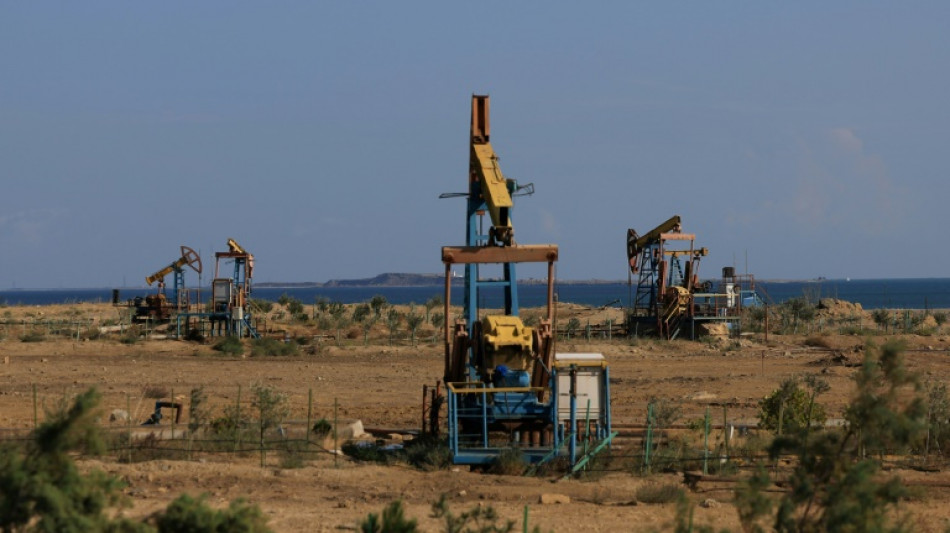
Azerbaijan: a country steeped in hydrocarbons / Photo: © AFP

Azerbaijan, which holds early legislative elections on Sunday, is a country in the Caucasus region with a historical relationship with hydrocarbons, which account for most of its revenues.
- An ancient history -
In the late 13th century, Venetian merchant, explorer and writer Marco Polo reported seeing a gushing "oil fountain" as he travelled along the Silk Road in the Caucasus.
The name Azerbaijan comes from the Persian "azer", or "sacred fire", from the temples of the ancient religion of Zoroastrianism, which were fuelled by gas or crude oil that gushed naturally from the ground.
Today, near the capital Baku, the Zoroastrian Ateshgah temple has an ever-burning fire fuelled by a pipe of methane gas from a nearby field. In the past the gas escaped from cracks in the ground.
- Cradle of oil extraction -
The country is historically one of the cradles of modern oil extraction: even before drilling started in the United States, a well was drilled in 1846 near Baku, which was quickly surrounded by derricks.
Swedes Robert and Ludvig Nobel, brothers of Albert, after whom the famous Nobel Prizes are named, were among the first to invest in Azeri oil.
They bought a refinery and oil fields from 1876, then founded the Branobel company that became the world's largest before being nationalised in 1920 when Azerbaijan came under Soviet control.
Towards 1900, it was estimated that more than half of world oil production came from the Absheron Peninsula on the Caspian Sea in the Baku region.
- An oil-gas republic -
The republic of Azerbaijan, which became independent in 1991 after the collapse of the Soviet Union, gets most of its wealth from oil and natural gas, which today mainly come from offshore deposits in the Caspian Sea.
Hydrocarbons represent 90 percent of the country's exports, half of state income and a third of gross domestic product, according to the International Energy Agency (IEA) and the US State Department.
The IEA ranks Azerbaijan as a "major" producer and exporter of natural gas and oil, with 32.7 million tonnes of crude and 35 billion cubic metres of natural gas produced in 2022, of which more than two-thirds was exported.
The country is among the 20 biggest net oil exporters and the 12th largest for gas, according to 2022 figures.
The deepwater Azeri-Chirag-Guneshli (ACG) oilfield complex, discovered in the 1970s around 100 kilometres (62 miles) east of Baku, is the country's main source of oil.
The site, operated by British company BP in association with state company Socar, accounts for more than half of national production of crude oil, according to BP's operating figures for the first quarter of 2024.
- The bet on gas -
While Azerbaijan's oil production has been on the decline since peaking in 2010, production of natural gas is burgeoning.
A member of OPEC+, an enlarged version of the Organization of Petroleum Exporting Countries, it defends gas as a transition energy as nations seek to cut carbon emissions, and plans to increase its production by 35 percent by 2034.
Baku hopes to benefit from falling Russian gas exports, hit by international sanctions following the war in Ukraine, to become a preferred supplier to Europe through the Southern Gas Corridor network of pipelines that cross Georgia and Turkey, linking Azerbaijan to Italy.
The main gas field, Shah Deniz, was discovered in 1999 in the Caspian Sea around 70 kilometres (43 miles) south of Baku and is one of the biggest natural gas sites in the world.
Operated by BP, it provides more than two-thirds of national production, according to BP's operating figures for the first quarter of 2024.
M.Chau--ThChM