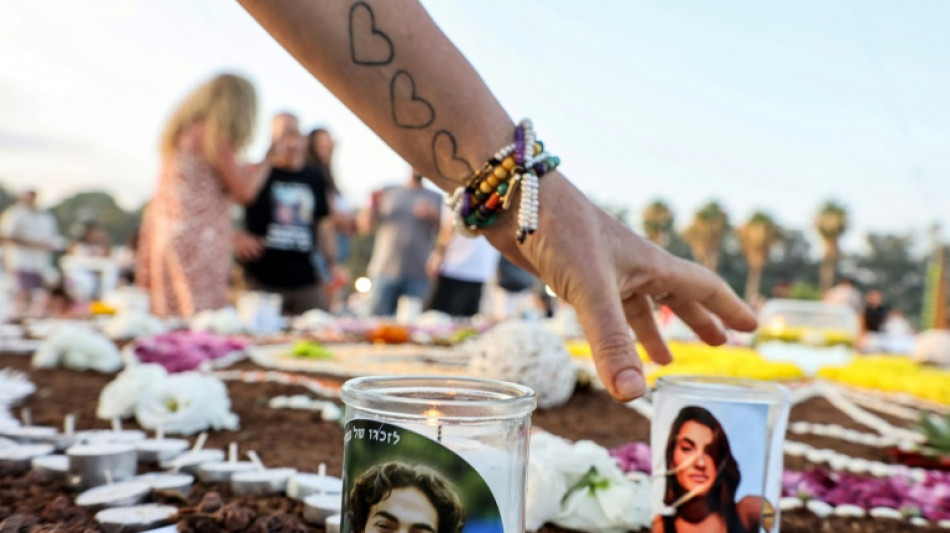
Israelis united in trauma, divided by war after October 7 / Photo: © AFP

A year after October 7, Israelis are united in the trauma caused by Hamas's attack on their country, but are divided in their views on how to end the war.
In the aftermath of the attack, the deadliest in Israeli history, a movement of national solidarity emerged, with volunteers preparing meals for soldiers and welcoming displaced people into their homes.
This shared grief and solidarity offered Israelis some comfort, but the health ministry says that the country now faces "the most serious mental health crisis in its history".
Questions around the fate of scores of Israeli hostages taken by militants on October 7 into Gaza have made it painfully difficult for people to move on from the trauma.
"Israelis' sense of security was shattered," said Merav Roth, an Israeli psychoanalyst who treats former hostages and families of the dead.
This was "both because they identified with the victims and because security forces were unable to prevent the invasion of the country.
"This invasion of the home, individual and collective, is unprecedented in the history of Israel and terrifying for Israelis."
It is not "a trauma that is over, but an event whose complications are only getting worse", with continuing announcements of dead hostages or soldiers fighting in Gaza and threats of all-out war against Hezbollah in Lebanon.
- 'Bring them home!' -
The October 7 attack by Hamas militants that triggered the war resulted in the deaths of 1,205 people, mostly civilians, on the Israeli side, according to an AFP tally based on Israeli official figures that include hostages killed in captivity.
Of 251 hostages seized by militants, 97 are still held in Gaza, including 33 the Israeli military says are dead.
Israel's retaliatory military offensive has killed at least 41,455 people in Gaza, most of them civilians, according to figures provided by the Hamas-run territory's health ministry.
The United Nations has described the figures as reliable.
In Israel, disagreements over the government's war policy have deepened since a short-lived truce in November that saw 105 hostages freed, with questions emerging over how to bring home the others.
Not a Saturday night passes without thousands of protesters taking to the streets of Israel's commercial hub Tel Aviv, and sometimes other cities, demanding that the authorities "Bring them home now!"
But those Israelis who demand an agreement with Hamas "at all costs" to ensure the hostages' release are countered by those who fear such protests undermine the government's position and could inadvertently boost the militants.
Tamar Hermann, senior research fellow at the Israel Democracy Institute, said this split broadly echoes the left-right political divide, which hardened before the war because of Prime Minister Benjamin Netanyahu's judicial reforms proposal.
Pushed by Netanyahu's far-right coalition partners, the proposal sparked months of protests, often involving tens of thousands of Israelis.
"Obviously everyone thinks that the hostage issue is terrible, but what divides opinion is how much we are prepared to pay for the release of less than 100 people" still captive in Gaza, Hermann said.
- Feeling abandoned -
The war has also exacerbated divisions between secular and religious Israelis, largely because of an exemption from conscription enjoyed by ultra-Orthodox Jews which irritates many.
With more than 700 members of the security forces killed since October 7, tens of thousands of reservists mobilised and the prospect of a major operation on the northern border with Lebanon, the issue is more contentious than ever.
"While my grandson is risking his life in... Gaza, her grandchildren parade into our room every day to visit her," said an octogenarian hospitalised in Jerusalem of her ultra-Orthodox roommate, who asked to remain anonymous to protect her grandchild's identity.
Meanwhile, residents of northern Israel complained the state was abandoning them long before the war, but their grievances have grown considerably since Hezbollah started launching cross-border strikes on October 8 in support of its Iran-backed ally Hamas.
The near-daily attacks forced tens of thousands to evacuate, and about 60,000 people have yet to return home.
- 'Hardest year' -
Most have been put up by the government in hotels, among them Dorit Siso, a schoolteacher from Shlomi on the border.
"I just want to go home. I don't care about the rockets," the 51-year-old mother of four told AFP.
Though security regulations forbid her from returning to Shlomi, earlier this month she finally left the hotel in Jerusalem and rented a house in a village in the north.
The move offered some relief after what she described as "the hardest year of my life", with her sons mobilising to fight and her 11-year-old daughter struggling with anxiety.
V.Liu--ThChM