Israeli strikes pound southern Beirut suburbs / Photo: © AFP

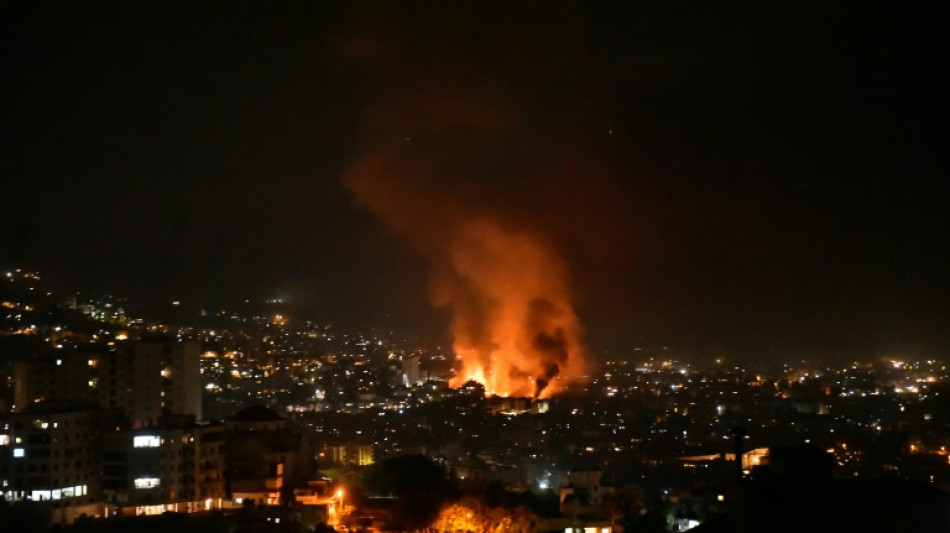
Israeli fighter jets bombarded the southern suburbs of Lebanon's capital Beirut overnight into Saturday, sending panicked families fleeing massive strikes reportedly targeting Hezbollah chief Hassan Nasrallah.
Israel said it was attacking Hezbollah's headquarters, while Israeli television networks reported that Nasrallah was the target, although a source close to the group said he was "fine".
The explosions that shook southern Beirut were the fiercest to hit the Iran-backed movement's stronghold since Israel and Hezbollah went to war in 2006.
After huge raids sounded across the Mediterranean city on Friday, Israel issued fresh warnings for people to leave the densely populated Dahiyeh suburbs early Saturday.
The Israeli army declined to comment on Nasrallah but claimed early Saturday that its air strikes killed "Muhammad Ali Ismail, the commander of Hezbollah's missile unit in southern Lebanon, and his deputy" as well as "other senior officials".
IDF spokesman Daniel Hagari said: "We are still checking the results of the attack on Hezbollah's central headquarters, which is located under civilian buildings in the heart of the Da'aheh neighborhood, in an underground space. We will update as soon as we know. We know that our attack was very accurate."
Forced from their homes, hundreds of families sought shelter in downtown Beirut's Martyrs' Square or along the seaside boardwalk area.
Syrian refugee and father of six Radwan Msallam said they had "nowhere to go".
"We were at home when there was the call to evacuate. We took our identity papers, some belongings and we left," he said.
Hours earlier at the UN General Assembly, Israeli Prime Minister Benjamin Netanyahu vowed to keep fighting Hezbollah until the country's border with Lebanon was secured.
"Israel has every right to remove this threat and return our citizens to their homes safe," he said.
Hezbollah started fighting Israeli troops along the Lebanon border a day after its Palestinian ally Hamas staged its unprecedented attack on Israel on October 7.
Since Monday, Israel has shifted its focus from Gaza to Lebanon, where heavy bombing has killed more than 700 people and sparked an exodus of around 118,000 people.
- Nasrallah -
A source close to Hezbollah said the initial wave of strikes had levelled six buildings, and, according to a preliminary toll, six people were killed and 91 wounded.
Israeli public broadcaster Kan 11, television network Channel 12 and the left-leaning Haaretz newspaper all reported the heavy overnight bombardment was targetting Hezbollah leader Nasrallah.
Rarely seen in public, Nasrallah enjoys cult status among his Shiite Muslim supporters and is the only man in Lebanon with the power to wage war or make peace.
To avoid assassination, he leads a life in hiding but has denied that he lives in a bunker.
In Beirut's Haret Hreik neighbourhood, strikes left craters up to five metres (16 feet) wide, an AFP photographer said, adding that ambulances were coming from all sides while fires burned.
"I felt like the building was going to collapse on top of me," said Abir Hammoud, a teacher in her 40s.
After the initial wave of strikes on Beirut, Hezbollah said it fired more rockets into Israel "in defence of Lebanon and its people". There were no immediate reports of casualties.
The Israeli military warned civilians in parts of Hezbollah's south Beirut stronghold to evacuate the area before conducting its second bombing.
It also said it would not allow Iran to transfer weapons to its ally Hezbollah through Beirut airport -- adding that its jets were ready to intervene should any such transfers be detected.
Israel's army said the second wave of strikes had targeted Hezbollah targets in the Tyre area of southern Lebanon.
- 'Deadliest in a generation' -
The UN has repeatedly condemned this week's sharp escalation of violence in Lebanon.
"We are witnessing the deadliest period in Lebanon in a generation, and many express their fear that this is just the beginning," the UN humanitarian coordinator in Lebanon, Imran Riza, said.
In Israel, too, many were weary of the violence.
"It is incredibly exhausting to be in this situation. We don't really know what's going to happen, there's talk of a ground offensive or a major operation," said Lital Shmuelovich, a physiotherapy student.
US Secretary of State Antony Blinken appealed again for a ceasefire, after a US-led bid for a truce failed earlier this week.
"The path to diplomacy may seem difficult to see at this moment, but it is there, and in our judgement, it is necessary," Blinken said.
In New York, Netanyahu also addressed the war in Gaza, saying that Israel's military would continue to fight Hamas until it achieved "total victory".
Hamas's October 7 attack resulted in the deaths of 1,205 people, mostly civilians, according to an AFP tally based on Israeli official figures that include hostages killed in captivity.
Of the 251 hostages seized by militants, 97 are still held in Gaza, including 33 the Israeli military says are dead.
Israel's retaliatory military offensive has killed at least 41,534 people in Gaza, most of them civilians, according to figures provided by the Hamas-run territory's health ministry. The UN has described the figures as reliable.
- 'Change the rules' -
The Lebanon violence has raised fears of spillover across the Middle East, with Iran-backed militants vowing to keep up their fight with Israel.
Netanyahu took aim at Iran in his UN General Assembly address, saying: "I have a message for the tyrants of Tehran. If you strike us, we will strike you."
He added: "There is no place in Iran that the long arm of Israel cannot reach, and that's true of the entire Middle East."
Analysts have said Iran would try to resist being dragged into the conflict.
But following the Beirut strikes, Iran's embassy in Lebanon said: "This reprehensible crime... represents a dangerous escalation that changes the rules of the game."
Iran's president, Masoud Pezeshkian, later condemned the strikes, branding them a "flagrant war crime".
burs-lb/cwl
O.Tse--ThChM