The China Mail - German govt sees economy shrinking again in 2024

USD -
AED 3.672504
AFN 66.000368
ALL 81.708779
AMD 361.738976
ANG 1.790365
AOA 917.000367
ARS 1524.875041
AUD 1.44321
AWG 1.8025
AZN 1.70397
BAM 1.737022
BBD 2.009681
BDT 122.678627
BGN 1.683441
BHD 0.376127
BIF 3010.346818
BMD 1
BND 1.277055
BOB 11.988987
BRL 5.210804
BSD 0.997824
BTN 96.669479
BWP 13.794573
BYN 3.005462
BYR 19600
BZD 2.00675
CAD 1.42495
CDF 2310.000362
CHF 0.8304
CLF 0.025096
CLP 990.920396
CNY 6.70455
CNH 6.712104
COP 3308.76149
CRC 457.213908
CUC 1
CUP 23.946889
CVE 97.930636
CZK 21.719304
DJF 177.681069
DKK 6.642604
DOP 59.576358
DZD 133.728851
EGP 52.20214
ERN 15
ETB 162.975798
EUR 0.88815
FJD 2.24725
FKP 0.755904
GBP 0.756974
GEL 2.60504
GGP 0.755904
GHS 11.718993
GIP 0.755904
GMD 73.503851
GNF 8777.476797
GTQ 7.625561
GYD 208.721524
HKD 7.847404
HNL 26.788934
HRK 6.696704
HTG 130.662996
HUF 327.440388
IDR 17888.5
ILS 3.05233
IMP 0.755904
INR 96.325504
IQD 1307.16284
IRR 1746539.503816
ISK 121.930386
JEP 0.755904
JMD 157.964386
JOD 0.70904
JPY 157.840385
KES 129.517297
KGS 87.450384
KHR 4047.24899
KMF 438.00035
KPW 900.000318
KRW 1343.190383
KWD 0.30883
KYD 0.831476
KZT 448.314756
LAK 22413.073405
LBP 89353.168436
LKR 329.979129
LRD 170.620365
LSL 16.683601
LTL 2.95274
LVL 0.60489
LYD 6.390159
MAD 9.913406
MDL 17.831165
MGA 4408.721524
MKD 54.687153
MMK 2099.554486
MNT 3597.321137
MOP 8.065101
MRU 39.872996
MUR 48.150378
MVR 15.460378
MWK 1730.183401
MXN 18.161204
MYR 4.084904
MZN 63.903729
NAD 16.683601
NGN 1330.790377
NIO 36.715662
NOK 9.618604
NPR 154.671167
NZD 1.780469
OMR 0.383712
PAB 0.997824
PEN 3.457791
PGK 4.518851
PHP 62.583504
PKR 276.36618
PLN 3.89575
PYG 5837.737022
QAR 3.637106
RON 4.741904
RSD 104.338559
RUB 83.307429
RWF 1477.774324
SAR 3.775674
SBD 8.078071
SCR 13.73871
SDG 601.503676
SEK 10.040104
SGD 1.278704
SHP 0.75503
SLE 24.603667
SLL 20969.491881
SOS 570.273991
SRD 37.811504
STD 20697.981008
STN 21.759403
SVC 8.730405
SYP 13002.000254
SZL 16.680137
THB 33.503646
TJS 9.184777
TMT 3.5
TND 2.973311
TOP 2.40776
TRY 49.127504
TTD 6.765842
TWD 31.821804
TZS 2629.246414
UAH 44.897287
UGX 3981.526711
UYU 40.21493
UZS 11768.728629
VES 865.47815
VND 25985.5
VUV 119.833605
WST 2.788681
XAF 582.588484
XAG 0.016565
XAU 0.000241497186
XCD 2.70255
XCG 1.798304
XDR 0.707052
XOF 582.588484
XPF 105.919446
YER 236.303589
ZAR 16.65505
ZMK 9001.203584
ZMW 19.606554
ZWL 321.999592
SSP 5712.591584
MXV 2.054907
  • RYCEF

    0.4000

    19.71

    +2.03%

  • CMSC

    0.0000

    20.4

    0%

  • BTI

    0.4200

    56.05

    +0.75%

  • BP

    0.2800

    44.43

    +0.63%

  • RBGPF

    1.6000

    67

    +2.39%

  • RIO

    -0.1500

    94.41

    -0.16%

  • AZN

    -0.4300

    166.15

    -0.26%

  • GSK

    0.4600

    49.7

    +0.93%

  • BCE

    -0.4100

    20.56

    -1.99%

  • NGG

    -0.2500

    75.24

    -0.33%

  • VOD

    -0.0400

    16.58

    -0.24%

  • RELX

    -0.4500

    33.07

    -1.36%

  • BCC

    -0.5500

    76.59

    -0.72%

  • CMSD

    -0.0300

    20.27

    -0.15%

  • JRI

    -0.2500

    10.77

    -2.32%

German govt sees economy shrinking again in 2024
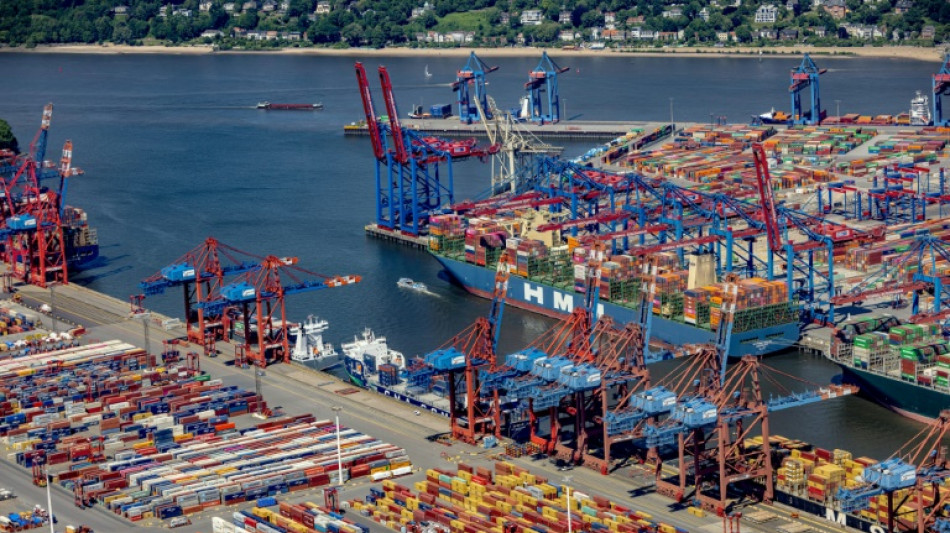
German govt sees economy shrinking again in 2024 / Photo: © AFP/File

German govt sees economy shrinking again in 2024

The German government slashed its 2024 forecast Wednesday for Europe's largest economy, saying it will contract for a second straight year before a recovery gets under way in 2025.

Text size:

Output is expected to shrink by 0.2 percent in 2024, the economy ministry said in a statement, a sharp downgrade from the 0.3-percent expansion previously forecast.

Germany's economy stalled in the first half of the year and a slew of disappointing indicators recently suggest "the economic weakness will persist into the second half of the year", it said.

Germany was already the only major advanced economy to fall into recession last year when it contracted by 0.3 percent, acting as a drag on the wider eurozone.

Stubbornly weak domestic and foreign demand, high interest rates and costly energy in the wake of Russia's war in Ukraine have all weighed heavily on the German economy -- particularly its crucial manufacturing sector.

At the same time, the country faces structural challenges including an ageing population, increased competition from China, burdensome bureaucracy and a complex green transition.

"Germany's structural problems are now taking their toll," Economy Minister Robert Habeck said.

"And this is happening amid major geo-economic challenges. Germany and Europe are caught in the middle of crises between China and the United States and must learn to assert themselves," he added.

Germany's woes were highlighted by a spate of bad news from the country's carmakers recently, as the flagship industry struggles with rising production costs and fierce competition from Chinese manufacturers on electric vehicles.

Volkswagen, Europe's biggest auto manufacturer, last month cut its annual outlook and said it would for the first time have to consider closing factories in Germany.

Rivals BMW and Mercedes-Benz have also lowered their outlook, citing falling Chinese demand.

- 2025 optimism -

The economy ministry nevertheless expressed confidence that a rebound was just around the corner.

Higher wages, easing inflation and lower interest rates are expected to encourage domestic consumption next year, the ministry said, while an improved global outlook should boost exports and industrial investments.

The economy is expected to grow by 1.1 percent in 2025, according to the latest forecasts, up from a previous estimate of one percent.

In 2026, output is predicted to expand by 1.6 percent.

Habeck said the government's proposed "growth initiative" had a key role to play in the anticipated economic revival.

The measures include tax breaks for companies making investments, reduced energy prices for industry, less red tape and incentives to keep older people in the workforce as well as to attract foreign skilled workers.

"The economy will grow more strongly," Habeck said, if the measures are "fully implemented".

Business associations have warned that the measures would not be enough.

The growth package is welcome "but nowhere near enough to truly get Germany back on track economically", Peter Adrian, president of the German Chamber of Commerce and Industry (DIHK), told the Rheinische Post newspaper.

M.Chau--ThChM