'Very challenging': Israel faces Hezbollah in tricky terrain / Photo: © AFP

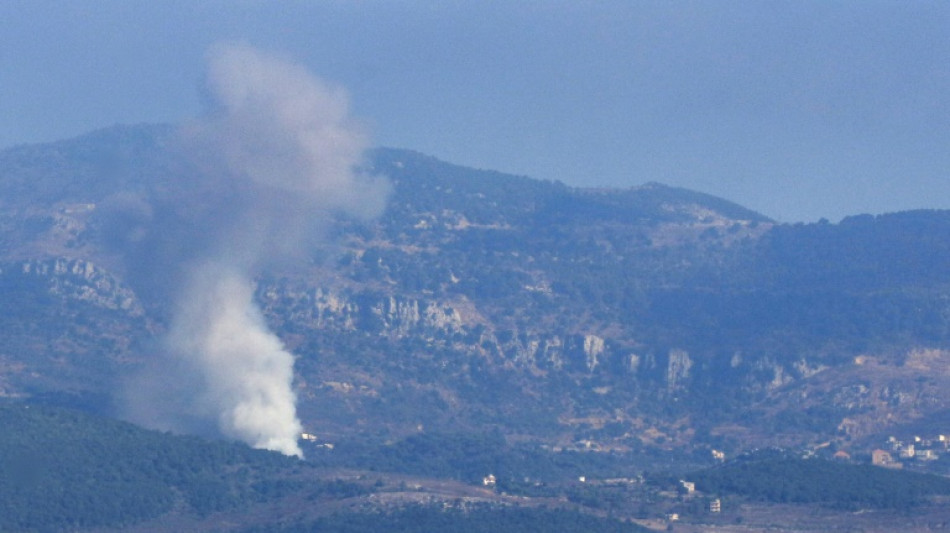
As Israel undertakes its fourth ground offensive in southern Lebanon in 50 years, its troops again face rocky terrain mined with explosives and full of hiding places that previous generations of soldiers have battled over.
After pounding Gaza for nearly a year, Israeli forces began "targeted" ground raids on September 30 intended to push back Hezbollah fighters in Lebanon who have been bombarding northern Israel over the last year.
The decision has sparked a debate about the wisdom of opening up a second front and presents Israeli soldiers with a different challenge to the flat, densely packed urban environment of Gaza.
Jonathan Conricus, who fought in Lebanon and served as an Israeli liaison officer to United Nations peacekeepers from 2009-2013, said the terrain was "vastly different" and forms a combat zone that is "many times larger".
"The topography is very challenging for an invading force and convenient for an enemy like Hezbollah," Conricus, a former military spokesman who now works for the conservative Foundation for Defense of Democracies in Washington, told AFP.
"The terrain also allows multiple ways for a defending enemy to use anti-tank missiles and IEDs against a conventional army," he added, referring to improvised explosive devices.
Miri Eisen, who served as an Israeli intelligence officer in Lebanon, remembers the steep hills and ravines she encountered during Israel's 1978 invasion.
"As soon as you cross the border, you go down drastically and up drastically," Eisen, who now works at the Institute for Counter Terrorism at Israel's Reichman University, told AFP.
"There are boulders that can be used as hiding places and there are areas that you can't just drive through with vehicles. It is also hard to walk through," she recalled.
Analysts believe Hezbollah constructed an intricate network of underground tunnels cut deep into the hills, with openings hidden inside homes among other locations.
- 'Quagmire' -
Israel's multiple wars in Lebanon have always had the same objective -- dealing with a security threat on its northern border -- but have produced highly contested results.
After "Operation Litani" against the Palestine Liberation Organisation (PLO) in 1978, Israeli troops invaded four years later for the wider-ranging "Peace for Galilee" operation, again targeting the PLO.
That invasion saw Israel briefly lay siege to Beirut, and left about 20,000 people killed by the end of the same year. Israeli troops ended up occupying the south of the country for 18 years.
During this period, the Shiite Islam Hezbollah group emerged under the supervision of Iran's Revolutionary Guards.
After Israel's withdrawal, a series of violent incidents involving Hezbollah followed, culminating in another ground offensive and war in 2006.
Hezbollah leader Hassan Nasrallah, who was assassinated in an air strike on September 27, proclaimed a "divine victory" in that 2006 war which was widely seen as a failure for Israel at a cost of 160 lives, mostly soldiers.
The 33-day war also killed 1,200 mostly civilian Lebanese people.
In his final speech days before his killing, Nasrallah warned his arch-enemy about the dangers of trying to create a buffer zone in southern Lebanon.
"This security belt will turn into a quagmire, a trap, an ambush, an abyss, and hell for your army if you want to come to our land," he warned on September 19.
So far, after nearly two weeks of combat, 14 Israeli soldiers have died, according to an AFP tally based on official Israeli figures.
- Battle-hardened -
Experts say both the Israeli army and Hezbollah have transformed since their last open confrontation.
Israeli military planners pored over the setbacks of 2006 to learn lessons.
"The IDF has been following the threat from Hezbollah for many years and it has had the additional past 11 months to prepare while they were fighting Hamas (in Gaza) before turning to Hezbollah," said Eisen.
Israel escalated an air campaign against Hezbollah on September 23, targeting senior figures and weapons dumps as it sought to degrade the organisation before the ground offensive.
The escalation came just after booby trapped communication devices used by Hezbollah detonated, wounding thousands.
The bombardment has killed more than 1,200 people, according to an AFP tally of Lebanese health ministry figures, while the International Organization for Migration says it has verified around 690,000 internally displaced people.
Since 2006, Hezbollah is known to have benefitted from years of weapons transfers from Iran, including ballistic missiles, while many of its troops are battle-hardened after fighting in Syria to support the regime of President Bashar al-Assad.
Rabha Allam from the Al-Ahram Center for Political and Strategic Studies, an Egyptian research institute, stressed that Hezbollah operated in "a decentralised way" like a guerilla army, enabling it to fight back in the south.
"The assumption that striking the (group's) leadership and communications would paralyse the movement was wrong," she told AFP.
Mounir Shehadeh, a former Lebanese government coordinator for the UN peacekeeping force UNIFIL, told AFP that Hezbollah had a substantial stockpile of anti-tank missiles and other weapons.
"This is what it is heavily depending on to stem the advance of (Israeli) tanks. It is not using them yet. It is relying on ambushes, traps and explosives against advancing forces," he said.
burs-adp/it
W.Tam--ThChM