Infighting and inflation ahead of Iraqi Kurdistan vote / Photo: © AFP

Iraqi Kurdish seamstress Sanaa will, like many other voters, boycott an election later this month, a signal of growing disillusionment with the political class that has long dominated the autonomous region.
Iraqi Kurdistan is seen as a relative oasis of stability in the turbulent Middle East and has historically been attractive to foreign investors thanks to its close ties to the United States and Europe.
But beneath the shiny skyscrapers of regional capital Arbil and the modern highways, activists and opposition figures point to the same issues that plague Iraq more broadly: corruption, political repression and cronyism practiced by those in power.
"There's no more trust," she told AFP, asking to use a pseudonym to speak freely about the two local political clans that have dominated Kurdish politics since the oil-rich region was formed in 1991.
"I won't vote because they do nothing," Sanaa, 33, added as she strolled through a market in Arbil where worries about the cost of living are foremost in shoppers' minds.
"They don't care about the issues that concern me. We have no money, everything is expensive."
The election for the Kurdistan parliament has been postponed four times due to disputes between the two main political parties, the Kurdistan Democratic Party (KDP) run by the Barzani family, and the Patriotic Union of Kurdistan (PUK), dominated by the Talabanis.
In the last regional elections in 2018, the KDP emerged as the biggest party and has ruled with allies since then.
But turnout was only 59 percent and could fall again if more people like Sanaa and her family, none of whom plan to vote, stay away from polling stations.
- 'Disenchantment' -
Of the six million inhabitants in Kurdistan, 2.9 million are registered to vote across four constituencies.
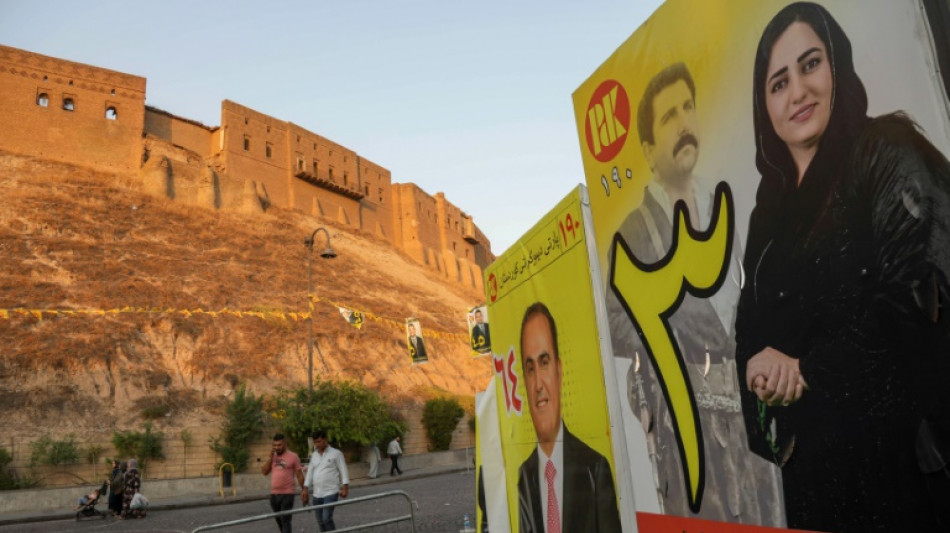
In a square at the foot of Arbil's centuries-old citadel, a stronghold of the KDP and the Barzani family, party flags are prominently displayed ahead of the vote.
In Sulaymaniyah, the region's second-largest city, it is the PUK and the Talabani family that are more visible.
Political analyst Shivan Fazil, a researcher at US-based Boston University with a focus on Iraq, noted that "overall disenchantment with politics has been on the rise" and that there was "a growing fatigue with the region's two ruling parties."
"People's living conditions have deteriorated over the last decade," he explained, highlighting rising unemployment, particularly among young people, with many risking their lives by attempting to migrate to Europe.
He cites the erratic payment of salaries for the region's 1.2 million civil servants as a problem because the money serves as "a vital source of income for households."
This issue is tied to ongoing tensions between Kurdistan and the federal Iraqi government in Baghdad which have also disputed control of the region's lucrative oil exports.
For the two historical parties, "the main challenge will be to retain the votes they won last time," said Sarteep Jawhar, a PUK dissident and political expert.
Voter dissatisfaction stems from a "lack of public services" and the "terror" caused by regular bombings and military operations conducted by the Turkish army against Kurdish fighters from the outlawed Turkey-based PKK (Kurdistan Workers' Party) in the region.
A protest vote could benefit opposition parties such as "New Generation" or a nascent formation led by Lahour Sheikh Zengi, a dissident from the Talabani clan.
- Oil problems -
Another vulnerability for the ruling party is the suspension of oil exports which were previously overseen by the Arbil government -- without Baghdad's approval -- and provided a crucial source of funding.
Kurdistan has been deprived of this income for over a year due to an international arbitration ruling in favour of the federal government in Baghdad.
Once elected, the new representatives will need to vote for a new president and prime minister, with both roles currently filled by KDP figures Nechirvan and Masrour Barzani.
Previously comprising 111 members, the Kurdish parliament has seen its number of seats reduced to 100 due to a decision by the Supreme Federal Court, which eliminated an 11-seat quota reserved for minorities. The court has since reinstated a quota, providing five seats out of 100.
In a cafe in Arbil, 52-year-old Mustafa Mahmoud expressed his intention to vote for the KDP -- but his expectations are limited.
"With the previous elections, we never saw improvements," he said. He conceded that there have been "some changes," but they have "not lived up to expectations."
He points to security and economic issues, calling for "job opportunities" for "young graduates without work."
E.Choi--ThChM