Italy's migration policy under far-right Meloni / Photo: © AFP/File

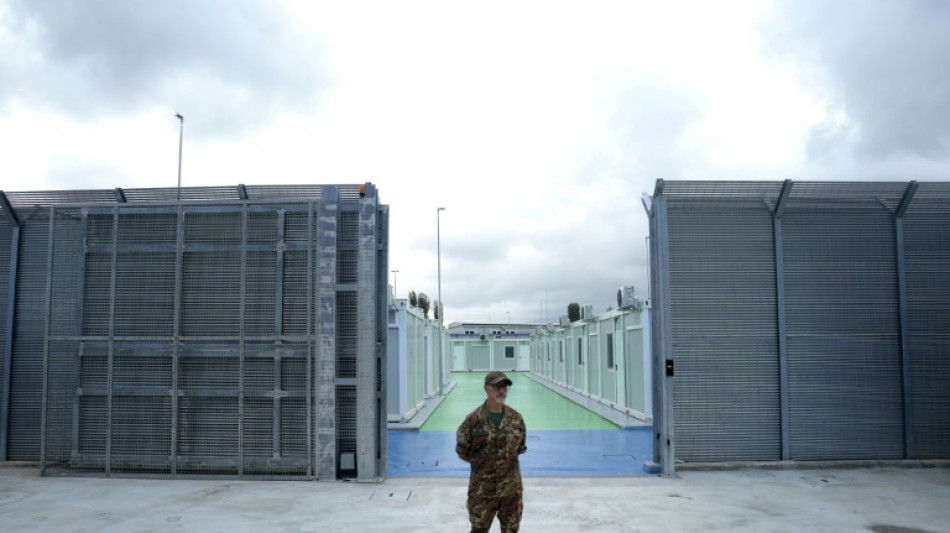
An Italian navy vessel on Wednesday brought the first migrants intercepted in their waters to Albania for processing in the newly created migrant centres.
The scheme, set up by Italian Prime Minister Giorgia Meloni, is part of a broader attempt to tackle illegal arrivals that has sparked criticism -- but also considerable interest.
Meloni, leader of the post-fascist Brothers of Italy party, won 2022 national elections promising to stop the tens of thousands of migrants who land on Italy's shores each year in boats from North Africa.
The Albanian plan -- which will see certain male migrants who are intercepted by Italian authorities in the Mediterranean taken to centres in non-EU Albania ahead of likely repatriation -- went live this week with the first transfer.
It is being watched closely by other EU leaders.
The coalition government in Rome -- which also includes Matteo Salvini's far-right League -- has already taken several other measures to tackle irregular migration, from striking deals with departure countries to expanding legal ways to enter the country.
- Stop human traffickers -
After coming to power in October 2022, Meloni dropped a campaign proposal to impose a naval blockade around Italy to deter migrant arrivals, which critics said would not be legally or practically possible.
Instead, she trained her sights on human traffickers who organise boat departures from the North African coast -- primarily Libya and Tunisia -- to Italy.
The government provides funding and training to the Libyan and Tunisian coastguards as part of an EU initiative to intercept and return to shore migrants attempting to depart.
But war-torn Libya in particular is regularly criticised for its handling of migrants, with rights groups alleging horrific treatment by smuggling gangs and inside state-run detention centres.
Meloni has insisted that more European investment in African nations will help curb departures.
- Clampdown on NGOs -
Italy's government has also targeted not-for-profit rescue organisations saving migrants in the Mediterranean, despite admitting that the NGO boats pick up only a small minority of arrivals.
The interior ministry has said that in 2023 only four percent of the migrant rescues in the Mediterranean were by NGOs.
Rome has characterised the charity rescue ships as a "pull factor" that encourage migrant departures -- something migration observers say is unproven -- while accusing them of being financed by traffickers, which the NGOs strongly deny.
It passed a law requiring ships to return to a designated port -- often far away -- after each rescue, detaining and fining ships that do not comply.
The NGOs say this is contrary to maritime law which requires them to come to the aid of any boat in distress, and have successfully challenged it in Italian courts.
- Expanding legal work visas -
The government has greatly expanded the quotas for legal work visas for non-EU workers -- in agriculture, tourism and other sectors -- while simplifying the process to acquire them.
While in 2018 and 2019 just under 31,000 of those temporary workers were allowed into Italy each year, the government has planned for more than 450,000 over three years to 2025.
Meloni has promised reforms, however, after warning that criminal gangs were exploiting loopholes within the system, with only small percentages of temporary workers signing legal contracts with their employers.
- Emergency solutions -
Human rights groups complain that the hardline policies of Meloni's government trample migrants' rights and fall foul of international law.
Italy's opposition parties, meanwhile, say many of the government's policies are expensive but have little impact.
The Council of Europe's human rights commissioner warned in December that Italy continued to "focus on emergency-based solutions", rather than contingency planning and more support for reception and the lengthy asylum system.
"The increasing tendency to consider crucial human rights safeguards as an impediment to the swift management of arrivals rather than the cornerstone for a more effective and humane response is worrying," it added.
- Stamp of approval -
Yet other countries facing similar challenges have praised Meloni's approach, including left-leaning governments.
On a recent visit to Italy, British Prime Minister Keir Starmer, from the centre-left Labour party, praised Meloni's "remarkable progress" in working to thwart traffickers and cut migrant arrivals.
Meanwhile, France's new hardline interior minister, Bruno Retailleau, has complained that EU law makes it "nearly impossible" to repatriate migrants to their home countries.
On Monday, European Commission President Ursula von der Leyen said the EU should further explore the idea of migrant "return hubs" outside its borders, and that it could "draw lessons" from the Italy-Albania experiment.
- Numbers down -
Meloni has pointed to dramatically lower migrant arrivals this year as proof her plan works, although experts say many factors affect migrant routes.
So far in 2024, 54,129 migrants have arrived on Italy's shores, compared with 140,481 during the same period last year, according to Italy's interior ministry.
Frontex, the EU's border agency, said Tuesday that irregular border crossings were down 64 percent this year through September for the central Mediterranean route -- in which migrants arrive in Italy or Malta from North Africa.
By contrast, arrivals via the eastern route into the EU have risen by 192 percent so far this year.
C.Mak--ThChM