Rwanda orphans build hope from horror 30 years after genocide
/ Photo: © AFP

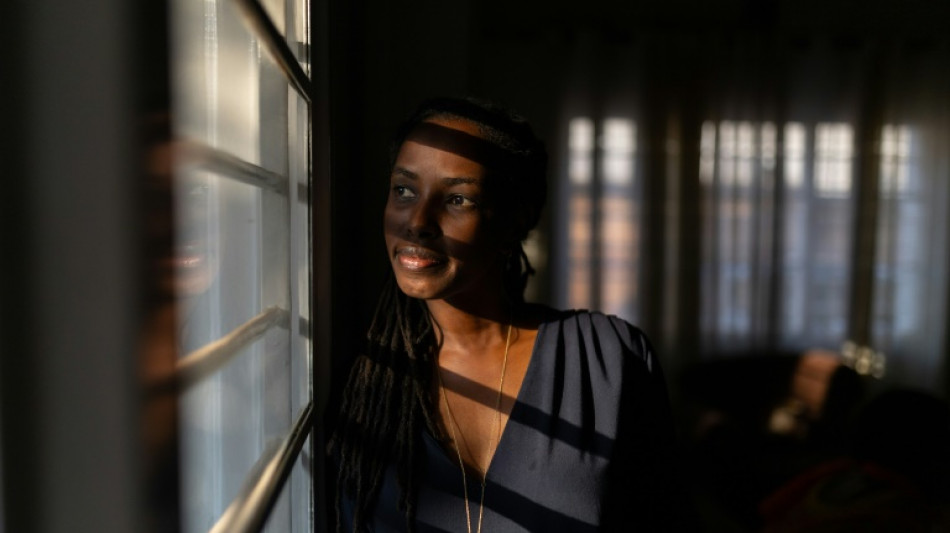
Jeanne Allaire Kayigirwa was sure she was going to die three times during the Rwandan genocide in which most of her friends and family were massacred.
She and her sister hid in the bush for six weeks as the slaughter went on around them, moving on all the time as Hutu extremists hunted Tutsis like them "down with dogs".
"I don't know how we survived," she said.
Much about that time she does not want to remember. "Otherwise I won't be able to go on."
Jeanne learned to live with her demons, but "you cannot wipe a genocide from your memory. It comes back went it wants."
Then one day she took stock. "Am I going to let the killers who wanted to wipe me out also take my second life?
"Or am I going to live it?" said the 46-year-old, who went on to be a top local government official in Paris.
More than a million people died in the genocide organised by the extremist Hutu regime in 1994.
Men, women, children from the Tutsi minority systematically exterminated between April and July 1994 -- often with machetes -- by Hutu forces, and sometimes even by their neighbours, colleagues and even friends.
Three decades after the horror, AFP set out to find Tutsi children who survived the killing and who were adopted or grew up in France.
They talked of the weight of what they witnessed, their feeling of injustice and about living for those who were slaughtered.
Some have remained abroad, while others have been drawn back to Rwanda.
Jeanne lost her father, sister, friends, cousins, aunts and uncles -- "I try not to count".
"They put the guns to our temples the day they came to kill us," she said.
- Silences -
Moving to France "gave me the chance to study", but more than anything it "helped me because I didn't have to see the killers every day."
Soon after arriving, Jeanne helped found the Ibuka group, a survivor group which keeps the memory of the genocide alive, going out into schools to speak about what happened.
Jeanne grabbed her "second life" in both hands, began a family and worked for the mayor of Paris.
"I feel that by talking about it I am not shutting up the dead who have been silenced."
A heavy silence, however, hung over Manzi Rugirangoga's childhood.
Now living back in the Rwandan capital Kigali, Manzi survived the unthinkable as a baby.
He was just 15 months old when his family took refuge in a school with other Tutsis in the southern town of Butare. On April 29, 1994, Hutu militia attacked. His mother, who was carrying him on her back, was killed along with his aunt and uncle.
But he and his sister and brother, who were four and seven, were not.
"The killers didn't spare us, they just said that they didn't want to waste their bullets on us." Instead they were left to "die from hunger and grief".
Manzi's father found him in an orphanage in Burundi three months later.
- A terrible injustice -
The children survived thanks to an extraordinary rescue operation by the Swiss charity Terre des hommes (Tdh), which has only come to light recently thanks to a book called "The Convoy" by Beata Umubyeyi Mairesse, one of 1,000 survivors its aid workers got out of the country.
"Dozens of members of my family" were killed in the genocide, said Manzi, now 31. "My father is the only survivor on his side." A vet, he was in France on a training course when the genocide began.
He brought the children to France "because he had very little hope of finding anything in Rwanda".
"I still feel this huge feeling of injustice about what happened," said Manzi.
Little was ever said at home. "People would ask you where you came from, and I knew very little."
It was only after the "shock" of returning to Rwanda for the first time when he was 10 that he felt "an instinctive need" to go home.
"I finally knew where I came from," he said.
After some difficult teenage years, Manzi went back to Kigali on his own when he was 15 to stay with his aunt, and then boarded at high school in the east of the country, where he had to learn Rwandan.
After university in France, he moved back to Kigali.
"Back then, I didn't see my future in France," he said.
Sandrine Lorusso grew up in the same silence. The youngest of nine, she lost both her parents and three siblings in the massacres.
Adopted by her eldest sister and her husband who were living in France, her interview with AFP was the first time the soft-spoken mother-of-two has ever talked publicly about what she went through in Kigali.
"It wasn't something we talked about," said the nurse.
"The killers gathered in front of our house. They took my mother, but they left me and my sister Aline. We ran to our neighbours and a few minutes later we heard gunfire," she said, her voice breaking with emotion.
- Panic attacks -
She still doesn't know how her father died. He was found in a mass grave.
Growing up, "my brain worked hard to hide" the memories. But things got "complicated" as Sandrine approached adulthood. It all got too much "between the ages of 17 and 24 and I had depression".
The trauma came back with a vengeance when she was pregnant with her first child. "I had inexplicable panic attacks. You try to keep it down but sooner or later it comes out," she said.
When she left for France, Jeanne thought she was also "leaving the genocide" behind her.
"I thought I was going to live a good life, I hoped to never have to see the images of the bones and the ruins. But even if you move 6,000 kilometres (3,700 miles), you bring the genocide with you," she said.
She described how it followed her down French streets where she would notice "spots where people might be able to hide", or be spooked by the "sound of shooting" when she went to the cinema.
"The nightmares have lasted a long time," she said.
Gaspard Jassef's memories would not leave him alone either. As a six-year-old, he hid out from the genocide alone in the forest for five months.
"The commemoration of the 30 years (since the genocide) touched me intensely... and I want to sort out of all the unknowns in my head about what happened to me," he told AFP in a Paris cafe.
His little sister and his mother -- a Tutsi married to a Hutu -- were poisoned by their Hutu relatives at the start of the genocide.
Fearful for his "mixed" child, his father told him to hide in the forest. But he never came to find him. He too had been killed, according to information Gaspard has been able to piece together.
In October 1994 -- three months after the genocide ended -- a French nurse called Dominique Jassef, who had been working in a local dispensary, found him in the forest with advanced malnutrition. "I ate what I could. I hunted small animals. I stayed in the trees," he said.
"When my second mother found me, I probably had a week to live," he said. The doctors thought "there was no hope" but the French nurse refused to give up on him, got him treatment and later adopted him, changing his life.
- France's shameful legacy -
Gaspard still has trouble sleeping and is haunted by the day when he had to bury his mother and his sister.
But in "my sadness I have had the great good luck to have had two very loving mothers", he added.
Despite the trauma, he was a brilliant student and worked for several years for a think tank and co-founded the support group, The Adopted of Rwanda.
Even so, "everyday life can be a struggle, and sometimes I feel very old", he admitted.
A deeply social party animal, Gaspard loves nothing more than talking French politics for hours on end. "My blood and my skin is Rwandan and I also feel fully French," he said.
Yet France's role in the genocide of the Tutsi has been an extremely touchy subject.
Paris, which had close relations with the murderous Hutu regime, was for a long time accused by Kigali of "complicity" in the genocide.
A commission of historians in 2021 found that France under the late president Francois Mitterrand had "heavy and overwhelming responsibility" for the genocide but had not been complicit.
The writer Beata Umubyeyi Mairesse makes a distinction between "the absolutely fantastic French people who welcomed her" and "the French politicians and military whose actions should be condemned".
Her host family "really looked after me" and even took her to a psychologist.
Despite the trauma, she was able to "reconstruct" her life. "Of course, you feel fragile," she admitted. "When you have been excluded from humanity... it's a long road back from that," she said.
She chose a career where she "fights against death", working for NGOs dealing with AIDs and addiction.
- Reconnecting -
The 30th anniversary of the genocide has been a big moment for many of the survivors.
Last year Jeanne moved back to Rwanda with her husband and young son.
"I felt I was missing something in France," she told AFP from Kigali. "I wanted to live with my family and my mother again. She is now over 80. I wanted to show my son my homeland and my language and maybe help rebuild the country."
Gaspard said he has finally found a "form of stability" and wants to go back to his village and understand what happened to his father.
Manzi has a heap of projects on the go in Kigali. He has written an "African futurist" novel, founded a publishing house and has invested in farms growing peppers, beans and watermelons.
"Reconnecting with my roots, my family and my history has helped me," he said.
But "the idea that we can totally reconstruct ourselves, and that we don't think about what happened, that is unobtainable," Manzi added.
Back in France, Sandrine wants to get more involved in a group keeping alive the memory of what was done.
She has also thought about going to a therapist. "There are things about what happened in 1994 that I can't remember -- and the genocide has also robbed me of my memories of what went before, of my early childhood."
Since she went back to Rwanda, Beata has found happiness in its particular "light and landscapes" and the spirit of the place.
"Every time I return, I reconnect with who I was," she said.
T.Wu--ThChM