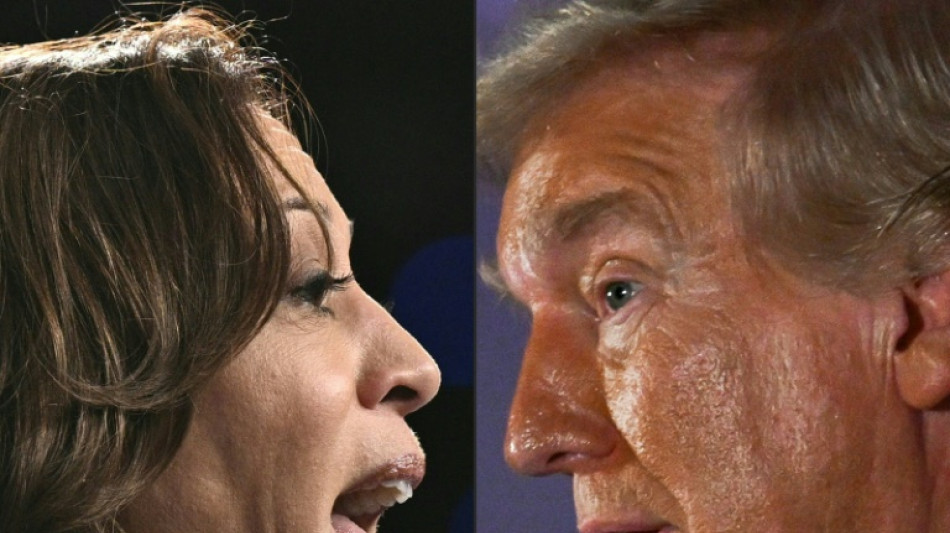
Is the US election really so close? / Photo: © AFP/File

The United States stands on edge as polls suggest one of the closest presidential races in history between former president Donald Trump and Vice President Kamala Harris.
Major polling outlets show the candidates virtually deadlocked.
In battleground states on election eve, polling aggregator FiveThirtyEight reported a 47.8 percent tie in Pennsylvania, near-identical numbers in Nevada, and mere one-point differences in Wisconsin, Michigan, and North Carolina.
But these razor-thin margins may not tell the whole story.
"I wonder, is it really this close?" asked W. Joseph Campbell, professor at American University in Washington.
His questions stems from pollsters' troubled track record in recent elections and a potential overreaction to past failures.
The political establishment was blindsided in 2016 when Trump won despite trailing in polls, while Joe Biden's 2020 victory margin proved much narrower than predicted.
In 2022, Republicans secured only a slim Congressional majority despite forecasts of a "red wave."
"The 2020 presidential election was collectively the worst for pollsters in forty years and an embarrassment for many," Campbell said.
Trump's emergence on the political scene largely explains these polling mishaps. His supporters were consistently undercounted in 2016 and 2020, prompting polling companies to adjust their methodologies.
- 'Traumatic for pollsters' -
History offers an intriguing parallel: In 1980, polls showed incumbent Jimmy Carter neck-and-neck with Ronald Reagan. Reagan ultimately won by 10 points, benefiting from a late surge while Carter lost support to a third-party candidate.
"I'm not saying that's going to be the model in 2024, but it is something to keep in mind," Campbell added.
Leading polling analysts openly acknowledged these challenges.
"No, you can't trust the polls... You can't safely assume that the candidate leading in the polls is going to win," wrote Nate Cohn, the New York Times chief political analyst and polling director.
Cohn explained that pollsters are working to correct systemic biases that emerged in the Trump era.
"It's hard to overstate how traumatic the 2016 and 2020 elections were for many pollsters. For some, another underestimate of Trump could be a major threat to their business and their livelihood."
However, he warned that while adjusting methods to better capture Trump voters, pollsters might now be underestimating Harris.
"On balance, these changes add up to a case for cautious optimism on better accuracy, but there are no guarantees," Cohn concluded.
Some experts suspect pollsters may be falling victim to groupthink, or "herding", adjusting results that deviate significantly from the consensus.
Professors Joshua Clinton and John Lapinski warned to NBC news: "State polls are showing not just an astonishingly tight race, but also an improbably tight race."
They suggest that "a risk-averse pollster who gets a 5-point margin in a race they think is tied may choose to 'adjust' the results to something closer to what other polls are showing, lest their outlier poll adversely affects their reputation..."
They said this raised a crucial question: "Is 2024 going to be as close as 2020 because our politics are stable, or do the polls in 2024 only look like the results of 2020 because of the decisions that state pollsters are making?"
B.Carter--ThChM