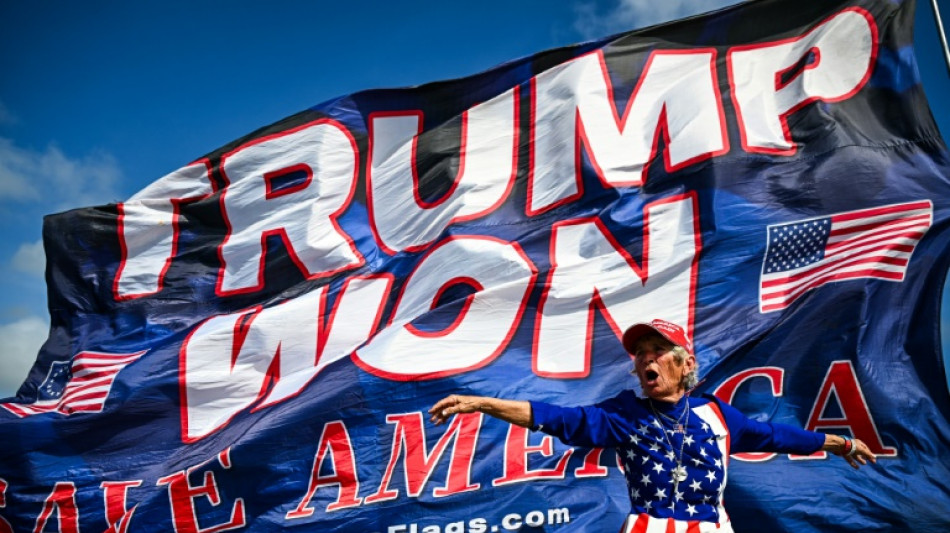
Trump rides global wave of anti-incumbency / Photo: © AFP

Incumbent leaders used to have the edge. In the United States, the power of the Oval Office and glamour of Air Force One once made presidents the prohibitive favorites to win reelection.
With Donald Trump's defeat of Kamala Harris, Republican and Democratic presidents will alternate control of the White House for the fourth straight term, a level of volatility between the parties not seen in the United States since the late 19th century.
Anti-incumbency fervor has swept not just the United States but other major democracies, battering both the left and the right.
Britain's Labour swept out Conservative rule in July, self-professed "anarcho-capitalist" Javier Milei triumphed in Argentina last November, and incumbent parties, some long-dominant, lost ground this year in countries as diverse as India, Japan, South Africa and South Korea.
There are exceptions -- with Claudia Sheinbaum of Mexico's ruling left-wing populists elected president in June -- but the anti-incumbency wave has defied traditional political trends.
Under outgoing President Joe Biden, US economic growth has topped the developed world, despite high inflation, and the country has no troops in active combat, factors that led respected political scientists to predict victory for Vice President Harris.
White House Press Secretary Karine Jean-Pierre pointed to the global trend as she explained the defeat and pointed to the aftereffects of the Covid-19 pandemic.
"What we saw two nights ago was not unusual to what we have seen from the incumbencies around the world on the global stage," she said Thursday.
The whiplash has wide-ranging effects on US policy and diplomacy.
Trump is expected again to pull the United States out of international commitments on climate change and to take a harsher approach with European allies, and he may work to undo signature Democratic domestic measures including on health care and the environment.
- Disapproval the new normal -
Trump won despite never once topping 50 percent approval in his 2017-2021 term -- the first time in Gallup polling since it began such ratings after World War II.
Biden enjoyed majority support only at the start of his term, with approval tumbling after the chaotic August 2021 withdrawal from Afghanistan, even as the pandemic eased.
Economic statistics, of course, do not mirror what ordinary voters feel, and every election also needs to factor in more abstract points such as candidates' personal charisma.
John V. Kane, a political scientist at New York University, said there was an increasingly smaller share of persuadable voters than in the 20th century, when presidents sometimes would win by 10 or 20 percentage points.
Voters still "tend to think presidents should be afforded two terms so long as the economic, social and international conditions are fairly normal," he said.
"And herein lies the challenge: the past five years have been anything but normal in these respects. The pandemic and subsequent shock to the economy in 2020 very likely turned incumbency from an asset into a liability," Kane said.
"Swing voters may not know the best policies, if any, to fix the situation, but one thing they can be certain about is that they want the situation to change."
- Democracy 'pendulum' -
Todd Belt, a political scientist at George Washington University, pointed to Covid and inflation but also the fragmentation of media sources, with voters turning to partisan outlets that fuel animosity toward incumbents.
"There are a lot of things in the world that are beyond the control of the president, but the president has to take credit or blame for all of them, and that makes things difficult," Belt said.
"We've reached sort of a pendulum aspect of democracy, because people are paying so much more attention to what's going on now, and people's patience is lessened for the incumbent party."
Kane noted that incumbents still won overwhelmingly in the US Congress, and he expected future presidents to enjoy an incumbency advantage in more stable times.
"If, however, the 'new normal' for the US economy is lackluster growth, high prices, etc., then swing voters may very well just perpetually keep trying their luck with the other party every four years," Kane said.
N.Wan--ThChM