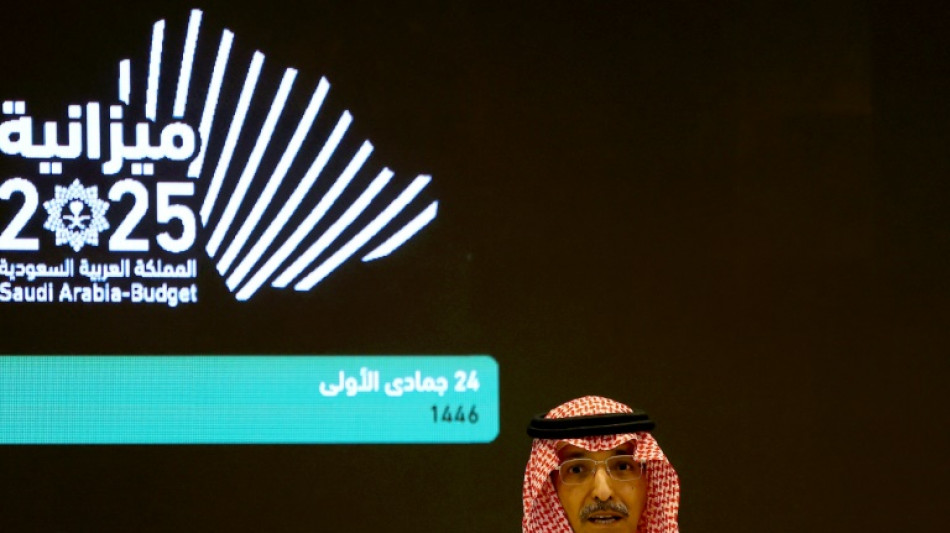
Saudi 2025 budget sees lower deficit on spending trims / Photo: © AFP

Saudi Arabia on Tuesday approved a budget for 2025 that projected a smaller deficit than last year despite continued heavy spending on reforms to transition the economy away from oil.
The expected deficit of $26.8 billion, amounting to 2.3 percent of GDP, is down from a 2024 deficit of $30.6 billion, or 2.8 percent of GDP, according to the budget published by the finance ministry.
That reflects a drop in expenditures from 1.345 trillion Saudi riyals, or roughly $358 billion, to 1.285 trillion riyals, or roughly $342 billion, the budget said.
The world's biggest oil exporter and the Middle East's largest economy is just over halfway through a splashy reform drive featuring projects that have been dogged by questions about their viability.
They include NEOM, a planned futuristic mega-city in the desert, and resorts along the Red Sea coast meant to draw tourists to the formerly closed-off kingdom.
In 2022, Saudi Arabia recorded its first budget surplus in nearly a decade after Russia's invasion of Ukraine led to a surge in oil prices.
But last year's budget signalled a return to deficits, with Finance Minister Mohammed al-Jadaan saying at the time this was the product of a deliberate decision to boost spending.
Deficits of up to 3 percent are "absolutely fine... if you spend that money right", Jadaan said at the time.
Jadaan also said then that officials had decided to push the timeframe for some major projects past 2030, without specifying which, though he also noted that others would be accelerated.
Crown Prince Mohammed bin Salman, Saudi Arabia's de facto ruler, said the budget approved on Tuesday would produce "sustainable levels of public debt and significant government reserves, in addition to a flexible spending policy that enables it to confront challenges and fluctuations in the global economy," the official Saudi Press Agency reported.
- 'Bigger picture' -
At an investor forum in Riyadh last month, Jadaan acknowledged some "challenges" in implementing Vision 2030 but said broadly the reform agenda was "on track".
The government has been "recalibrating our plans", he said, trying not to overheat the economy and to give the private sector time to "catch up" with ambitious proposals.
There has been mounting scepticism over signature projects like NEOM, which is meant to feature a ski resort and twin skyscrapers 170 kilometres (105 miles) long.
Authorities have reportedly scaled back 2030 size and population targets for NEOM, though officials have not confirmed any revisions.
At a press briefing on Tuesday, Jadaan said it was important to "focus on the bigger picture" and not individual projects and targets.
"A project like NEOM is a 50 or more than 50-year project, not a one-year or five-year project," he said.
"There are many successful projects that have started operating successfully, with high quality and high efficiency in spending."
The new budget estimates that GDP will have grown by 0.8 percent in 2024, "driven by an increase in non-oil activities, which are expected to grow by 3.7 percent", the finance ministry said.
The economy is expected to grow by 4.6 percent in 2025, it said.
B.Clarke--ThChM