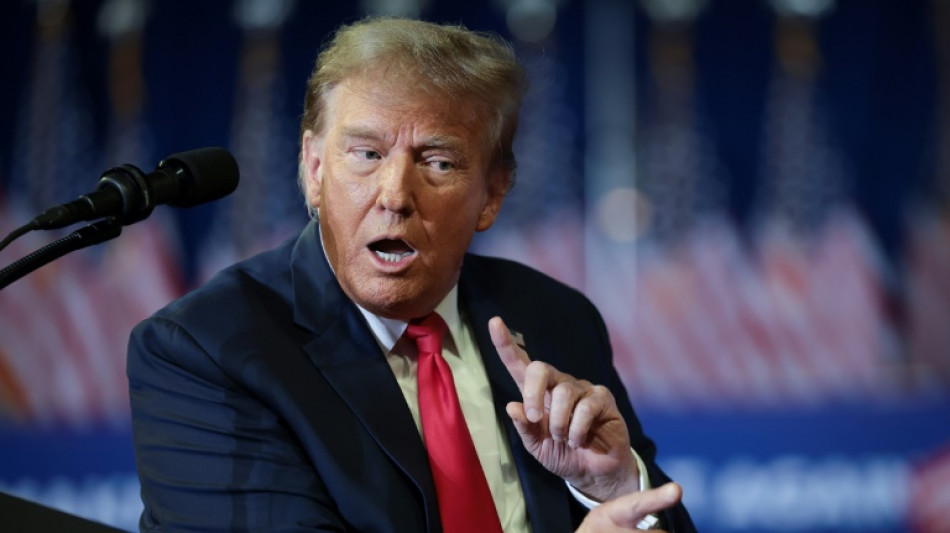
Autos, food: What are the risks from Trump's tariff threat? / Photo: © GETTY IMAGES NORTH AMERICA/AFP/File

Fresh US tariffs on Canada and Mexico could raise costs of automobiles and building materials, analysts said Tuesday, after President-elect Donald Trump threatened to erect new trade barriers.
Similarly, further tariff hikes on China could add to consumer prices, as the United States is still reliant on the world's second biggest economy for goods like electronics and batteries.
What products face risks from Trump's tariff pledges?
- Canada: Energy, construction -
US-Canada trade ties are significant, with a highly integrated energy and automotive market, the Congressional Research Service (CRS) noted in July.
Nearly 80 percent of Canada's 2023 goods exports were US-bound, while about half its goods imports came from the United States.
Canada has been the biggest supplier of US energy imports including crude oil, natural gas and electricity, the CRS added.
Economist Ryan Sweet of Oxford Economics warned that a 25 percent tariff on Canadian goods could hit imported fuels, risking higher energy costs.
"The 2026 midterms are not that far off, and voters don't forget inflation," he told AFP.
The United States imports construction materials from Canada, too, he added, and tariffs could drive up housing costs.
Last year, $2.5 billion in goods crossed the US-Canada border daily, said Dennis Darby of industry group Canadian Manufacturers & Exporters.
Imposing tariffs "would also hurt US manufacturers," he added.
- Mexico: Food, autos -
The United States is Mexico's most critical trading partner, taking in 80 percent of its exports, the CRS noted.
In 2023, Mexico outpaced China for the first time in two decades to be America's leading source of imports, government data showed. US goods imports from Mexico stood at $484.5 billion.
A 25 percent tariff would weigh on the auto sector, worth tens of billions in Mexico's US exports, alongside medical instruments and devices.
Vehicle costs could rise about 10 percent, estimates Gary Hufbauer, nonresident senior fellow at the Peterson Institute for International Economics.
A significant portion of North America trade happens between the United States, Mexico and Canada with products crossing borders multiple times.
This means "even low tariffs add up," said Joshua Meltzer, a senior fellow at the Brookings Institution.
Agricultural products would also be impacted.
In 2023, Mexico supplied over 60 percent of US vegetable imports and nearly half of US fruit and nut imports, the Department of Agriculture noted.
Additional import costs for Mexico's fresh fruit and vegetables could be entirely passed to consumers, Hufbauer warned.
- China: No early concession? -
Consumer goods like smartphones and computers, alongside lithium-ion batteries and other products, made up nearly 30 percent of US goods imports from China in 2023, according to the Atlantic Council.
"US reliance on China for these goods has hardly budged since 2017. In fact, China's share in US battery imports has actually increased in that time," it added this month.
This is despite a trade war during Trump's first term, in which he slapped tariffs on hundreds of billions of dollars in Chinese imports.
A 10 percent tariff additionally is unlikely to be "fully absorbed" before it hits the consumer, Sweet said.
Best Buy CEO Corie Barry warned that China accounts for around 60 percent of its cost of goods sold, adding that consumers will likely bear some cost of tariffs.
Meltzer said he expects Beijing would be willing to address US fentanyl concerns -- Trump's stated reason for the tariffs -- but might not offer concessions to avoid signaling it would "capitulate every time the US raises tariffs."
- Trade deals threat -
Hufbauer of PIIE expects Trump will allow a buffer before imposing fresh tariffs on Canada and Mexico, given that this provides an opportunity to negotiate before triggering retaliation.
"Given their heavy, heavy dependence on the US, they will be inclined to do what they can to strike a bargain," he told AFP.
But Trump's tariffs would be inconsistent with a trade agreement between the United States, Mexico and Canada -- which Trump once touted as the best ever -- Meltzer added.
"It underscores this question of, why do a deal with the Trump administration?" he said.
Z.Huang--ThChM