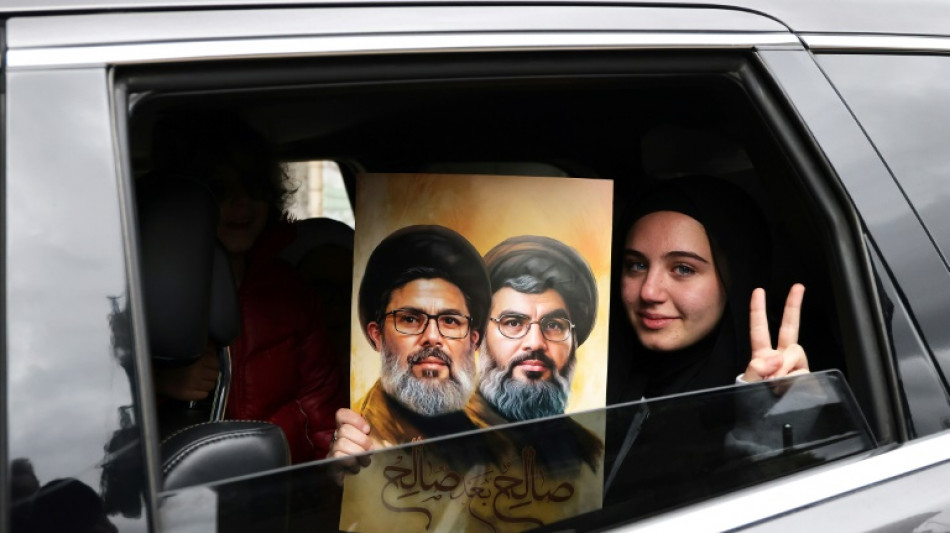
Hezbollah under pressure after war with Israel / Photo: © AFP

With its longtime leaders dead, its military capabilities vastly diminished, and its fighters forced to retreat from southern Lebanon, Hezbollah emerges from its war with Israel facing unprecedented challenges.
But analysts say that it is too early to write off the Iran-backed group, which still plays a major role in Lebanese politics.
When Hezbollah began firing rockets at Israel in support of Hamas in Gaza more than a year ago, it was the most formidable member of Iran's so-called "axis of resistance", with an arsenal believed to be superior than the Lebanese military's.
Since then, however, Israel has killed its leader of 32 years, Hassan Nasrallah, his widely expected replacement Hashem Safieddine and a string of other top commanders, while hammering away at its rockets and missiles.
According to a source close to Hezbollah, the movement lost hundreds of fighters since September.
Israel shocked the group with back-to-back attacks involving exploding pagers and walkie-talkies that killed dozens and wounded thousands, according to Lebanese authorities, and left its membership riven with fear of infiltration.
In its last war with Israel in 2006, Hezbollah claimed victory by fighting its enemy to a standstill.
This time round, Hezbollah claimed victory too -- but the chants ring hollow after it accepted a ceasefire whose terms it had long rejected.
- 'Unprecedented pressure' -
"Hezbollah is under unprecedented pressure," said Lina Khatib, of the Chatham House think tank.
"It will not abandon its narrative in which it presents itself as a 'resistance' force against Israel but the terms of the ceasefire agreement pave the way for dismantling the group's military capabilities, which makes putting its narrative into action virtually impossible," she added.
Hezbollah was the only Lebanese armed group that refused to surrender its weapons after the 1975-1990 civil war.
Its popularity soared after Israel ended its 22-year occupation of south Lebanon in 2000, and it claimed that it alone could defend the country against future attacks.
Under the ceasefire that took effect Wednesday, Hezbollah must withdraw from its south Lebanon heartlands and leave only the army and UN peacekeepers to deploy.
The truce, mediated by the United States and France, should bring an end to its military presence in the south.
But under UN Security Council Resolution 1701, which ended the last Israel-Hezbollah war in 2006, Hezbollah should already have withdrawn from south Lebanon.
After that deal, Hezbollah rebuilt its presence in southern Lebanon, including through an extensive network of tunnels, according to military experts.
This difference now is that the key Israel backer the United States and its ally France will monitor the agreement to prevent a repeat strategy, said a political official speaking on condition of anonymity.
- Wounded, not crushed -
Nearly a year of cross-border exchanges of fire escalated into full-scale war in September, when Israel stepped up its bombing campaign against Hezbollah.
On September 30, Israel launched a ground invasion of southern Lebanon, aiming to push Hezbollah back from the border.
On the ground, Israeli troops engaged in fierce combat with Hezbollah militants who know the territory better than their enemy.
In the rubble of south Beirut, Hezbollah's main bastion, and south Lebanon's villages, supporters of the group celebrated the militants' fight against Israel's far superior military capabilities.
Imad Salamey, head of the International and Political Studies Department at the Lebanese American University, said Hezbollah had emerged from the war wounded, not crushed.
"While the war has undoubtedly weakened Hezbollah militarily, with significant leadership losses and reduced operational capacity, it has not been defeated," he said.
"Hezbollah cannot fully transform into a purely political party as its entire legitimacy and influence are rooted in its role as an armed resistance movement," he added.
The group will "continue to use its influence to shape Lebanon's political process", he said.
- 'Hezbollah hegemony' -
Hezbollah is deeply rooted in its support base in Lebanon's majority Shiite Muslim community.
It built this support by providing social and economic services, in a country long been wracked by division and corruption.
Hezbollah wields immense influence in domestic politics in Lebanon, though Salamey said it may now have to show more flexibility.
In a wartime address, Hezbollah leader Naim Qassem pledged to make "an effective contribution to the election of a president".
On Thursday, Lebanon's National News Agency said parliament would meet on January 9 to elect a president.
Lebanon has been stuck with a caretaker government and no president for more than two years, with critics blaming Hezbollah for the gridlock.
According to Khatib, the group's postwar weakness presents an opportunity for Lebanon to finally move forward.
"For the first time since Hezbollah came to dominate Lebanese politics almost two decades ago, Lebanon has the opportunity to reconfigure its internal politics to free itself from Hezbollah's hegemony," she said.
X.So--ThChM