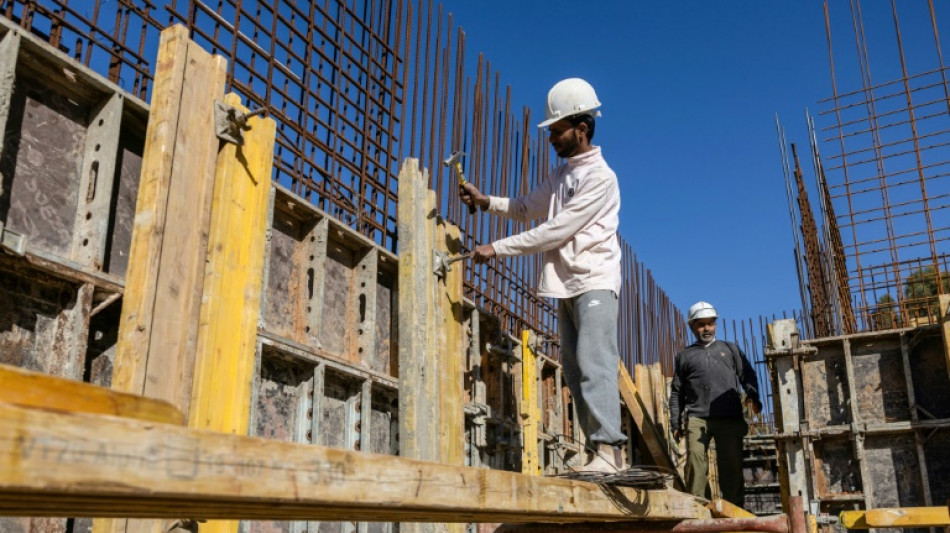
Indian workers replace Palestinians in Israel's building sector / Photo: © AFP

Wearing a safety belt, helmet and work boots, Raju Nishad navigates the scaffolding, hammering blocks that will form part of a building in a new neighbourhood in central Israel's town of Beer Yaakov.
While he and other Indians working alongside him do not look out of place on the expansive construction site, they are relative newcomers to Israel's building industry.
They are part of an Israeli government effort to fill a void left by tens of thousands of Palestinian construction workers barred from entering Israel since Hamas's unprecedented October 7, 2023 attack.
If that attack had not happened, this site, with its slowly emerging high-rise towers, homes, roads and pavements, would have teemed with labourers speaking Arabic -- unlike the Hindi, Hebrew and even Mandarin of today.
The Hamas attack triggered the deadliest war yet between Israel and militant group Hamas in the Gaza Strip.
It later spread to include other Iran-backed groups including Hezbollah in Lebanon and Huthi rebels in Yemen, and even direct confrontation with the Islamic republic itself.
None of this deterred Nishad, 35, from coming to Israel.
"There's nothing to be afraid of here," he said, despite several air raid warnings that have sent him running for the shelters.
"Once it (the siren) stops, we just resume our work," he told AFP.
High earnings in Israel, where some workers can make three times what they would back home, are the key to why people like Nishad flock here, thousands of kilometres (miles) away.
"I'm saving for the future, planning to make wise investments and do something meaningful for my family," Nishad said.
He is just one of around 16,000 workers who have come from India over the past year -- and Israel has plans to bring thousands more.
- New recruitment drive -
India is the world's fifth-largest economy and one of the fastest growing, but it has also struggled to generate enough full-time jobs for millions of people.
Indians have been employed in Israel for decades, thousands as caregivers looking after elderly Israelis, while others work as diamond traders and IT professionals.
But since the war in Gaza escalated, recruiters have launched a drive to bring Indians in for Israel's construction sector also.
Samir Khosla, chairman of Delhi-based Dynamic Staffing Services, which has sent about 500,000 Indians to work in more than 30 countries, has so far brought more than 3,500 workers to Israel, a new market for him.
Khosla himself arrived for the first time a month after the October 7 attack, after the authorities appealed for foreign workers in the construction industry, which ground to a halt when the Gaza war broke out.
"We didn't know much about the market, and there wasn't an incumbent workforce from India here," Khosla said.
"We really had to move around and understand the needs," he said, adding that he believed India was a natural choice for Israel given their "excellent relations".
He now hopes to bring in up to 10,000 Indian labourers, as he has a large pool of skilled Indian workers across all trades.
- Long-term effects possible -
In nearby Tel Aviv, a group of Indians live in a small flat where, in addition to the construction skills they brought with them, they have also learned to cook the familiar spicy dishes they miss from home.
"In a short time, one can earn more money" in Israel, said Suresh Kumar Verma, 39. Like Nishad, he is from India's most populous state, Uttar Pradesh. Verma works on a construction site north of Israel's commercial capital.
"Making money is also necessary... It's important to continue working hard for the family's future."
Israeli researchers believe the number of Indians working in construction still does not match the number of Palestinians who did so before the war, and this is hampering the sector's overall growth.
Before the Hamas attack, around 80,000 Palestinians were employed in construction, along with some 26,000 foreigners, Eyal Argov of the central Bank of Israel said.
Now there are about 30,000 foreigners employed, far fewer than the previous overall workforce figures, he said, adding that activity in the current quarter of 2024 is about 25 percent below pre-war levels.
"These numbers (of Indians) are still very low," Argov said.
While this does not create an immediate "shortage of housing, it may cause delays in the supply of new housing", he said.
"Israel has a growing population, increasing by two percent annually, and this delay might lead to some shortage in the future."
I.Taylor--ThChM--ThChM