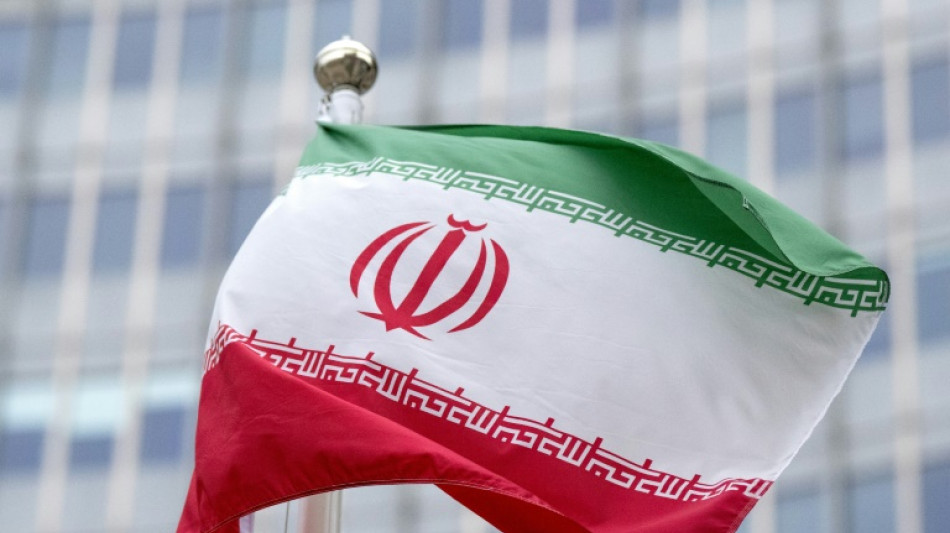
Iran, European powers hold 'constructive' nuclear talks / Photo: © AFP

Iran and European powers said they held "frank and constructive" talks on Monday about Tehran's nuclear programme, just a week before US President-elect Donald Trump takes office.
It was the second round of such talks in less than two months, following a discreet meeting in Geneva last November between Tehran and the three European powers, Britain, France and Germany, known as the E3.
Few details were revealed about the topics discussed Monday or even the venue of the talks, but both sides said they were "constructive" and that the parties agreed to carry them on.
Iran's ISNA news agency reported that Iranian Deputy Foreign Minister Majid Takht-Ravanchi met "his counterparts from the E3".
"They discussed issues of mutual interest, including negotiations for lifting sanctions, the nuclear issue and the worrying situation in the region," it added without elaborating.
Later, Iran's Deputy Foreign Minister for International Affairs Kazem Gharibabadi described the talks as "serious, frank, and constructive".
"We discussed ideas involving certain details in the sanctions-lifting and nuclear fields that are needed for a deal," he said in a post on X.
"Sides concurred that negotiations should be resumed and to reach a deal, all parties should create and maintain the appropriate atmosphere. We agreed to continue our dialogue," he added.
British, French and German foreign affairs representatives afterwards called the talks "serious, frank and constructive".
"Against a challenging context, we discussed concerns and reiterated our commitment to a diplomatic solution. We agreed to continue our dialogue," they said in a statement posted on their X accounts.
Before the meeting, the German foreign ministry told AFP that the talks were "not negotiations" while Iran said they were merely "consultations".
The talks, scheduled for Monday and Tuesday, will cover a "wide range of topics," Iran's foreign ministry spokesman Esmaeil Baqaei said during a weekly press briefing.
"The primary objective of these talks is to remove the sanctions" on Iran, he noted, adding that Iran was also "listening to the topics that the opposite parties want to raise".
ISNA reported that Takht-Ravanchi will meet on Tuesday separately with the European Union diplomat Enrique Mora in Geneva.
- 'Breaking point' -
On Thursday, France's foreign ministry said the meeting was a sign that the E3 countries were "continuing to work towards a diplomatic solution to the Iranian nuclear programme, the progress of which is extremely problematic".
The talks come with Iran's nuclear programme under renewed focus in light of Trump's return to the White House on January 20.
During his first term, Trump pursued a policy of "maximum pressure", withdrawing the United States from a landmark nuclear deal which imposed curbs on Iran's nuclear programme in return for sanctions relief.
Tehran adhered to the deal until Washington's withdrawal, but then began rolling back its commitments.
Efforts to revive the 2015 nuclear pact have since faltered and European officials have repeatedly expressed frustrations over Tehran's non-compliance.
Last week, French President Emmanuel Macron said the acceleration of Iran's nuclear programme was "bringing us very close to the breaking point". Iran called the comments "baseless" and "deceitful".
In December, Britain, Germany and France accused Tehran of growing its stockpile of highly enriched uranium to "unprecedented levels" without "any credible civilian justification".
"We reiterate our determination to use all diplomatic tools to prevent Iran from acquiring a nuclear weapon, including using snapback if necessary," they added.
- 'Significant non-performance' -
The snapback mechanism -- part of the 2015 deal, known as the Joint Comprehensive Plan of Action (JCPOA) -- allows signatories to reimpose United Nations sanctions on Iran in cases of the "significant non-performance" of commitments.
The option to trigger the mechanism expires in October this year, adding urgency to the ongoing diplomatic efforts.
The International Atomic Energy Agency (IAEA) nuclear watchdog says Iran has increased its manufacturing of enriched uranium such that it is the only non-nuclear weapons state to possess uranium enriched to 60 percent.
That level is well on the way to the 90 percent required for an atomic bomb.
Iran maintains that its nuclear programme is solely for peaceful purposes and denies any intention to develop atomic weapons.
It has also repeatedly expressed willingness to revive the deal.
President Masoud Pezeshkian, who took office in July, has favoured reviving that agreement and called for ending his country's isolation.
In a recent interview with China's CCTV, foreign minister Abbas Araghchi also expressed willingness "to engage in constructive negotiations".
"The formula that we believe in is the same as the previous JCPOA formula, namely, building trust on Iran's nuclear program in exchange for lifting sanctions," he added.
D.Pan--ThChM