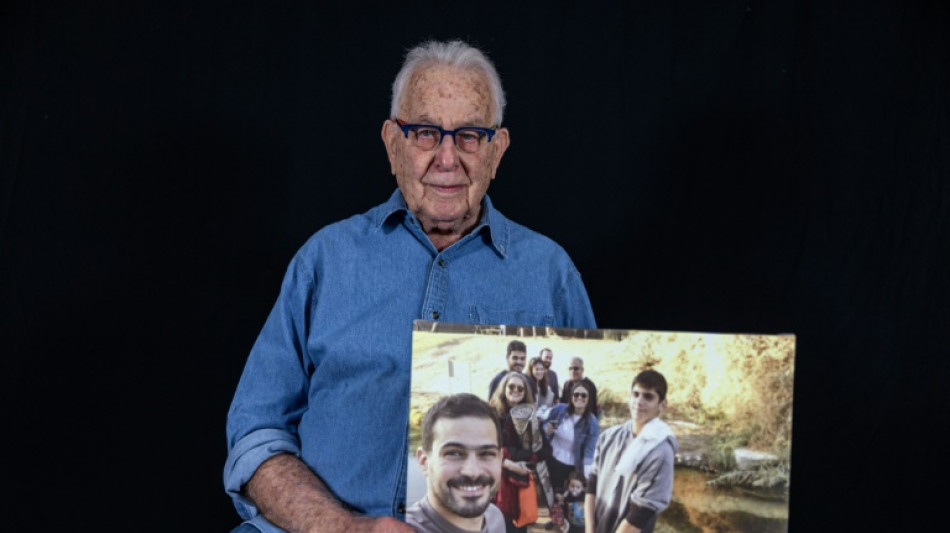
Life after the unthinkable: Shoah survivors who began again in Israel / Photo: © AFP

For years, Auschwitz survivor Naftali Furst kept his story to himself.
But since his granddaughter survived the October 7 massacre at the Kfar Aza kibbutz -- one of the bloodiest in Hamas's unprecedented attack on Israel that sparked the war in Gaza -- the 92-year-old is more determined than ever to testify.
With anti-Semitism at levels rarely seen since World War II, Furst warned that "if we forget our history, we risk seeing it repeat itself".
Eighty years after the Red Army liberated the Auschwitz-Birkenau extermination camp on January 27, 1945, AFP reached out to Holocaust survivors who rebuilt their lives in Israel.
Several came through the horrors of that slaughterhouse in occupied Poland where one million of the six million Jews killed in the Shoah were murdered, and which has become a symbol of the genocide perpetrated by Nazi Germany.
Here are their stories:
- Naftali Furst, born in Slovakia in 1932: daughter, four grandchildren and three great-grandchildren -
Naftali Furst was only 10 when he and his family were rounded up and sent to a concentration camp, ending up in Auschwitz in November 1944. He was separated from his parents and a number was tattooed on his arm.
But with Soviet troops approaching, the Nazis forced the remaining prisoners on a "Death March" through the winter snow towards Germany and Austria.
Those weeks were the "worst of my life", Furst recalled.
"It was an indescribable experience." He and his brother saw "lots of people drop dead or collapse by the roadside. Those who could not keep up were killed on the spot. Survival meant fighting not to be left behind.
"We encouraged each other when we were about to drop, forcing ourselves to keep going and stay with the group to avoid being killed."
When they finally arrived at Buchenwald in Germany they were saved from death by a Czech communist resistance member called Antonin Kalina, who was later honoured by Israel as Righteous Among the Nations for rescuing hundreds of Jewish children.
Furst was 12 when American soldiers liberated the camp. You can see him in one of the most iconic images of the Shoah, stretched out on a plank in a barrack with other survivors including, Elie Wiesel, who would later win the Nobel Peace Prize.
He now heads a group of former Buchenwald inmates and told AFP he intends to talk about what happened to them as long as he can "so people will never forget what happened.
"Many who lived through these horrors are no longer there and I consider it my responsibility to testify. But I am afraid that in 50 or 100 years, the Shoah will become just another page of history, and that we will forget how unique and tragic it was."
Furst was at home in Haifa in northern Israel when Hamas militants launched their attack on Israel from the Gaza Strip on October 7, 2023.
But his granddaughter Mika and her family were living in a kibbutz less than two miles (three kilometres) from the Gaza border and he could not get through to them on the phone.
Mika, her husband and their two-year-old son hid for more than 12 hours in their shelter as one of the worst massacres of that terrible day happened around them.
At least 62 of their neighbours died and 19 were taken hostage. Both her husband's parents were murdered, burned in their home.
"My granddaughter and her family are survivors like me," Furst said.
But he does not compare October 7 with the Holocaust. "It's terrible, unimaginable, painful and should not have happened, but it is not the Shoah," he said.
And he is worried that "similar atrocities could happen again".
- Miriam Bolle, born in the Netherlands in 1917: three children -
Miriam Bolle has much to tell, though she insists she "has done nothing special".
As a secretary at Amsterdam's Jewish Council during the war, which the Nazis set up to control the community after they invaded, she knew all about the deportation of Dutch Jews.
Her turn came in 1943, ending up in the Bergen Belsen concentration camp in Germany.
"They wanted to starve us. They wanted us dead," said Bolle who was 26 at the time.
She remembers inmates sharing a few vegetables at a Passover "feast" celebrating the freeing of the Jews from slavery in Egypt. Instead of reciting the traditional prayer of "Next year in Jerusalem", the children sang, "This year in Jerusalem".
And their prayer was answered. Bolle and her family were "miraculously" freed with a number of others in exchange for German prisoners of war in British-controlled Palestine in July 1944. She travelled across Europe by train to "the land of Israel", where she has lived ever since.
There she was reunited with her fiance Leo, who had emigrated before the war. They married in 1944 and had three children. Two died young defending Israel during their military service. The third died childless.
During her time in the camps, she wrote a series of letters to Leo that she never sent.
They were finally published in 2014 as "Letters Never Sent", a rare insight into Jewish life in the Dutch capital under Nazi occupation, which has since been translated into seven languages.
"I wanted to tell what had happened so it would not be forgotten," said Bolle, who has lost none of her elegance at 107 years old.
But she is worried by the rise of anti-Semitism in Europe. "I don't understand why Jews are so important. I think the future for Jews there is uncertain. I am happy to be in Israel as it is the safest place for us even with the problems now," said one of the oldest of the survivors.
- Dan Hadani, born in Poland in 1924: two children, two grandchildren -
Work saved Auschwitz survivor Dan Hadani.
"To escape the nightmares and try to forget, I worked day and night. I never stopped. I was so tired when I slept that I never dreamed," said the Polish-born 100-year-old.
Hadani's father died in the Lodz ghetto before he and his family were sent to the death camp in 1944.
His mother was killed as soon as they arrived and his sister murdered when the Nazis liquidated the women's camp as the Red Army neared.
Hadani was almost picked out for medical experiments by Josef Mengele, the SS doctor known as the "Angel of Death". But he threw Mengele off by speaking to him in German.
"Stay there, you dog," Mengele replied.
It was only later that the 20-year-old realised he could have been shot on the spot. "I will never forget that moment," he said.
Put to work in one of the camp's factories, Hadani survived the "Death Marches" and was liberated from the Wobbelin camp in Germany by American GIs.
When he returned home to Poland, he realised that the rest of his family had perished. He left for Italy before emigrating to Israel just after the creation of the state in June 1948.
He began to rebuild his life and became an officer in the navy before founding a press photo agency, leaving two million pictures telling the story of the young country to its national library.
Small and bearded, Hadani still has remarkable energy, proudly showing the driving licence that was renewed before his 100th birthday before driving the AFP team to his home in Guivatayim in central Israel.
Every Thursday morning he joins what he calls a "parliament" of former journalists and diplomats to put the world to rights over a coffee.
Hadani, who was born Dunek Zloczewski, is convinced that the testimony of the thousands of survivors like him will help to ensure the Shoah is not written out of history.
But what worries him is the future of Israel, particularly since the October 7 attacks. A fierce critic of Prime Minister Benjamin Netanyahu, he warned that the Holocaust "could happen again. Men are animals. That is how I see the world".
- Abraham Wassertheil, born in 1928 in Germany: four children, three grandchildren, two great-grandchildren -
Long silences follow when Abraham Wassertheil is asked what happened to his family during the war.
"I am not very talkative," said the 96-year-old.
Hounded out of his home when he was nine in 1937, he survived a succession of camps -- Markstadt, Funfteichen, Gross Rosen, Buchenwald and Dautmergen -- by pretending he was older than he was, before being liberated from Allach, a sub-camp of Dachau near Munich in 1945.
Unlike his friend Dan Hadani, who he met in a refugee camp in Italy before they joined the Israeli navy together, he chose not to talk publicly about what happened to him.
Until now.
"With age, I have realised that you have to talk," he said, telling AFP that "in the camps, I thought about only one thing -- eating and looking for something to eat".
The most important thing is to have "passed on my story and that of my parents to my children", he said.
He has also taken his daughters back regularly to Chrzanow in southern Poland, not far from Auschwitz, where his family originally came from.
Two years ago, the town opened a park in memory of its lost Jewish population, naming it after Wassertheil's mother Esther.
For him it has become the tomb she never had, not knowing where or when she was murdered in Auschwitz. For a moment, the emotion broke through.
Despite losing all his family, and now living in a part of northern Israel which has been in the firing line for Hezbollah, Wassertheil insisted that he is at peace.
Yet the October 7 attacks came amid personal tragedy, the day after he buried his wife. And a year later a missile fired by Hezbollah from Lebanon hit a neighbouring building, forcing him to take refuge in a shelter.
"My life will soon be over," he said.
"I cannot do anything to change things, but my children are in good health. They are doing fine without me and I can manage without them. That's why I am optimistic," he added.
- Eva Erben, born in 1930 in Czechoslovakia: three children, nine grandchildren, 15 great-grandchildren -
Eva Erben, who grew up in a well-off Jewish family near Prague, was 11 in 1941 when she and her family were sent to Theresienstadt (Terezin), the "model camp" the Nazis used in their propaganda to pretend that Jews were being well treated.
She was also one of the children who sang the opera "Brundibar" there, which was performed for a Red Cross visit to the camp in 1944.
She even sang along when AFP showed her a film of one of their performances, before pointing out that all of the children and the camera crew were sent to Auschwitz afterwards.
She and her mother survived the extermination camp, only for her mother to die during a "Death March" with the retreating Germans.
Erben, now 94, was left behind in a haystack where she was sleeping. She was saved by some Germans -- "they were not all murderers" -- and then some Czechs who hid her till the end of the war.
She proudly showed a photo of herself with her children and grandchildren at her home in Ashkelon, southern Israel, with its large garden and trees planted by her late husband.
"We didn't ignore the Holocaust. We lived it and now it is time for life -- children, singing, playing sport, travelling: a normal life of eating and living well.
"The Shoah was a shadow on our lives, yes, but one we traversed."
Erben's story is featured in a book on the Holocaust for schoolchildren which has been translated into several languages. The former nurse has also appeared in films and documentaries.
But since the October 7 attacks, and having just returned from a fortnight giving talks in Germany, she argued that the priority now is to "defend Israel".
More than 600 rocket alerts have sounded in Ashkelon, which is close to the Gaza Strip, since the war began. But Erben has refused to go to a shelter.
"If Hitler didn't succeed in killing me, they won't either," she said with a laugh.
But she is worried and "disappointed at the way Israel is seen in the world now.
"It is all very well to come with flowers to pay homage (to the victims of the Holocaust), but we have got over the Shoah, we rebuilt, we had children. Now Israel needs to be respected and accepted," she said.
L.Kwan--ThChM