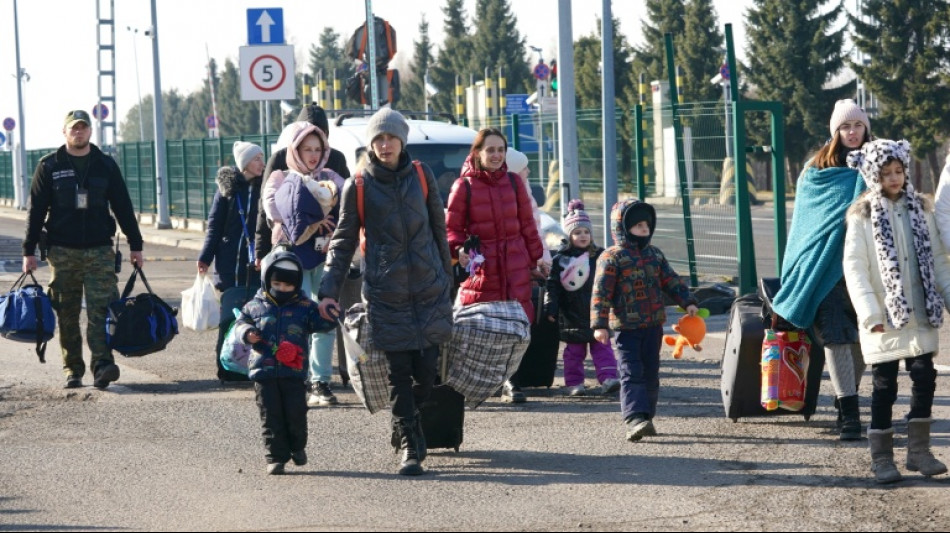
Financial strain forcing Ukrainians to return home despite risk: Red Cross / Photo: © AFP

Three years into Russia's full-scale invasion of Ukraine, many who fled the conflict are returning home due to financial hardship in their host countries, the Red Cross said Friday.
Declining international support is driving many refugees into "severe hardship", warned the International Federation of Red Cross and Red Crescent Societies (IFRC).
"The latest data shows that financial hardship and gaps in healthcare access are pushing many refugees to return home, not by choice, but by necessity," it said.
In a report, the IFRC painted a stark picture of people pushed to their limits, both inside and outside Ukraine.
"People are reaching a tipping point, between the hardship of displacement and the uncertainty of returning to potentially dangerous areas," Birgitte Bischoff Ebbesen, IFRC's regional director for Europe, said in a statement.
"Whether they stay or go, their needs are growing and require sustained support."
The analysis examined IFRC and secondary source data and surveys regarding 3,200 refugee households across six European countries and 2,200 households whose members had returned to Ukraine.
The report determined that just over half of refugees returning to Ukraine said they were drawn by family and emotional ties.
It also highlighted a number of push factors.
A full 42 percent said they went back for employment; 13 percent said they were seeking medical services, while 10 percent were seeking education and nine percent cited "financial strains abroad", the report found.
- Growing vulnerability -
This is a sign that for those abroad, the support systems set up as refugees began flooding out of Ukraine after Russia launched its full-scale invasion in February 2022 have weakened, even as the cost of living has continued to rise, the IFRC said.
"We have seen governments (apply) the temporary protection directive in a more restricted way, which does lead to new levels of vulnerability," Madeleine Lyons, one of the report's authors, told AFP.
"We have been watching vulnerability creeping up over the past three years," she said, pointing in particular to how many elderly refugees are facing swelling debt levels.
The report found that one in three refugees were currently in debt, with 12 percent facing crippling debt that they are unable to pay back.
"Household debt is an indicator of vulnerability," she said, also pointing to large numbers of elderly well past retirement age "looking for employment... to supplement their income because of the heightened cost of living across Europe".
The fact that refugees were deciding to return to Ukraine to seek vital healthcare was also a troubling sign.
And for those who return, "the humanitarian needs are significant, ranging from food and necessities to assistance finding employment", Ebbesen said.
The report found that 23 percent of those who returned to Ukraine had to reduce their food consumption due to financial constraints.
Most surprising perhaps was that more than a quarter of those returning were settling in areas near the frontlines, despite security concerns.
And 79 percent of returnees to such areas reported "urgent unmet humanitarian needs", the report found.
With millions of Ukrainians facing worsening conditions both at home and abroad, the IFRC said it was urging governments and other donors to provide more support.
"Without urgent funding and policy action, we are pushing people into an impossible choice: poverty abroad or insecure conditions at home," Ebbesen said.
"We must do better."
M.Zhou--ThChM