Iran to face censure amid stalled nuclear talks / Photo: © AFP/File

Major European countries and the United States are expected to seek to censure Iran when the UN atomic watchdog meets this week amid stalled talks to revive the 2015 nuclear deal.
The resolution drafted by the United States, Britain, France and Germany is a sign of their growing impatience as diplomats warn the window to save the landmark deal is closing.
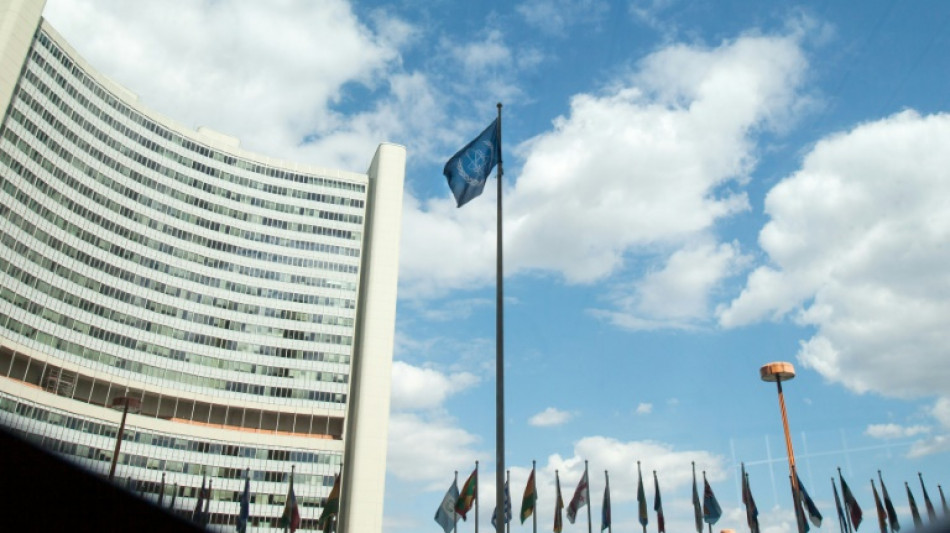
The International Atomic Energy Agency's Board of Governors meets Monday through Friday in Vienna.
If the resolution urging Iran to "cooperate fully" with the IAEA is adopted, it will be the first motion censuring Iran since June 2020.
Talks to revive the accord started in April 2021 with the aim to bring the United States back into the deal and lift sanctions again and get Iran to scale back its stepped-up nuclear programme.
The 2015 landmark deal -- promising Tehran sanctions relief in exchange for curbs in its nuclear programme -- started to fall apart in 2018 when then president Donald Trump withdrew from it.
Talks to revive the agreement have stalled in recent months.
The coordinator of the talks, the EU's top diplomat Josep Borrell, warned in a tweet this weekend that the possibility of returning to the accord was "shrinking".
"But we still can do it with an extra effort," he said.
- 'Send a message' -
In a report late last month, the IAEA said it still had questions that were "not clarified" regarding traces of enriched uranium previously found at three sites which had not been declared by Iran as having hosted nuclear activities.
Iran has warned "any political action" by the United States and the so-called E3 group of France, Germany and the UK would "provoke without any doubt a proportional, effective and immediate response".
"There is no excuse for Iran's continued failure to provide meaningful cooperation with the agency's investigation," Kelsey Davenport, an expert with the Arms Control Association, told AFP.
"A resolution censuring Iran is necessary to send a message that there are consequences for stonewalling the agency and failing to meet safeguards obligations," she said.
China and Russia, which are also parties to the Iran nuclear deal -- together with Britain, France and Germany -- have warned that any resolution could disrupt the negotiation process.
Russia's ambassador to the UN in Vienna, Mikhail Ulyanov, in a tweet called on the EU to "undertake extra diplomatic efforts".
- In shadow of Ukraine -
But even if the climate is tense, negotiations are unlikely to fall apart, according to Clement Therme, associate researcher at the Rasanah International Institute for Iranian Studies.
"Given the war in Ukraine, the Europeans are not ready to trigger a new crisis with Iran when they are already dealing with a crisis with Russia" which invaded its neighbour in February, he said.
The expert suggested that the resolution would be worded "in a way that does not close the door to further negotiations".
A key sticking point is Tehran's demand for Washington to remove the Islamic Revolutionary Guard Corps, the ideological arm of Iran's military, from the official US list of terror groups.
US President Joe Biden's administration has refused to do so ahead of tough November midterm elections.
"The political cost Biden will pay for lifting sanctions on the IRGC is high, but it pales in comparison to the threat of a nuclear-armed Iran," Davenport said.
She said Biden's administration "should double down on other creative proposals to get negotiations back on track".
According to the latest IAEA report, the Islamic republic now has 43.1 kilograms (95 pounds) of 60-percent-enriched uranium.
If enriched to 90 percent, this could be used to make a bomb in under 10 days, Davenport warned in a report last week.
"Weaponising would still take one to two years, but that process would be more difficult to detect and disrupt once Iran moved the weapons-grade uranium from its declared enrichment facilities," Davenport said.
Iran has always denied wanting to develop a nuclear weapon.
D.Pan--ThChM