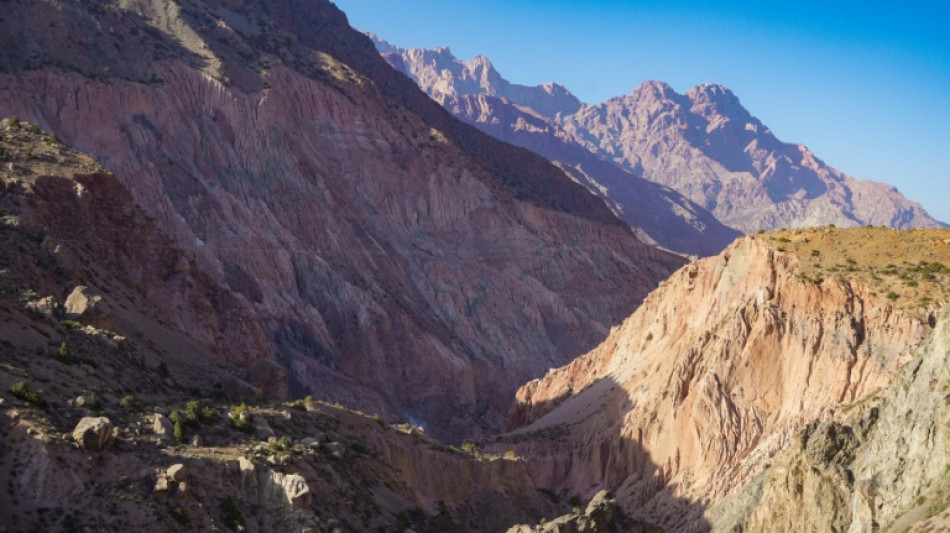
Race for rare minerals brings boom to Tajikistan's mines / Photo: © AFP

In a labyrinth of tunnels running beneath 4,000-metre peaks, Tajik miners are scrabbling to secure antimony, one of the metals at the centre of a worldwide race for rare minerals.
The silver grey element, once best known as an ingredient in cosmetics, is a key resource in strategic industries -- powering the clean energy transition and toughening military equipment.
In Saritag, in the steep valleys of western Tajikistan, the 1,500 employees of mining firm Talco Gold scour some 50 kilometres (30 miles) of underground galleries.
Where once Tajiks sought gold, now they are branching out.
"We are conducting drilling operations to determine what underground mineral resources are present," explained miner Imomkhasan Yorov, guiding AFP on a rare visit to the huge, remote site.
The miners drill sample holes 50 metres (165 feet) long to check for minerals and can dig a 54-metre tunnel for extraction in half a day, said underground site manager Kholmakhmad Khakimzoda.
Once extracted, the antimony will find its way into the batteries and solar panels of the renewable energy industry or reinforce the armour protecting military vehicles on future battlefields.
It is just one of the metals and rare earths that have triggered a rush of interest in mineral deposits across Central Asia, from the mountains of Kyrgyzstan to the deserts of Uzbekistan and Turkmenistan.
China -- which operates the Saritag mine jointly with a Tajik enterprise -- is dominant in the sector but Russia, the European Union, the United States and the Gulf are all scrambling to secure a share.
- Critical and rare -
"There are many antimony deposits in Tajikistan," said Murad Dzhumazoda, deputy director of Talco Gold, which produces 10 percent of global supply.
According to the United States Geological Survey (USGS), China represents nearly half of the world's antimony production, followed by Tajikistan with a quarter -- around 21,000 tonnes in 2023.
Antimony can be found both in open cast quarries and through deep mining in tunnels, Dzhumazoda explained, speaking over the clatter of new vehicles and rock-crushing equipment from Chinese, Finnish and Swedish manufacturers.
Concerned that allowing rivals such as Beijing to control the mineral supply chain could threaten its economic sovereignty, the European Union is monitoring 34 elements designated "critical raw materials".
Antimony is on the list, along with rare earths, natural rubber and several hard-to-find metals.
Each has irreplaceable characteristics in strategic sectors of the economy, with supply chains controlled by a limited number of actors.
According to the European Commission, 54 percent of the EU's antimony imports come from Tajikistan.
Its price hit a record high last year when China introduced export restrictions.
Tajikistan is banking on the new minerals rush to fund an industrialisation drive.
Wracked by civil wars in the 1990s, it still has one of the weakest economies across the former Soviet Union.
Portraits of veteran national leader Emomali Rakhmon, in power since 1992, loom over the Talco miners, along with extracts of his speeches.
"Significant reserves of raw materials ensure accelerated industrialisation," one of them reads.
- China, the essential partner -
Before being exported, the ore extracted at Talco is crushed at an enrichment plant, where "5,000 tonnes are processed daily, ground in two immense drums", said manager Fayzullo Safarov.
The metal is separated from the ore using chemical reagents in a flotation tank. Then the concentrate is filtered and dried in sedimentation basins.
The resulting sand is then bagged as 30-percent pure antimony.
It is a complex process on an ambitious scale, made possible by a huge Chinese investment in 2022.
Next up is the construction of an antimony purification plant, further concentrating control over the production chain.
The site is a Soviet-era mine, built by Moscow.
Mosaics glorifying antimony extraction and a faded portrait of Soviet revolutionary leader Vladimir Lenin are visible in the rock.
But China has gradually replaced Russian influence and is now the dominant mining power in Central Asia.
And it is China's Xi Jinping who appears next to Tajikistan's president on a billboard-sized poster, celebrating the "golden key of Tajikistan-China friendship".
K.Leung--ThChM