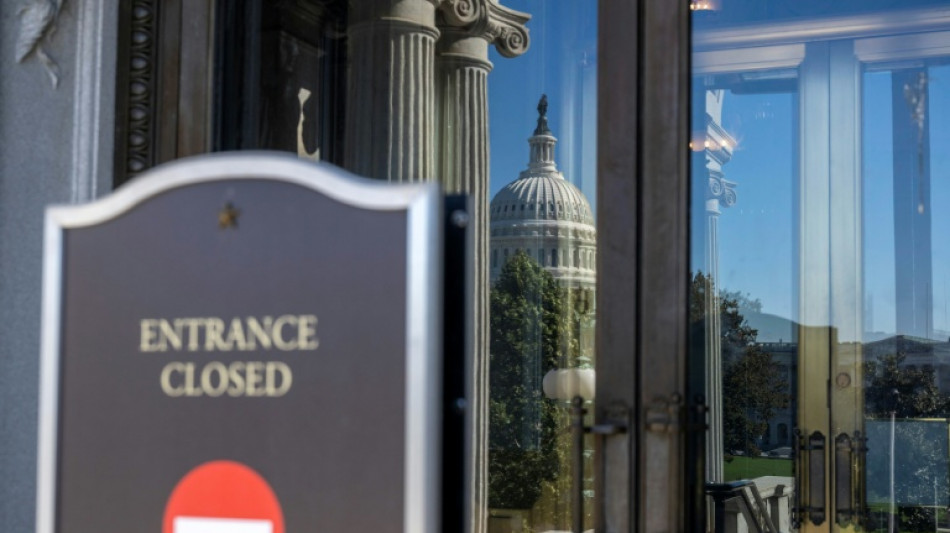
US economy in the dark as government shutdown cuts off crucial data / Photo: © AFP/File

US policymakers, financial institutions and business owners have been flying blind for almost a month as a government shutdown has stopped the release of crucial federal economic data ranging from the size of the labor force to the country's GDP.
The void is set to deepen by Thursday as Washington holds off publishing gross domestic product (GDP) numbers measuring the growth of the world's biggest economy in the July to September period.
The United States has already delayed reports on employment, trade, retail sales and others, only recalling some furloughed staff to produce key inflation figures needed for the government to calculate Social Security payments.
Congressional Republicans and Democrats remain at an impasse, each assigning blame to the other side over the shutdown with no quick end in sight and food aid for millions now at stake.
Analysts warn the growing information blackout could, in turn, cause businesses to lower hiring and investment.
"There's a huge demand right now for government data," said Heather Long, chief economist at Navy Federal Credit Union. "Every industry is trying to figure out if the Federal Reserve is going to keep cutting interest rates."
The central bank's decisions hinge upon the economy's health, particularly inflation and the weakening jobs market.
"This is the time of year where most organizations are finalizing their budgets for 2026," Long told AFP.
"So, almost any company is sitting there thinking: Do we think 2026 is going to be an uptick? Or a slowdown, or a recession?"
The nonpartisan Congressional Budget Office estimates the shutdown could cost the economy up to $14 billion.
Economist Matthew Martin of Oxford Economics expects firms to proceed cautiously, with President Donald Trump's tariffs already sending uncertainty surging this year.
"Businesses would therefore reduce their overall hiring to be on the safe side of things, until they see data that really points towards increased demand, or at least stabilization in the economy," he told AFP.
Similarly, those in the financial markets need data to make investments and decide their moves in equities, he said.
- 'Tainted data' -
Should the shutdown last through mid-November, as prediction markets expect, most delayed data releases will likely not come out until December, Goldman Sachs said in a note this week.
"The risk would grow that delays could distort not just the October but the November data too," the report added.
Long said that October's data could even be lost if the shutdown drags on for too long, "because the data was not collected."
Government workers could ask people to recount economic conditions once the shutdown ends, but this proves tricky if the delay is too long, she said.
The risk is no data or "tainted data" if memories are seen as less reliable over time, she added.
While economists, policymakers and business leaders have been relying on private sector data, analysts stress that these cannot replace numbers produced by the US government, which are viewed as the gold standard.
"We have a remarkable amount of uncertainty about just literally what's happening with labor supply, like how many people are in the United States and want jobs," said Brookings Institution senior fellow Wendy Edelberg.
She added that there is significant disagreement about how many people have left the country since the start of 2025.
Wells Fargo senior economist Sarah House said despite strong GDP growth recently, there are many "signs of strain underneath the surface," alongside signals that "not every component or group in the economy is doing equally well."
She cautioned that the shutdown is unhelpful for the economy: "If you're not sure when your next paycheck is coming as a government worker, you're not going to be going out to eat for dinner."
"You're maybe pushing off a trip, or just not buying little discretionary things."
T.Luo--ThChM