Trump's order on nuclear testing: what we know / Photo: © US AIR FORCE/AFP

President Donald Trump has ignited a firestorm of controversy and confusion with his announcement that the United States will begin nuclear weapons testing.
It's unclear whether he was referring to testing weapons systems -- which the United States already does -- or actually conducting nuclear explosions, which only US arch-foe North Korea has carried out in the 21st century.
Below, AFP examines what Trump has said, the state of current US testing, and what it would take to resume explosive tests.
- What Trump said -
Trump said in a social media post that he had instructed the Defense Department "to start testing our Nuclear Weapons on an equal basis" with Russia and China.
However, neither of those countries are confirmed to have carried out recent explosive testing, and it is the Department of Energy that is responsible for the US nuclear stockpile.
The president subsequently told journalists on Air Force One that "they seem to all be doing nuclear testing," and that "we halted it many years ago but with others doing testing I think it is appropriate we do also."
He offered no details on the nature of the testing he had ordered.
- Current US testing -
The United States conducted the world's first nuclear test in July 1945 and used two nuclear weapons against Japan near the end of WWII.
It has carried out more than 1,000 explosive nuclear tests in total -- most recently in 1992 with a 20-kiloton underground detonation at the Nevada Nuclear Security Site.
That year, Congress passed a temporary moratorium on underground nuclear tests unless a foreign state conducted one, which has since occurred. Washington had already agreed not to conduct tests in the atmosphere, outer space and underwater as part of the Limited Test Ban Treaty, which it has been a party to since 1963.
The United States has also been a signatory since 1996 to the Comprehensive Nuclear-Test-Ban Treaty, which bans all atomic test explosions, but the Senate has yet to ratify it.
In the absence of explosive testing, the United States ensures its arsenal's reliability through the so-called Stockpile Stewardship Program, which includes "a wide range of scientific activities, from modeling and simulation to subcritical nuclear experiments," according to the US National Nuclear Security Administration.
"This program allows us to assess and certify the stockpile with extraordinary confidence," it says.
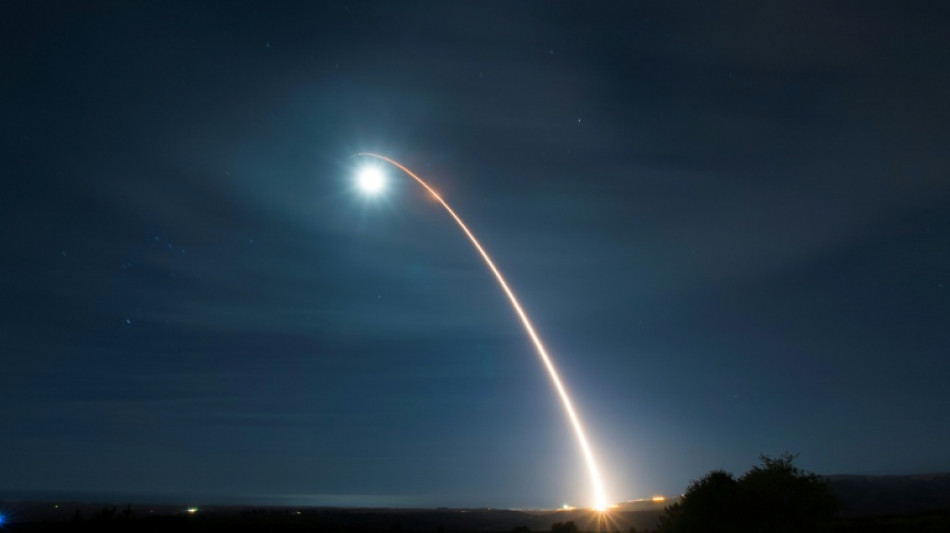
Washington also periodically tests its nuclear delivery systems such as intercontinental ballistic missiles.
The US military launched an unarmed Minuteman III missile earlier this year, with the Space Force saying at the time that the United States had carried out more than 300 similar tests overall.
- Resuming explosive testing -
The president has the authority to authorize explosive tests, and Washington's forces have "the capability to resume testing within 24-36 months of a presidential decision to do so," the US Congressional Research Service says.
It notes that a 2012 study found that "the response time for resuming underground explosive testing is driven more by compliance with environmental, health, and safety regulations than by the technical testing requirements or the need to restore equipment and facilities."
Doreen Horschig, a fellow with the Project on Nuclear Issues at the Center for Strategic and International Studies, said the US National Nuclear Security Administration would be able to "get the test site ready within six to 10 months for a very basic underground test."
"The timeframe is much longer if you want to test new warheads and new capabilities," Horschig said.
But she also noted that there is likely to be political opposition to a resumption of testing "from both sides of the political camps" in the United States, while "our allies (also) do not see a need for (a) return to testing."
D.Peng--ThChM