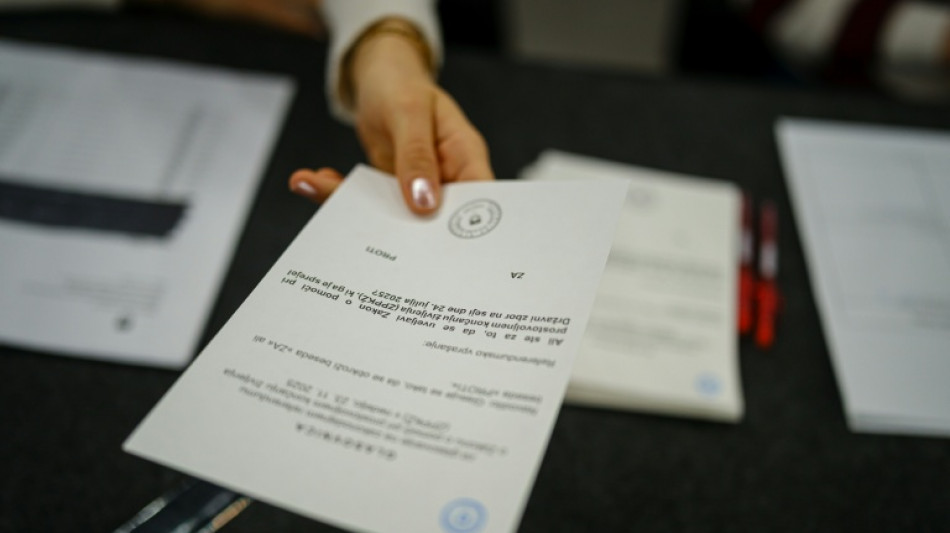
Slovenia holds crunch vote on contested assisted dying law / Photo: © AFP

Slovenians began voting Sunday in a new referendum that will determine if a law legalising assisted dying will be enforced or suspended, after critics mounted a campaign against the legislation.
Several European countries, including Austria, Belgium, the Netherlands and Switzerland allow terminally ill people to receive medical help to end their lives.
Slovenia's parliament approved a law in July allowing assisted dying after a 2024 referendum supported it.
But a new vote was called after a civil group, backed by the Catholic Church and the conservative parliamentary opposition, gathered 46,000 signatures in favour of a repeat, exceeding the 40,000 required.
The law will come into force unless a majority of participants, representing at least 20 percent of the 1.7 million eligible voters, rejects it.
Polls opened at 7:00 am (0600 GMT) and will close 12 hours later, with first partial results expected late Sunday.
- 'Culture of death' -
At the Stozice sports hall, the largest polling station in Ljubljana, 63-year-old pensioner Romana Hocevar said she would vote in favour of assisted dying.
"I'm a stage four cancer patient, I would not like to suffer. Had my father die of cancer and mother suffering dementia and I know what it looks like."
Vid Ursic, a 24-year-old student, said it was "good that we get to vote on relevant issues" and added that he supported "the right for people to decide on their own lives".
But Marija Unuk, in her late fifties, said she had voted against the law "because I support the culture of life, not the culture of death".
Under the disputed law, which was to take effect this year, lucid, terminally ill patients would have the right to aid in dying if their suffering is unbearable and all treatment options have been exhausted.
It also allows for assisted dying if treatment offers no reasonable prospect of recovery or improvement in the patient's condition, but not to end unbearable suffering from mental illness.
Prime Minister Robert Golob, who voted in advance, has urged citizens to back the law "so that each of us can decide for ourselves how and with what dignity we will end our lives".
The group opposing the law, called Voice for the Children and the Family, has accused the government of using the law to "poison" ill and elderly people.
- 'Human dignity' -
The Catholic Church has said allowing assisted dying "contradicts the foundations of the Gospel, natural law and human dignity".
Some 54 percent of citizens back the legalisation of assisted dying, almost 31 percent oppose it and 15 percent are undecided, according to a poll published this week by the Dnevnik daily, based on 700 responses.
In June 2024, 55 percent backed the law.
If a majority of voters oppose the new law on Sunday, parliament cannot vote again on a bill that deals with the same issue over the next 12 months.
While several European countries already allow terminally ill people to receive medical help to end their lives, in others it remains a crime, even in cases of severe suffering.
In May, France's lower house of parliament approved a right-to-die bill in a first reading. The British parliament is debating similar legislation.
F.Brown--ThChM