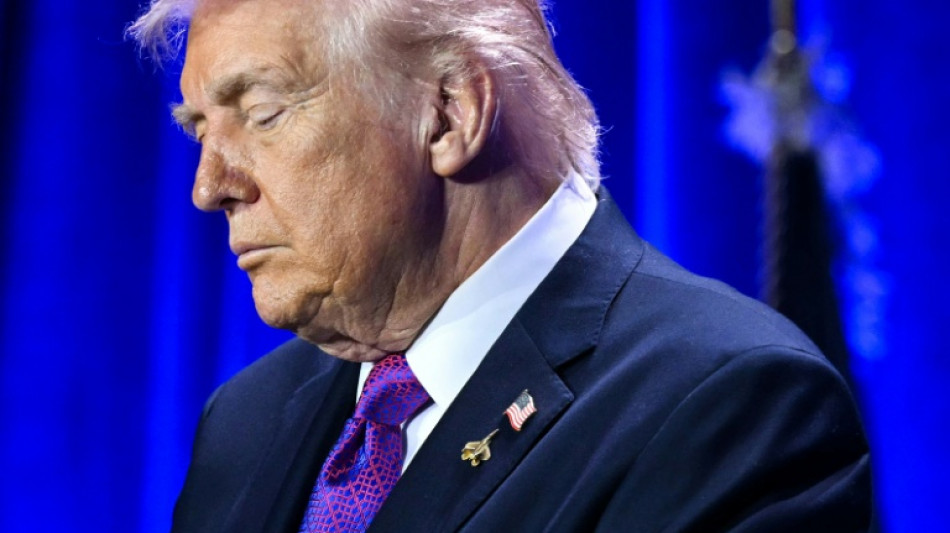
Trump urges new nuclear treaty after Russia agreement ends / Photo: © AFP

US President Donald Trump on Thursday called for a brand new nuclear treaty after the last agreement with Russia expired, prompting fears of a new global arms race.
The Trump administration has repeatedly pressed for a new treaty to include China, whose arsenal is growing but still significantly smaller than those of Russia and the United States, but Beijing has publicly rejected the pressure.
Trump had been mostly mum on Russian calls to extend New START, the 2010 treaty that imposed the last restrictions on the two largest nuclear powers after decades of agreements dating from the Cold War.
But hours after it expired, Trump said that the treaty, signed by predecessor Barack Obama and extended by Joe Biden, was "badly negotiated" and "is being grossly violated."
"We should have our Nuclear Experts work on a new, improved, and modernized Treaty that can last long into the future," he wrote on his Truth Social platform.
Asked if Washington and Moscow had agreed to stick to the terms of the expired START treaty while negotiations on a new accord are ongoing, White House spokesperson Karoline Leavitt said: "Not to my knowledge."
Russia had refused inspections under New START as relations deteriorated with the Biden administration.
It said Wednesday that it no longer considered itself bound on the number of nuclear warheads due to the expiration of New START.
Despite the stalemate on New START, Trump has enthusiastically restarted diplomacy with Russia and invited President Vladimir Putin to Alaska last August.
The United States announced Thursday that it was resuming military dialogue with Russia after three-way talks in Abu Dhabi on the Ukraine war.
- 'Unconstrained nuclear competition' -
Campaigners have warned that the end of the New START treaty could trigger a global arms race, and urged nuclear powers to enter negotiations.
A group of former senior arms control officials from around the world, in a joint statement Thursday, called on the United States and Russia to agree to keep observing New START's limits as a first step.
The end of New START "will reduce nuclear stability and predictability, threaten global security, and increase the risk of a new era of unconstrained nuclear competition," they wrote.
UN Secretary-General Antonio Guterres said the nuclear treaties between the United States and Russia after more than half a century were at a "grave moment."
"This dissolution of decades of achievement could not come at a worse time -- the risk of a nuclear weapon being used is the highest in decades," Guterres said, after Russian suggestions of using tactical nuclear weapons early in the Ukraine war.
A NATO official, speaking on condition of anonymity, called for "restraint and responsibility" and said that the US-led military alliance "will continue to take steps necessary" to ensure its defense.
The official condemned "Russia's irresponsible nuclear rhetoric."
- China rejects pressure -
On Wednesday, US Secretary of State Marco Rubio said that arms control was "impossible" without including China.
China's foreign ministry expressed regret Thursday over New START's demise but said Beijing "will not participate in nuclear disarmament negotiations at this stage."
"China's nuclear capabilities are of a totally different scale as those of the United States and Russia," foreign ministry spokesman Lin Jian told a news conference.
Russia and the United States together control more than 80 percent of the world's nuclear warheads.
China's nuclear arsenal is growing faster than any country's, by about 100 new warheads a year since 2023, according to the Stockholm International Peace Research Institute.
China is estimated to have at least 600 nuclear warheads, the institute says -- well below the 800 each at which Russia and the United States were capped under New START.
France and Britain, treaty-bound US allies, together have another 100.
Daryl Kimball, executive director of the Arms Control Association, which warns of nuclear risks, agreed that China should engage.
But "there is no indication that Trump or his team have taken the time to propose risk reduction or arms control talks with China since returning to office in 2025," Kimball said.
N.Lo--ThChM