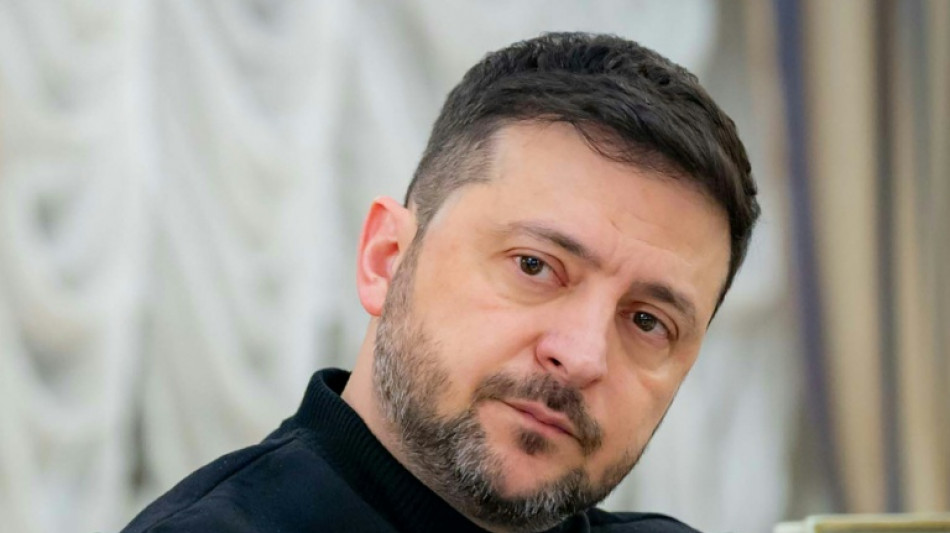
The obstacles to holding war-time elections in Ukraine / Photo: © UKRAINIAN PRESIDENTIAL PRESS SERVICE/AFP/File

Throughout Russia's four-year invasion of Ukraine, the Kremlin -- and more recently the White House -- have said Ukraine must hold elections as part of any peace deal.
Citing anonymous sources, the Financial Times reported Wednesday that Kyiv was mulling the possibility of staging a presidential election within the next three months.
Here AFP looks at the obstacles that would need to be cleared for Ukraine to hold a war-time vote.
- Martial law -
Ukraine imposed martial law when Russian forces swept over the border in February 2022, and military rule prohibits elections from being held.
President Volodymyr Zelensky has repeatedly said Ukraine can hold elections after a peace deal with Russia is signed, and has recently signalled willingness for a speedy vote as part of a US plan to end the war.
Kyiv last year launched a working group of politicians and military official to look at how elections could be held after martial law is lifted.
"I do not want Ukraine to be in any kind of weak position -- for anyone to be able to use the absence of elections as an argument against Ukraine," Zelensky told reporters -- including from AFP -- in December.
"And that is why I am definitely in favour of holding elections," he added.
He has also said any deal that involves ceding territory to Moscow should be put to a referendum.
A senior lawmaker from Zelensky's party told AFP on Wednesday that despite the moves, the political consensus in Ukraine was that "neither a referendum nor elections can be held under martial law."
- Voting under attack -
Ukrainian officials routinely cite the ongoing fighting as a huge hurdle to holding any vote.
Towns and cities near the sprawling front line are bombed daily by Russian forces, killing civilians.
Millions of Ukrainians have fled abroad since Russia invaded, and millions more are living under Russian occupation.
It is also unclear how hundreds of thousands of soldiers could vote from the front.
"Elections in the occupied territories are completely impossible," said political analyst Volodymyr Fesenko.
"Even after the end of the war, they are impossible," he added, noting that staging a vote in Moscow-held areas would be a contradiction of Ukrainian law.
Only 10 percent of Ukrainians support holding an election before a ceasefire, polling late last year by the Kyiv International Institute of Sociology (KIIS) found.
- What say the US, Russia -
The Kremlin, which set out to topple Zelensky and his government in early 2022, has said that the 48-year-old Ukrainian leader is illegitimate since his five-year term expired in 2024.
Moscow has said it could cease fire during any voting in Ukraine, but only if Ukrainians living in Russia and Russian-controlled areas are allowed to vote.
US President Donald Trump has stipulated that elections be held in Ukraine as part of the deal he is trying to broker.
In December, Trump -- Ukraine's most important but unpredictable ally -- accused Kyiv of leveraging the ongoing fighting to avoid holding a ballot.
- Candidates -
Zelensky is seen by analysts as hopeful for a second term, though last year said he would be ready to step down after a peace deal.
"If we finish the war with the Russians, yes, I am ready," not to run in the next election, he told the Axios news outlet in a video interview, adding: "It's not my goal, elections."
The Ukrainian leader has seen his approval ratings gradually dip from unprecedented levels at the beginning of the invasion nearly four years ago.
Some 59 percent of Ukrainians said they trusted the 48-year-old former comedian, the late 2025 KIIS poll found.
Though another poll on voting intentions found Zelensky was neck-and-neck with popular ex-army chief Valery Zaluzhny -- who he fired in 2024 -- and could lose to him in the second round.
Zelensky has also faced accusations he and now-dismissed chief aide Andriy Yermak centralised too much power during the war and sidelined opponents, like Zaluzhny, who is now Ukraine's ambassador to Britain.
Fesenko said several others could run, including former President Petro Poroshenko and former Prime Minister Yulia Tymoshenko -- though their chances appear slim -- as well as popular military officials.
B.Chan--ThChM