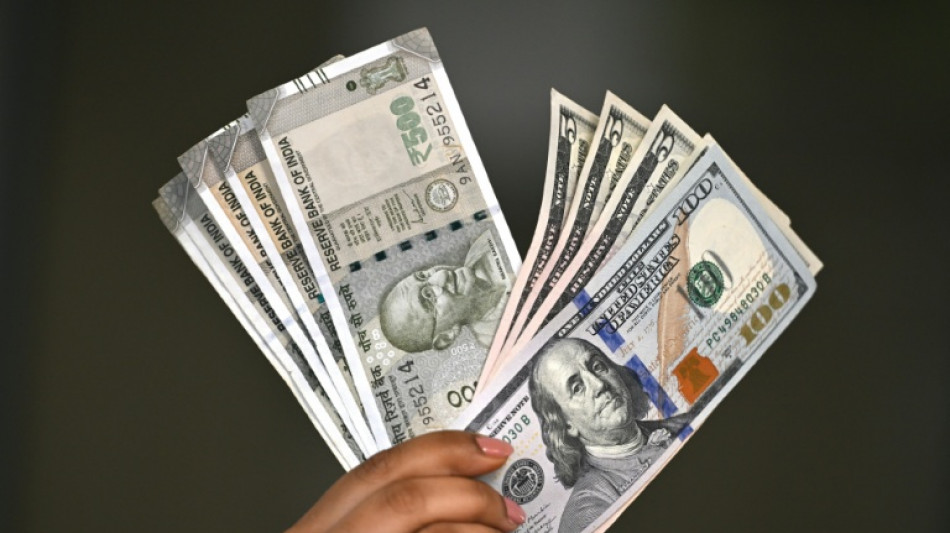
India forced to defend US trade deal as doubts mount / Photo: © AFP/File

India is scrambling to defend a new trade deal with the United States that critics have branded as a surrender to Washington, as countries navigate the fallout from President Donald Trump's sweeping tariffs.
The deal announced this month has rattled India's powerful farmers' unions, who argue that cheap US imports would throttle local producers in a country where agriculture employs more than 700 million people.
Details of the deal remain sparse, limited to a joint statement and a White House factsheet, but New Delhi says an interim pact should be finalised by the end of March.
Analysts warn that other elements of the agreement could also prove volatile.
"In the Trumpian era, there is nothing called certainty," trade expert Abhijit Das told AFP.
Even if the deal is signed in a few weeks, it would only hold until Trump "decides to impose more tariffs for any perceived inconsistency," he said.
The most contentious pledge is India's stated intention to buy $500 billion worth of US goods over five years. India's annual imports from the US last fiscal year were around $45 billion.
Doubling annual purchases to $100 billion "is unrealistic", said Ajay Srivastava of the Global Trade Research Initiative, a New Delhi-based think tank.
- Intention not commitment -
Aircraft purchases were a major component of this commitment but even a major expansion of Boeing aircraft orders -- decisions made by private airlines -- would fall far short, he said.
"Even if India were to add another 200 Boeing aircraft over the next five years, at an estimated cost of $300 million per aircraft, the total value would be about $60 billion."
Some economists argue the language around purchases is non‑binding, hence it protects New Delhi if it fails to meet the goal.
"Framing the target as an intention, rather than a commitment, reduces the risk of the deal later breaking down," Shivaan Tandon of Capital Economics said in a note on Friday.
Trump's unpredictability also continues to loom large.
He recently threatened higher tariffs on South Korea over perceived delays by Seoul in implementing a trade agreement announced last July.
Another flashpoint is Washington's rollback of a 25 percent duty after what it described as India's "commitment" to stop buying Russian oil.
This promise finds no mention in the joint statement and has neither been confirmed nor denied by the Indian government.
India says its energy policy is driven by national interests and that the country depends on multiple sources for crude oil imports.
- 'Oil plank' -
New Delhi's Russian oil imports have dropped from a mid‑2025 peak of more than two million barrels a day to about 1.1 million in January.
Local reports say state-owned refiners have already started purchasing Venezuelan oil for delivery in April.
But it remains unclear if Russian purchases will fall to zero.
The outlook hinges heavily on Mumbai-headquartered Nayara Energy, partly owned by Russia's Rosneft, which Bloomberg reported plans to keep buying around 400,000 barrels a day.
This will likely remain a bone of contention, given the Trump administration's stance that it intends to monitor India's imports.
"New Delhi continues to avoid publicly confirming a full halt and frames energy sourcing as driven by price and availability, which underlines ongoing ambiguity over the oil plank," Darren Tay of BMI, a unit of Fitch Solutions, told AFP.
"There is tentative evidence that Indian refiners are reducing spot purchases of Russian crude, implying partial adjustment rather than a formal pledge," Tay said.
The deal remains "too fragile and politically contested" to justify a growth forecast change for India, he added.
O.Tse--ThChM