The China Mail - Top WTO official sounds fertiliser warning over Middle East war

USD -
AED 3.673042
AFN 64.000368
ALL 80.559269
AMD 363.520403
ANG 1.790365
AOA 918.000367
ARS 1529.000104
AUD 1.421904
AWG 1.8
AZN 1.70397
BAM 1.714464
BBD 2.012413
BDT 122.948664
BGN 1.683441
BHD 0.377041
BIF 2997
BMD 1
BND 1.276562
BOB 12.244898
BRL 5.188104
BSD 0.999106
BTN 95.679045
BWP 13.604786
BYN 3.018795
BYR 19600
BZD 2.00952
CAD 1.41465
CDF 2340.000362
CHF 0.828114
CLF 0.024357
CLP 961.770396
CNY 6.71325
CNH 6.72581
COP 3304.74
CRC 454.274493
CUC 1
CUP 23.978646
CVE 97.12504
CZK 21.384404
DJF 177.720393
DKK 6.562804
DOP 59.503884
DZD 133.78604
EGP 51.914688
ERN 15
ETB 162.087103
EUR 0.87791
FJD 2.24725
FKP 0.756753
GBP 0.754546
GEL 2.61504
GGP 0.756753
GHS 11.604951
GIP 0.756753
GMD 73.503851
GNF 8787.432499
GTQ 7.630269
GYD 209.052178
HKD 7.84345
HNL 26.817273
HRK 6.613804
HTG 130.75952
HUF 320.61504
IDR 17914.1
ILS 3.04806
IMP 0.756753
INR 95.81765
IQD 1308.910162
IRR 1374575.000352
ISK 120.260386
JEP 0.756753
JMD 158.069366
JOD 0.70904
JPY 157.27504
KES 129.540385
KGS 87.448204
KHR 4063.223227
KMF 433.00035
KPW 900.000318
KRW 1354.750383
KWD 0.30864
KYD 0.832592
KZT 442.57352
LAK 22411.284101
LBP 89473.841083
LKR 329.886786
LRD 171.856371
LSL 16.301459
LTL 2.95274
LVL 0.60489
LYD 6.387819
MAD 9.588067
MDL 17.734435
MGA 4411.249036
MKD 53.977298
MMK 2099.49869
MNT 3598.832458
MOP 8.072056
MRU 40.194433
MUR 47.530378
MVR 15.450378
MWK 1732.502279
MXN 17.68405
MYR 4.074104
MZN 63.910377
NAD 16.301459
NGN 1326.380377
NIO 36.766253
NOK 9.50785
NPR 153.086647
NZD 1.765537
OMR 0.385672
PAB 0.999106
PEN 3.391893
PGK 4.451574
PHP 62.347038
PKR 276.855854
PLN 3.83775
PYG 5889.262922
QAR 3.641998
RON 4.629204
RSD 102.866038
RUB 84.387414
RWF 1476.627731
SAR 3.749807
SBD 8.000512
SCR 13.906325
SDG 601.503676
SEK 9.91775
SGD 1.278038
SHP 0.755002
SLE 24.650371
SLL 20969.491881
SOS 571.04285
SRD 37.667504
STD 20697.981008
STN 21.477663
SVC 8.742724
SYP 13002.000254
SZL 16.297602
THB 33.375038
TJS 9.217161
TMT 3.51
TND 2.957752
TOP 2.40776
TRY 48.942504
TTD 6.795708
TWD 31.728704
TZS 2644.998038
UAH 44.740953
UGX 3913.317904
UYU 40.026123
UZS 11824.624919
VES 852.43145
VND 25976
VUV 118.506411
WST 2.765483
XAF 575.871484
XAG 0.015553
XAU 0.000233347179
XCD 2.70255
XCG 1.8005
XDR 0.707052
XOF 575.871484
XPF 104.548005
YER 236.650363
ZAR 16.29284
ZMK 9001.203584
ZMW 19.490322
ZWL 321.999592
SSP 5712.5919
MXV 2.003989
  • RELX

    0.0100

    33.52

    +0.03%

  • NGG

    0.2600

    75.49

    +0.34%

  • BCE

    -0.3300

    20.97

    -1.57%

  • RBGPF

    -0.5900

    65.4

    -0.9%

  • BCC

    1.0400

    77.14

    +1.35%

  • RIO

    0.0900

    94.56

    +0.1%

  • CMSC

    -0.1100

    20.4

    -0.54%

  • JRI

    -0.1500

    11.02

    -1.36%

  • CMSD

    -0.0700

    20.3

    -0.34%

  • RYCEF

    -0.3600

    19.31

    -1.86%

  • AZN

    2.0200

    166.58

    +1.21%

  • VOD

    0.1300

    16.62

    +0.78%

  • GSK

    -0.4100

    49.24

    -0.83%

  • BP

    -0.2600

    44.15

    -0.59%

  • BTI

    -0.3900

    55.63

    -0.7%

Top WTO official sounds fertiliser warning over Middle East war
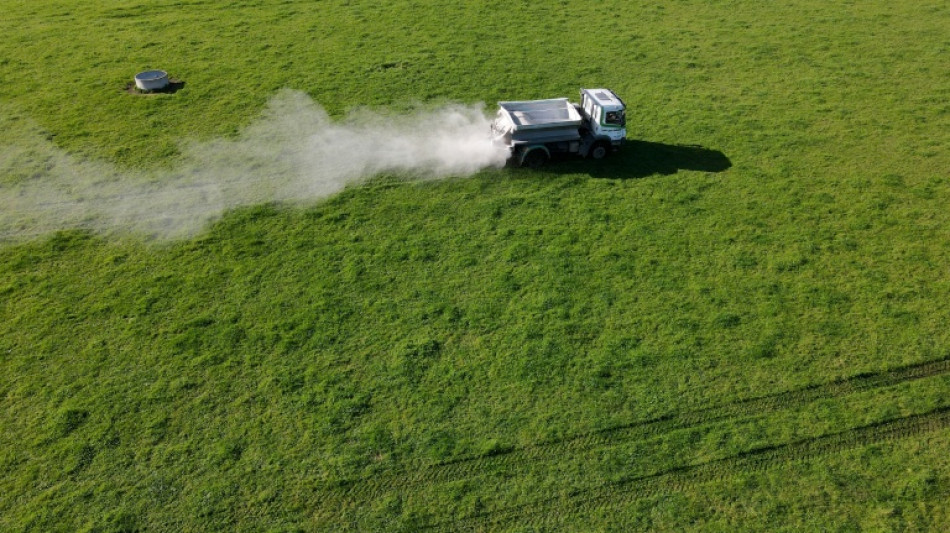
Top WTO official sounds fertiliser warning over Middle East war / Photo: © AFP

Top WTO official sounds fertiliser warning over Middle East war

Disruptions to fertiliser supplies caused by the Middle East war pose a double threat to global food security through scarcity and high prices, a top World Trade Organization official has warned.

Text size:

Iran has virtually shut the Strait of Hormuz, choking a vital transit route for oil and gas -- as well as fertilisers.

A third of the world's fertilisers normally transit the strait, and the disruption has prompted multiple warnings about the impact on food production.

"Fertilisers are the number one issue of concern today. If there is no more fertiliser, there is an impact on quantities but also on prices," WTO Deputy Director-General Jean-Marie Paugam told AFP in an interview in Yaounde.

"The effect compounds the following year: harvests shrink and prices rise."

The Gulf's ample supplies of natural gas, a key ingredient in artificial fertilisers, have made the region a major manufacturer.

But production has been severely impeded by the war, with some major facilities forced to shut down.

Major food exporters such as India, Thailand and Brazil depend on the Gulf for urea, a nitrogen-based fertiliser, making them vulnerable.

Because the war is only a few weeks old, there is currently no fertiliser shortage, Paugam said.

"But if fertilisers from the Gulf do not circulate, we will feel a direct impact on supplies to major producer countries just as planting seasons begin for the crops that will be harvested next year," he said.

"If the Strait of Hormuz is blocked for three months, the impact will be significant."

- Risk of stockpiling -

Net food-importing countries would be in a very bad position, including "a large part of west Africa and north Africa", Paugam noted.

This effect can be amplified if countries start stockpiling, as happened during disruptions to international trade at the height of the Covid-19 pandemic.

Covid set back the fight against hunger worldwide. Since then, the world returned to its trajectory towards eliminating hunger by 2030, one of the goals adopted by UN member states in 2015.

"But with the risks linked to the war in the Middle East, there is once again a risk of falling off track," Paugam warned.

P.Deng--ThChM