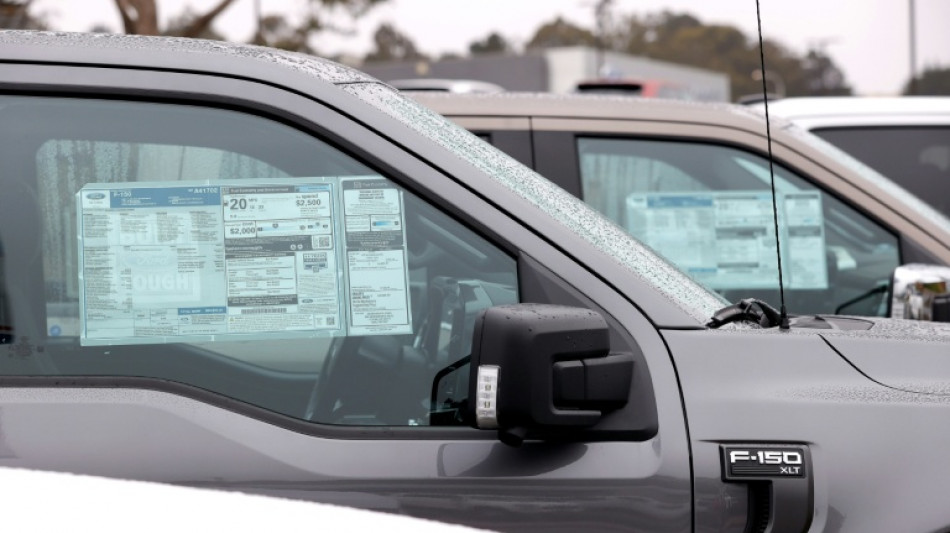
US auto sales seen falling as car market awaits war impact / Photo: © GETTY IMAGES NORTH AMERICA/AFP

Carmakers are expected to report lower first-quarter US sales as the Middle East war clouds the industry's outlook compared with unusually favorable dynamics a year ago.
The US-Israeli offensive on Iran, launched on February 28, has boosted oil prices by more than 50 percent, sending gasoline prices to more than $4 a gallon.
While that adds to the affordability challenges facing the industry, experts and automakers say it is too soon to determine the war's overall impact on sales.
"We're certainly keeping an eye on this situation," Toyota said. "At this stage, however, it's too early to determine how the industry will be impacted."
Cox Automotive forecasts a 0.1 percent dip in Toyota's auto sales in the first quarter.
A bigger factor than the war in the first quarter will be the market dynamics compared with last year, when worries about expected tariffs from President Donald Trump prompted shoppers to rush car purchases.
Cox Automative expects sales drops of more than nine percent for both General Motors and Ford compared with a year earlier, when both automakers reported sizzling sales amid the tariff headlines.
Exactly how the Iran conflict impacts auto sales will depend on the length of the fighting, especially if higher inflation prompts central banks to keep interest rates high, or raise them higher.
"The current Middle East conflict adds tremendous amount of uncertainty to the vehicle market," said Charlie Chesbrough, economist at Cox Automotive.
- Impact on EVs? -
The auto information website Edmunds projects US car sales of 3.7 million in the first quarter, down 6.5 percent from the year-ago period.
"Between severe weather, geopolitical uncertainty, rising gas prices and ongoing affordability challenges, it's no surprise sales are down year over year," Edmunds said.
Deutsche Bank said it did not anticipate an "immediate near-term impact" from the Mideast war on volumes, confirming an outlook of 15.8 million sales for this year, down 2.5 percent from last year.
Analysts that track electric vehicle maker Tesla expect it sold 365,645 units in the first quarter, which would be an increase of 8.6 percent from the 2025 period but a decrease of 12.6 percent from the fourth quarter of 2025.
The outlook for EV sales has been clouded by US President Donald Trump's elimination of tax credits to encourage sales of the climate-friendly autos.
But an extended period of high energy prices due to the Iran war could spark greater interest in EVs.
Searches for EVs on Edmunds accounted for 23.8 percent of customer queries in the week of March 16, up from 20.7 percent at the end of February.
"While higher gas prices can spur interest in electrified vehicles, they typically need to be sustained or more pronounced to drive a meaningful shift," said Jessica Caldwell, head of insights at Edmunds.
"Right now, many consumers appear to view the latest spike as temporary," she said.
Previous oil-price spikes have sent automobile markets into tailspins: Sales dropped 44.7 percent the year after the 1973 oil shock and more than 40 percent after the 1979 Iranian Revolution led to another steep increase in crude prices.
Auto sales also plunged in the year after the 2008 financial crisis, dropping 45.5 percent, and were down 12.7 percent after the 2022 Russian invasion of Ukraine, according to figures from Anderson Economic Group.
But more efficient vehicles in the United States combined with the country's domestic energy production means the "US is now energy sufficient overall," said Patrick Anderson, CEO of the research group.
Z.Huang--ThChM