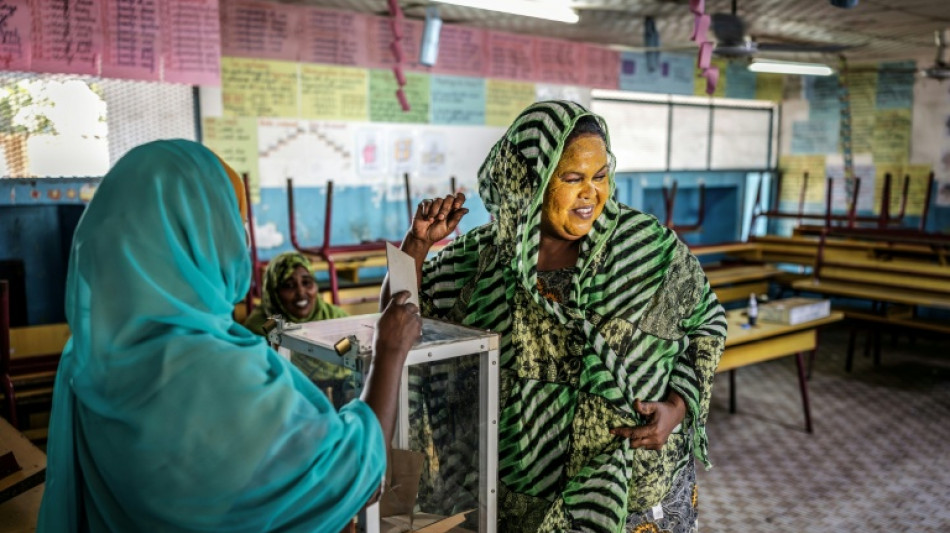
Djibouti counts votes as leader seeks sixth term / Photo: © AFP

Djibouti began counting votes Friday in a presidential election expected to hand a sixth term to 78-year-old Ismail Omar Guelleh, who faces just one little-known opponent in the small but highly strategic Horn of Africa nation.
Guelleh has ruled the east African country of about one million people for 27 years with an iron grip, leveraging its key location to turn it into an international military and maritime hub.
Its mere 23,000 square kilometres (8,900 square miles) host military bases and contingents from France, the United States, China, Japan and Italy, generating substantial financial, security and political benefits.
Guelleh had announced he would step down this year but a constitutional amendment in November removed the upper age limit of 75 for presidential candidates, clearing the way for him to run again.
Catching up after a delayed opening on Friday morning, some polling stations in the capital Djibouti closed around 7:00 pm (1600 GMT), an hour after the official end of voting, AFP journalists saw.
The first official results were expected later in the evening.
"I'm not going to vote, it's pointless. He's been in power for 27 years and the city is dirty," a taxi driver told AFP.
Just over 256,000 people were eligible to choose between Guelleh and Mohamed Farah Samatar, leader of the Unified Democratic Centre (CDU), a party with no seats in parliament.
Amid heavy security, Guelleh, widely known by his initials IOG, voted before noon at City Hall alongside his wife, while Samatar cast his ballot earlier.
"By the grace of God, we have arrived here, and we hope that this will end in victory," Guelleh told reporters.
After trickling in throughout most of the day, voter numbers picked up in the late afternoon at polling stations in the capital, although no queues formed.
Turnout ranged from 36 to 58 percent at several polling stations visited by AFP, but it exceeded 90 percent at one where soldiers were voting.
Guelleh has plastered the capital with campaign posters and drawn thousands to his rallies, while Samatar has struggled to gain support.
The national broadcaster aired one of Samatar's rallies, with only a few dozen people present.
"I'm going to vote for Ismail Omar Guelleh because he has a good programme for young people. I don’t even know what his opponent looks like," Deka Aden Mohamed, 38, told AFP.
- Unemployment and debt -
In the last presidential election in 2021, which the opposition largely boycotted, Guelleh won more than 97 percent of the vote.
He has faced little opposition since succeeding the country's first president, Hassan Gouled Aptidon, in 1999. He had been Aptidon's chief of staff.
In 2005, he was re-elected unopposed.
His candidacy is seen by some as offering "stability" in the troubled Horn of Africa region, but analysts say it is driven by the absence of a unanimously accepted successor. The health of the president has come under scrutiny.
Despite claims by the Djibouti League of Human Rights that the vote is a "masquerade", people told AFP they were eager to vote.
"It's a duty to go vote," said Yussuf Mohamed Hussein. "I'm going to vote for the president; Samatar, I don't even know him."
Around 70 percent of young Djiboutians are unemployed and the country's development has come at the cost of substantial debt, particularly to China.
Djibouti is situated on the key Bab al-Mandeb strait, which divides the Red Sea and the Gulf of Aden and is one of the world's busiest shipping routes.
The nation is accused by human rights organisations of repressing dissent, while Guelleh faces claims of favouring his own majority Issa ethnic group at the expense of the Afar minority.
F.Brown--ThChM