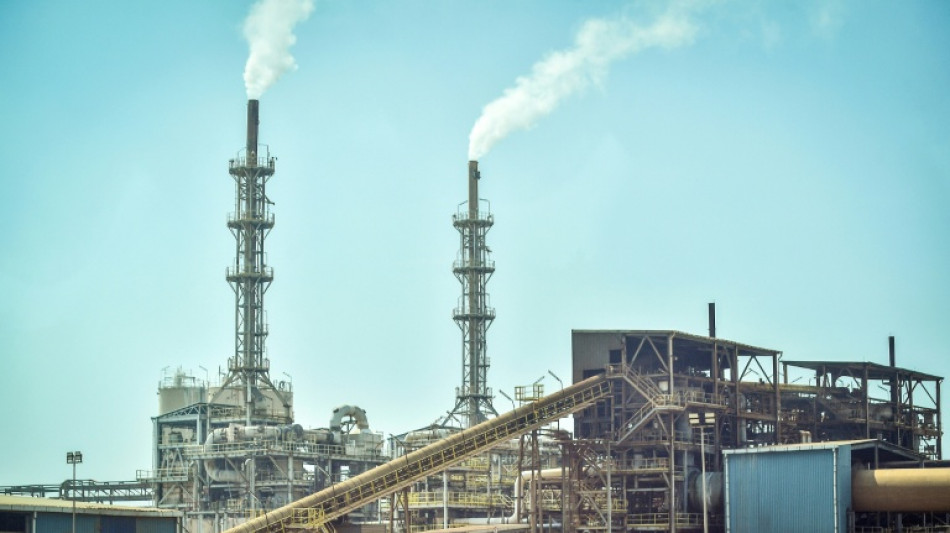
Delicate extraction: Malaysia offers rare earths alternative to China / Photo: © AFP

Workers load tonnes of rare earth minerals into bags ready for shipping at a refinery in eastern Malaysia, fuelling the global pushback against China's grip on the critical sector.
Rare earths are a key ingredient in products ranging from smartphones to fighter jets, electric cars and wind turbines -- and increasingly for hardware powering the artificial intelligence boom.
Global jitters about Beijing's dominance as a rare earths producer have kicked Australian mining giant Lynas into action, expanding its portfolio of rare earths refined in Malaysia as it hopes to boost its approximately 10 percent share of the market.
China makes up the other 90 percent of the world's market, stoking fears about Beijing's ability to choke global supplies.
"China has built its success on executing a clear industrial plan -- it takes us to be serious about it," Lynas company's chief executive Amanda Lacaze told AFP.
Pushing against Chinese dominance will "take discipline, focus and clear planning", she said during a rare press visit to the company's sprawling chemical plant in Malaysia's Gebeng industrial hub, near the coastal city of Kuantan.
The Lynas facility in Gebeng is now the world's largest single rare earths processing plant.
- Downstream demand -
Since 2012, the facility has been refining pure metals from raw materials mined in Western Australia, in an intensive and complicated separation procedure.
It currently handles 11 of the 17 rare earths -- a number that is increasing -- with plans to expand even further to include "heavies" such as yttrium and lutetium, used for lasers, medical imaging and cancer therapy.
From the plant, the bags are transported to Port Klang on the other side of Malaysia, and leave on a ship for Japan, where the metal powders are turned into high-performance magnets used in advanced industries such as electronics and aerospace.
Most bags contain NdPr, short for neodymium-praseodymium, a rare-earth mixture and key magnet material, which sells for around $100,000 per bag.
Smaller quantities of other separated heavy rare earth oxides like dysprosium, terbium and samarium are sold in 25-kilogramme tins.
Rare earths are so vital for the global economy that they have become a flashpoint in the blistering trade war between the United States and China.
Beijing leveraged its grip on the precious minerals in spectacular fashion last October, reaching a deal with Washington to pause the trade war after its curbs on exports rattled markets and snarled supply chains.
Supply of rare earths is expected to be a key discussion point at an upcoming summit between US President Donald Trump and his Chinese counterpart Xi Jinping in Beijing set for mid-May.
But the challenge for Lynas is not its production capacity, chief operating officer Pol Le Roux said.
Instead, incentives are needed to boost downstream capacity -- the ability to turn raw minerals into a finished product -- which is "growing too slowly", he told AFP.
Lacaze said the company was already partnering with magnet makers to close the gap between rare-earth processing and manufacturing.
However, she stressed: "We won't just say that we are going to wake up tomorrow and be a magnet maker."
- 'Minimise risks' -
Producing rare earths requires heavy chemicals and can produce toxic waste, with cases including illegal operations polluting Mekong tributaries in Myanmar, Laos and Cambodia with arsenic and cadmium.
Lynas got the green light last month from the Malaysian government to process rare earths there for another 10 years.
The licence was issued as environmental watchdogs such as Greenpeace raised concerns over the management of radioactive by-products.
Under the latest agreement, the government said the company must now halt all activities that produce radioactive waste within five years of its renewed operating licence.
Lynas however, says its by-product from rare earth refining produces a non-toxic, non-radioactive magnesium-rich gypsum and an iron phosphate with a very low level of naturally occurring radioactive material.
Existing by-product is already stored in a permanent disposal facility "constructed and managed to ensure the material does not impact on the surrounding environment," the company said.
Lynas also has ambitions to diversify further into producing rare earths as catalysts over the next decade.
Rare earths are particularly important as a low-cost catalyst in the hydrogen supply chain, for instance, in the recovery process when the gas is transported long-haul as ammonia.
"In 10 years from now, I expect this to be a substantial part of the business," Le Roux said.
G.Tsang--ThChM