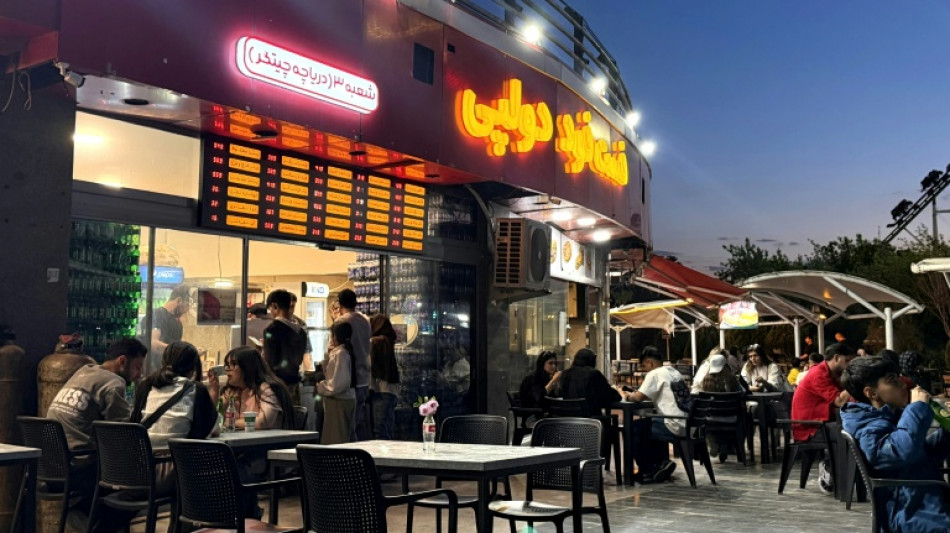
Routine returns but Iranians struggle to afford daily life / Photo: © AFP

Gyms and cafes have reopened in Tehran as life returns to a familiar rhythm under a ceasefire following weeks of US-Israeli airstrikes, but for IT worker Mayhar such everyday amenities are out of reach as financial pressures mount.
Trendy cafes in affluent northern Tehran were busy on Wednesday night, the start of Iran's weekend, with men and women sipping colourful drinks and strolling the streets.
But the sense of normalcy belies the economic pains weighing on many Iranians in the capital and beyond, as Tehran and Washington face off with market-rattling blockades.
"For many people, paying rent and even buying food has become difficult, and some have nothing left at all," 28-year-old Mahyar told an AFP reporter based outside Iran, saying the company he worked for had laid off 34 people -- nearly 40 percent of its staff.
Salaries hadn't been increased either, Mahyar said, and inflation, already over 45 percent before the war, reached 53.7 percent in recent weeks, according to the national statistics centre.
"Only those who had real estate, large businesses and significant wealth still have a normal situation," he said.
The Iranian rial plummeted to a record low against the dollar on Wednesday, according to currency-tracking websites, trading at around 1.8 million on the black market, compared to 1.7 million at the time the war erupted.
Iran's deputy labour minister said that 191,000 people had filed for unemployment after losing their jobs due to the impacts of the war.
- 'Increasing every day' -
But 49-year-old Tonekabon said "even wealthy people are complaining", as tenants -- including his own -- struggle to pay rent.
"Everyone is repairing what they have or buying second-hand instead," he said.
Prices have been steadily rising, making paying for basic necessities a challenge, with anything but immediate needs put off.
The minimum daily wage in Iran is roughly 5.5 million rials ($3 on Thursday, according to currency-tracking websites), said a labour authority announcement carried by state media on April 20.
But as of April 28, less than a litre of cooking oil cost around four million rials and eggs were 240,000 each, with meat costing from seven to 23 million rials per kilogramme.
"Even during wartime, prices didn't rise this much, they're increasing every day," said Fatemeh, a 29-year-old in the southeastern Iranian city of Zahedan.
The mother-of-two said she works all day sewing clothes and embroidering but she can't afford baby formula for her youngest.
With her husband unemployed, she says she has been putting off medical care for a painful tooth for three months because she can't afford it or find anyone to lend her the money.
"It's not just us, many of our relatives and neighbours don't go for medical treatment because it has become so expensive."
Student Shahin Nampoor was fed up with mounting costs and varying prices, not to mention the current impasse in bringing the war to a definitive end.
"Either there should be an agreement, or a war," he told AFP journalists in Tehran.
- 'Despite it all' -
Iran's sanctions-hit economy was already struggling before Israel and the United States launched the war on February 28, and the conflict has only ratcheted up the pressure.
Iran recently banned steel exports after Israeli-US airstrikes targeted its plants, as well as civilian infrastructure including roads, bridges and petrochemical facilities.
The Islamic republic has been inflicting global economic pain by choking off vital trade through the Strait of Hormuz, but its own ports have been blockaded by Washington to try to pressure it into a deal on its nuclear programme.
Some Iranians have expressed worry the standoff could explode into fighting again, but for many their focus is on getting by each day.
Some said they couldn't find work, while others saw their income dry up after the authorities restricted the internet when the war started, suffocating industries and workers that relied on connecting to the global web.
There has been little indication that protests might break out as they did in late December, sparked by economic pains and quickly expanding into mass anti-government rallies met by a violent crackdown that rights groups say killed thousands.
Shervin, a photographer, lost his online work and for the first time was late paying rent recently.
He said he can't afford his music streaming platform subscription anymore, but is going to parks and cafes for some normalcy, like the families who set out in paddleboats on a lake in Tehran on Wednesday or cycled through one of the city's leafy parks.
"I am trying to see the beauty in life and to keep going despite it all," said Shervin.
burs-sw/smw
A.Kwok--ThChM