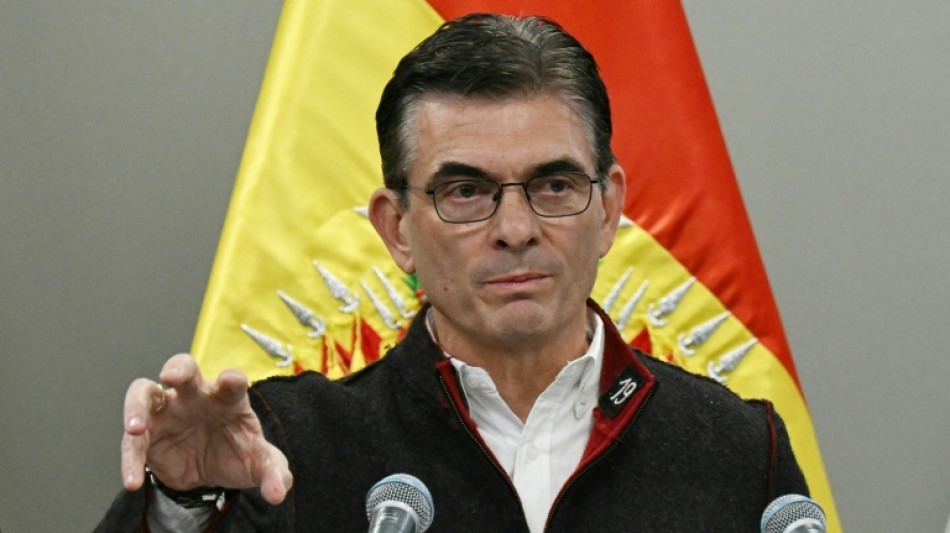
Embattled Bolivia leader promises 'to listen' to protesters / Photo: © AFP

Bolivian President Rodrigo Paz on Wednesday announced plans to reshuffle his cabinet to make it more inclusive following weeks of anti-government protests.
Bolivians began demonstrating and erecting roadblocks three weeks ago to demand salary increases, stable fuel supplies and measures to mitigate the worst economic crisis in 40 years.
The protests have since snowballed into a revolt, marked by calls for Paz's resignation, just six months after he took office.
The government has accused the protesters of trying to stage a "coup" but in his first remarks to the press in nearly a week Paz sounded a conciliatory note.
"We need to reorganize a cabinet that must be able to listen," he said, without giving details.
He added that he would also set up an "economic and social council" to allow the Indigenous groups, farmers, miners and other workers who have been in the street to have a say in government policy.
But he was adamant he would not "negotiate with vandals" -- a reference to the looting and arson that marred mass protests in La Paz on Monday -- while assuring his "door is always open to those who respect democracy."
On Wednesday, a march by hundreds of Indigenous farmers and transport workers in La Paz passed off peacefully, in marked contrast to Monday's violent clashes between protesters and police.
Romer Cahuaza, a striking transport worker demanding improved fuel supplies, warned however of "bloodshed" if Paz's government did not step aside.
Foreign Minister Fernando Aramayo accused the demonstrators of trying to "disrupt the democratic order."
The election of the US-backed Paz -- part of a right-wing tide sweeping Latin America -- brought an end to two decades of socialist rule launched by Indigenous coca farmer Evo Morales.
Paz's government accuses Morales, who is wanted on charges of trafficking a minor, of fomenting the recent unrest.
"The United States stands squarely in support of Bolivia's legitimate constitutional government," Secretary of State Marco Rubio wrote on X on Wednesday,
Alluding to the role of Morales' heartland in Bolivia's cocaine trade, Rubio added that Washington would "not allow criminals and drug traffickers to overthrow democratically elected leaders in our hemisphere."
- Food, fuel shortages -
Paz attempted to rescue the economy from the brink of collapse by scrapping fuel subsidies that ate into the country's dollar reserves.
But the measures have yet to bear fruit.
The roadblocks erected by demonstrators on roads to La Paz have triggered shortages of fuel, food and medicine in the city.
"We have almost nothing left, it's impossible to even find an egg," Sheyla Caya, 43, told AFP as she queued to buy a chicken.
The government has been forced to fly in meat and vegetables to La Paz from the central city of Cochabamba and Santa Cruz in the east.
It has also announced plans to deploy police to take down the roadblocks.
- 'Geopolitical arrogance' -
The situation is being closely watched across the region for signs of who will prevail -- Paz or the protesters.
On Wednesday, Bolivia said it was expelling Colombia's ambassador following "interference" by left-wing President Gustavo Petro in its affairs.
The outspoken Petro, who crossed swords with US President Donald Trump in the past, labelled Bolivia's protests a "popular insurrection" against "geopolitical arrogance."
He slammed the expulsion of his ambassador, saying it showed a drift to "extremism" under Paz.
N.Lo--ThChM