The China Mail - India learns to live with hotter summers

USD -
AED 3.6725
AFN 63.000559
ALL 80.457093
AMD 364.26286
ANG 1.790365
AOA 917.999719
ARS 1516.020796
AUD 1.421262
AWG 1.8
AZN 1.703747
BAM 1.719271
BBD 2.021123
BDT 123.385271
BGN 1.683441
BHD 0.378322
BIF 3015.506057
BMD 1
BND 1.282238
BOB 11.967247
BRL 5.167297
BSD 1.003494
BTN 96.024226
BWP 13.645973
BYN 3.038502
BYR 19600
BZD 2.018222
CAD 1.410525
CDF 2309.999891
CHF 0.82405
CLF 0.024397
CLP 963.32995
CNY 6.71135
CNH 6.71495
COP 3288.88
CRC 455.322571
CUC 1
CUP 26.5
CVE 96.924335
CZK 21.453034
DJF 178.696847
DKK 6.56695
DOP 59.694539
DZD 133.960182
EGP 51.423997
ERN 15
ETB 163.912608
EUR 0.87845
FJD 2.24975
FKP 0.754629
GBP 0.755145
GEL 2.614989
GGP 0.754629
GHS 11.625096
GIP 0.754629
GMD 74.000256
GNF 8825.403802
GTQ 7.659717
GYD 209.949851
HKD 7.842625
HNL 26.934944
HRK 6.6228
HTG 131.167861
HUF 321.224503
IDR 17912
ILS 3.042105
IMP 0.754629
INR 95.906303
IQD 1314.638595
IRR 1374574.999728
ISK 121.229727
JEP 0.754629
JMD 158.109403
JOD 0.708991
JPY 158.176503
KES 129.550235
KGS 87.449801
KHR 4069.900318
KMF 432.999946
KPW 900.000318
KRW 1368.669769
KWD 0.30914
KYD 0.836289
KZT 446.228832
LAK 22485.935302
LBP 89536.891783
LKR 330.148377
LRD 173.10397
LSL 16.369989
LTL 2.95274
LVL 0.60489
LYD 6.406329
MAD 9.606146
MDL 17.761955
MGA 4409.185804
MKD 54.084346
MMK 2099.566963
MNT 3597.939506
MOP 8.107421
MRU 40.17914
MUR 48.117591
MVR 15.450336
MWK 1740.028568
MXN 17.525502
MYR 4.078905
MZN 63.910232
NAD 16.36963
NGN 1325.94969
NIO 36.927972
NOK 9.48942
NPR 153.640463
NZD 1.760855
OMR 0.384499
PAB 1.003538
PEN 3.387908
PGK 4.470678
PHP 62.741047
PKR 278.093308
PLN 3.846635
PYG 5947.478299
QAR 3.658363
RON 4.6333
RSD 103.188969
RUB 85.252219
RWF 1481.149407
SAR 3.760068
SBD 8.000512
SCR 13.860281
SDG 601.502977
SEK 9.91639
SGD 1.27951
SHP 0.755002
SLE 24.650009
SLL 20969.491881
SOS 573.472922
SRD 37.822496
STD 20697.981008
STN 21.535906
SVC 8.780419
SYP 13002.000254
SZL 16.365674
THB 33.3825
TJS 9.287209
TMT 3.51
TND 2.964119
TOP 2.40776
TRY 48.854902
TTD 6.820349
TWD 31.824497
TZS 2648.919876
UAH 45.041292
UGX 3903.815472
UYU 40.223974
UZS 11841.856581
VES 852.43145
VND 25997.5
VUV 118.51472
WST 2.751818
XAF 576.225518
XAG 0.015597
XAU 0.000233
XCD 2.70255
XCG 1.808584
XDR 0.707052
XOF 576.225518
XPF 104.837044
YER 236.649827
ZAR 16.377096
ZMK 9001.196392
ZMW 19.543175
ZWL 321.999592
SSP 5712.591861
MXV 1.986148
  • BCC

    -1.2400

    77.76

    -1.59%

  • RIO

    -2.2400

    95.25

    -2.35%

  • CMSC

    -0.1020

    20.508

    -0.5%

  • JRI

    -0.2350

    11.25

    -2.09%

  • GSK

    -1.0100

    49.71

    -2.03%

  • CMSD

    -0.0800

    20.34

    -0.39%

  • BTI

    0.1000

    55.85

    +0.18%

  • AZN

    -5.0400

    163.33

    -3.09%

  • RBGPF

    0.0000

    67

    0%

  • RYCEF

    -0.2300

    19.67

    -1.17%

  • VOD

    -0.2700

    16.35

    -1.65%

  • RELX

    0.2400

    33.22

    +0.72%

  • BP

    1.3900

    44.49

    +3.12%

  • NGG

    -1.6100

    75.25

    -2.14%

  • BCE

    -0.0900

    21.61

    -0.42%

India learns to live with hotter summers
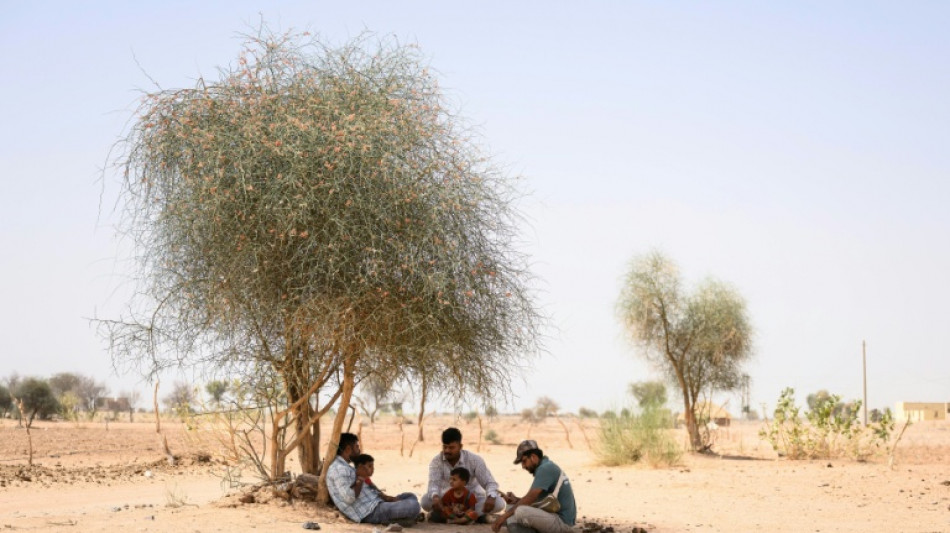
India learns to live with hotter summers / Photo: © AFP

India learns to live with hotter summers

On India's hot plains, scorching summers have become increasingly harder to endure, requiring adaptations and forcing life into the hours of dark before the sun turns punishing.

Text size:

"We try to adjust, but the traditional ways to combat heat are not working," said 26-year-old herdsman Sawai Bhati Singh, who lives outside the desert city of Jaisalmer, in the western state of Rajasthan.

"Every year the heat is increasing."

His home, made of thick stone blocks with few windows, helps keep some of the furnace-like heat out. But temperatures inside are still stifling.

The South Asian country is no stranger to scorching summers, but years of scientific research have found climate change is causing heatwaves to become longer, more frequent and more intense.

Temperatures in Singh's village of Sanwata hit 45C in early June, as is often during the summer. The highest temperature recorded in the area has been 49C.

Singh is worried about the health of his two young sons, aged two and four, playing barefoot in the dust.

In a separate kitchen hut with a thatched roof for ventilation, his wife and mother struggle as they cook on a wood fire.

Water is drawn from a nearby well and cooled in bottles wrapped in woven jute string, using evaporation to lower the temperature.

Singh's herd of goats and cattle struggles too.

"They stay in the shade," he said. "The heat impacts the eating, and that lowers their milk."

But temperatures are becoming harder to endure. The family bought their first air cooler, which uses wet fibres, last year.

"We never needed it before, but last year was hot, so we bought one," he said. "Now we have two."

A world away, along the lush green banks of the Yamuna river floodplains near the capital, New Delhi, farmer Bhole Shankar faces a different version of the same crisis.

New Delhi hit 46.5C this summer, still below the sizzling 49.9C record measured in 2024.

"Living on the floodplain feels cooler than being stuck in the middle of houses," 36-year-old Shankar said, standing outside a hut made of plastic sheeting on bamboo poles. "But on some days, day and night feel the same."

Shankar, his wife and their three sons, aged between nine and 16, live beneath the city's power lines -- but their hut is not connected. A solar panel provides enough power to run a small fan, pushing hot air.

The family shifts its routine, working in the fields before dawn, resting in the shade during the fiercest heat, and returning to check crops towards dusk.

The family roll up the tent's plastic wall and sleep on traditional rope-lattice beds, which both allow air to circulate.

"Each passing year feels hotter," he said. "We try to keep in the shade, but when you are a farmer, that's hard."

R.Yeung--ThChM