US faces tough path to new Iran nuclear deal / Photo: © @Scavino47/AFP

The United States is about to embark on difficult negotiations with the Iranian government, whose survival of a massive US-Israeli military assault has undercut American leverage while bolstering the Islamic republic.
US President Donald Trump tore up the last nuclear deal with Tehran and now faces the key test of whether his administration can come up with a better one -- or any at all -- in talks that are set to start soon and last for an initial 60 days.
But things are significantly different than when Washington and Tehran reached an agreement during Barack Obama's presidency more than a decade ago -- an effort that took years.
"It's a much worse situation strategically for the US now than it was back in the 2010 to 2015 time period," said Alan Eyre, distinguished diplomatic fellow at the Middle East Institute.
"The Iranian nuclear program is a lot more advanced now" -- though its nuclear facilities and enrichment ability were set back by US strikes last year -- and "there's a lot less bilateral trust," said Eyre, one of the negotiators of the 2015 deal.
After Trump withdrew from that deal in 2018, Iran began rolling back its commitments, with the International Atomic Energy Agency saying Tehran was enriching uranium to 60 percent purity -- far above the previous 3.67 percent cap.
- Missiles and proxies -
By attacking Iran, Washington has already played what would have been a major card: the threat of military force.
"We used it, and they're still standing. So what are we going to threaten them with?" Eyre said. "We have failed strategically, despite our military preeminence. Iran succeeded in that Iran's goal in this war was to survive."
The US and Israel launched their war against Iran on February 28 -- a massive air campaign that lasted until a ceasefire took effect on April 8 -- while sporadic violence continued until the announcement of a memorandum of understanding last weekend.
At the beginning of the war, Trump stated that US goals included destroying Tehran's missile capabilities and navy, preventing it from acquiring a nuclear weapon and stopping Iran from funding its proxy forces across the Middle East.
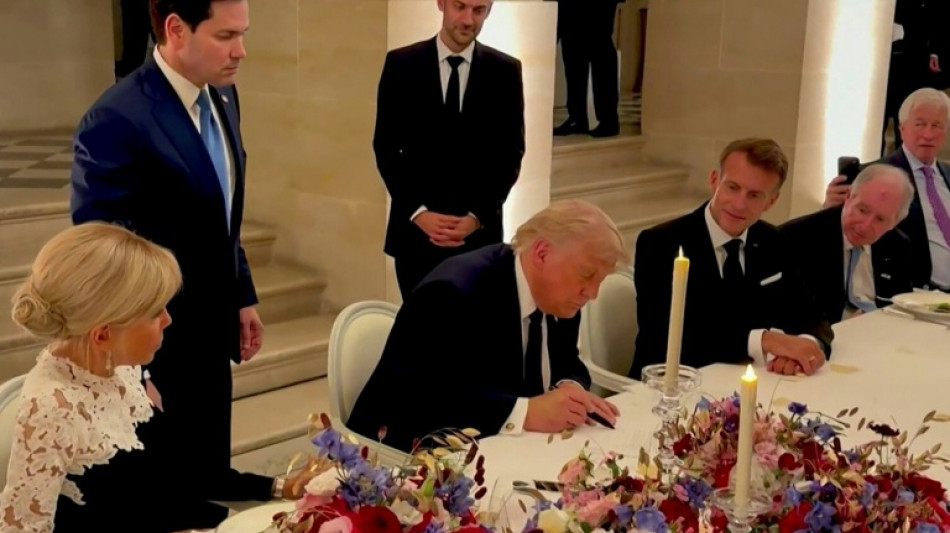
The memorandum of understanding -- signed by Trump and his Iranian counterpart Masoud Pezeshkian on Wednesday -- says Iran "reaffirms that it shall not procure or develop nuclear weapons," but provides no mechanism for that to be verified or enforced.
The document makes no mention of missiles, proxies or the navy, though the latter has been largely destroyed by US strikes.
- 'Be so lucky'
It also provides for the establishment of a $300 billion reconstruction fund for Iran, the lifting of a US naval blockade of Iran's ports, and sanctions waivers allowing Tehran to export oil, among other steps.
Richard Haas, president emeritus of the Council on Foreign Relations, said the emerging deal seems set to be a "massive victory" for the Iranian government.
"The regime will receive a financial windfall that will strengthen its hold on the country and help it rearm itself and its proxies," Haas wrote in a newsletter, noting that Tehran's government now also "has the prestige of having successfully stood up" to the US.
Trump and his administration have defended the agreement, with the US president deriding its detractors as "fools" and "jealous, bad people," while Vice President JD Vance described it as a "win-win situation for the United States."
For Eyre, the prospects of Washington reaching a more favorable deal than the one Trump scrapped are slim.
"The US should be so lucky as to get as good a deal as Obama, and I'm not saying that because I was part of it," he said.
"Trump and his people pride themselves on being good deal makers, but you know, the more you ask for, the more you have to give," Eyre said.
"If we're trying to get Iran to walk back its nuclear program to where it was in 2018 when we pulled out, that is, I think, a bridge too far."
C.Fong--ThChM