The China Mail - Bolivia declares state of emergency and begins removing protester roadblocks

USD -
AED 3.6725
AFN 63.000559
ALL 80.457093
AMD 364.26286
ANG 1.790365
AOA 917.999719
ARS 1516.020796
AUD 1.421262
AWG 1.8
AZN 1.703747
BAM 1.719271
BBD 2.021123
BDT 123.385271
BGN 1.683441
BHD 0.378322
BIF 3015.506057
BMD 1
BND 1.282238
BOB 11.967247
BRL 5.167297
BSD 1.003494
BTN 96.024226
BWP 13.645973
BYN 3.038502
BYR 19600
BZD 2.018222
CAD 1.410525
CDF 2309.999891
CHF 0.82405
CLF 0.024397
CLP 963.32995
CNY 6.71135
CNH 6.71495
COP 3288.88
CRC 455.322571
CUC 1
CUP 26.5
CVE 96.924335
CZK 21.453034
DJF 178.696847
DKK 6.56695
DOP 59.694539
DZD 133.960182
EGP 51.423997
ERN 15
ETB 163.912608
EUR 0.87845
FJD 2.24975
FKP 0.754629
GBP 0.755145
GEL 2.614989
GGP 0.754629
GHS 11.625096
GIP 0.754629
GMD 74.000256
GNF 8825.403802
GTQ 7.659717
GYD 209.949851
HKD 7.842625
HNL 26.934944
HRK 6.6228
HTG 131.167861
HUF 321.224503
IDR 17912
ILS 3.042105
IMP 0.754629
INR 95.906303
IQD 1314.638595
IRR 1374574.999728
ISK 121.229727
JEP 0.754629
JMD 158.109403
JOD 0.708991
JPY 158.176503
KES 129.550235
KGS 87.449801
KHR 4069.900318
KMF 432.999946
KPW 900.000318
KRW 1368.669769
KWD 0.30914
KYD 0.836289
KZT 446.228832
LAK 22485.935302
LBP 89536.891783
LKR 330.148377
LRD 173.10397
LSL 16.369989
LTL 2.95274
LVL 0.60489
LYD 6.406329
MAD 9.606146
MDL 17.761955
MGA 4409.185804
MKD 54.084346
MMK 2099.566963
MNT 3597.939506
MOP 8.107421
MRU 40.17914
MUR 48.117591
MVR 15.450336
MWK 1740.028568
MXN 17.525502
MYR 4.078905
MZN 63.910232
NAD 16.36963
NGN 1325.94969
NIO 36.927972
NOK 9.48942
NPR 153.640463
NZD 1.760855
OMR 0.384499
PAB 1.003538
PEN 3.387908
PGK 4.470678
PHP 62.741047
PKR 278.093308
PLN 3.846635
PYG 5947.478299
QAR 3.658363
RON 4.6333
RSD 103.188969
RUB 85.252219
RWF 1481.149407
SAR 3.760068
SBD 8.000512
SCR 13.860281
SDG 601.502977
SEK 9.91639
SGD 1.27951
SHP 0.755002
SLE 24.650009
SLL 20969.491881
SOS 573.472922
SRD 37.822496
STD 20697.981008
STN 21.535906
SVC 8.780419
SYP 13002.000254
SZL 16.365674
THB 33.3825
TJS 9.287209
TMT 3.51
TND 2.964119
TOP 2.40776
TRY 48.854902
TTD 6.820349
TWD 31.824497
TZS 2648.919876
UAH 45.041292
UGX 3903.815472
UYU 40.223974
UZS 11841.856581
VES 852.43145
VND 25997.5
VUV 118.51472
WST 2.751818
XAF 576.225518
XAG 0.015597
XAU 0.000233
XCD 2.70255
XCG 1.808584
XDR 0.707052
XOF 576.225518
XPF 104.837044
YER 236.649827
ZAR 16.377096
ZMK 9001.196392
ZMW 19.543175
ZWL 321.999592
SSP 5712.591861
MXV 1.986148
  • JRI

    -0.2350

    11.25

    -2.09%

  • BCC

    -1.2400

    77.76

    -1.59%

  • BCE

    -0.0900

    21.61

    -0.42%

  • RBGPF

    0.0000

    67

    0%

  • CMSC

    -0.1020

    20.508

    -0.5%

  • CMSD

    -0.0800

    20.34

    -0.39%

  • RIO

    -2.2400

    95.25

    -2.35%

  • NGG

    -1.6100

    75.25

    -2.14%

  • GSK

    -1.0100

    49.71

    -2.03%

  • AZN

    -5.0400

    163.33

    -3.09%

  • RYCEF

    -0.2300

    19.67

    -1.17%

  • RELX

    0.2400

    33.22

    +0.72%

  • BTI

    0.1000

    55.85

    +0.18%

  • BP

    1.3900

    44.49

    +3.12%

  • VOD

    -0.2700

    16.35

    -1.65%

Bolivia declares state of emergency and begins removing protester roadblocks
Bolivia declares state of emergency and begins removing protester roadblocks / Photo: © AFP

Bolivia declares state of emergency and begins removing protester roadblocks

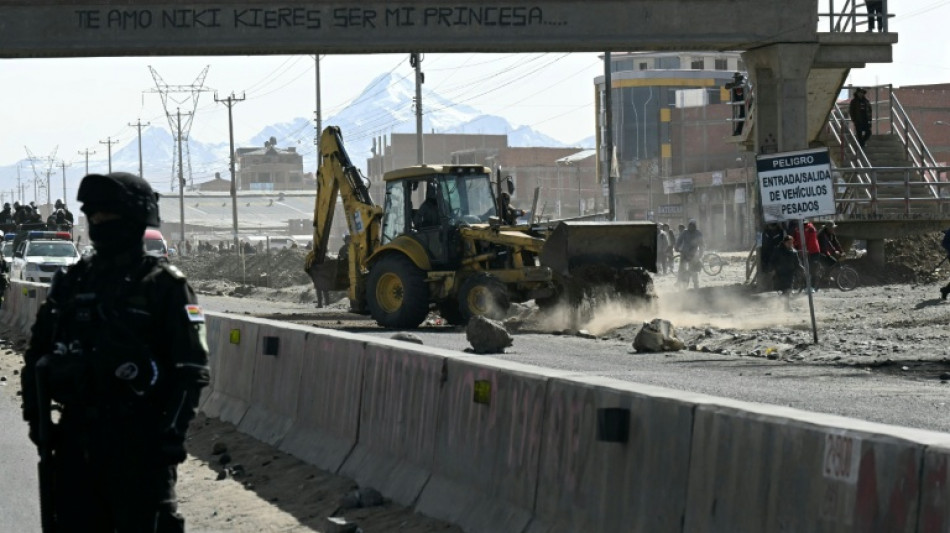
Bolivia's president on Saturday declared a state of emergency and deployed police and bulldozers to clear anti-government roadblocks that have paralyzed the Andean nation.

Text size:

For more than six weeks, an array of anti-government unions, Indigenous groups and coca farmers have marched through cities and blocked main roads across the country with rubble, logs and debris.

Major cities have seen acute shortages of fuel, food and medicine; the economy has lost billions of dollars; and the protests have threatened to topple Bolivia's first non-socialist government in two decades.

Moving to end the crisis, President Rodrigo Paz on Saturday appeared in a late-night televised address to warn protesters they would face "the full force of the law."

He declared a 90-day state of emergency, which curbs the right to protest and allows the military to be deployed domestically.

Hours after his address, AFP reporters in the city of El Alto saw squads of armed police moving in a convoy as bulldozers moved in to clear roadblocks.

Some residents clapped as they passed.

In nearby La Paz, a handful of military police and navy personnel guarded the presidential palace and police tactical units were stationed on main squares.

"Bolivians cannot continue to be held hostage by blockades that prevent them from working, studying, receiving medical care, getting supplies and bringing food to their homes," Paz said in a social media post.

"This state of emergency is not intended to take away normalcy, but to restore it."

The protesters want Paz, the country's first rightist president in two decades, to abandon liberal economic reforms and step down.

The 58-year-old had signaled he was ready to negotiate and, earlier this week, agreed to a deal with one of the country's major unions to end the crisis.

In exchange for a promise not to privatize state companies and to hold further talks, the Bolivian Workers' Central union agreed to end their protests.

But some Indigenous groups have vowed to fight on, and more than 40 major roadblocks remain.

"We want him gone. We don't want him to be the one governing," Lidia Callisaya, a 42-year-old Aymara leader, told AFP recently.

- Standoff -

Paz has accused "narcoterrorists" -- and in particular former president Evo Morales -- of being behind the protests.

Morales, a leftist firebrand, Indigenous leader and former coca farmer, was president from 2006 to 2019.

He is currently in hiding while facing charges of alleged trafficking of a minor, which he denies.

His stronghold is the Chapare region in central Bolivia, which is now a potential flashpoint.

He is protected by thousands of Indigenous supporters who have so far prevented police from arresting him.

Morales recently told AFP from hiding that Bolivians were rebelling against a conservative government that is "utterly submissive" to the United States.

O.Tse--ThChM