Rubio rejects Iran tolls on Hormuz as deal strains multiply / Photo: © POOL/AFP

US Secretary of State Marco Rubio said Tuesday that Washington would not accept Iranian tolls or fees on the Strait of Hormuz, as disputes over the vital waterway, nuclear inspections, and missiles exposed early strains in negotiations to end the Middle East war.
Washington and Tehran have signed a preliminary agreement to halt the conflict and concluded a first round of talks in Switzerland, opening a 60-day negotiation period on sanctions relief, Iran's nuclear programme and the future of Hormuz.
An Iranian blockade early in the war choked maritime traffic through the strait, sending global oil prices surging, but crossings have begun rising since the deal was signed.
Iran has repeatedly insisted it will retain control over the waterway.
On Tuesday, Tehran and Oman said in a joint statement that they would study the administration of the trade route and the costs to be charged for services, while insisting on their sovereignty over the strait.
Rubio, opening a regional tour in the United Arab Emirates, said Washington would oppose any such move.
"It's an international waterway. No country is allowed to charge tolls or fees on an international waterway," he said, adding that he believed "all the countries in this region would agree".
Tehran's top negotiator, Mohammad Bagher Ghalibaf, had earlier said Hormuz "will never return" to the pre-war status quo, despite both sides agreeing to set up communication lines to keep it open.
The UN's maritime agency, meanwhile, said it would begin evacuating more than 11,000 sailors stranded by the blockade, working with Iran, Oman and the United States after securing "the necessary safety guarantees".
Traffic through the strait on Monday reached its highest level since the war began, according to two maritime tracking platforms, though it remained just over 40 percent of the normal peacetime level of about 120 vessels a day.
- Red lines -
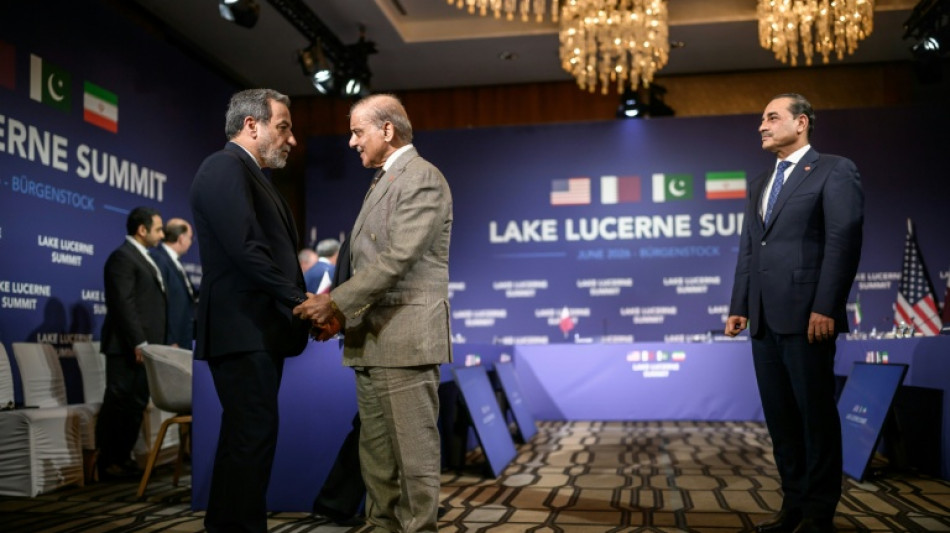
Diplomacy was in full swing Tuesday, with Iran's president visiting mediator Pakistan, Rubio beginning a tour of Gulf allies and Lebanon and Israel kicking off more direct talks in Washington.
But Tehran signalled that its ballistic missile programme would not be part of any final settlement.
"If the missiles we have for our defence did not exist, Israel and the United States would have ploughed Iran just like Gaza," Iranian President Masoud Pezeshkian said in Pakistan.
He added that the Islamic republic would "never negotiate with anyone, under any circumstances, ever, about our defensive capabilities."
Pakistani Prime Minister Shehbaz Sharif confirmed that the preliminary US-Iran agreement made no mention of ballistic missiles, saying there could not be "double standards" on which countries may possess them.
Iran fired hundreds of missiles and thousands of drones at Israel and Gulf neighbours during the war, while Israel has long viewed the programme as an existential threat.
US President Donald Trump, who previously sought to include missiles and Tehran's support for armed proxies in negotiations, appeared last week to soften his position, saying it was "a little bit unfair" for Iran not to have some missiles if other countries did.
Iran also denied a claim by US Vice President JD Vance that Tehran had agreed to invite International Atomic Energy Agency inspectors back to nuclear sites bombed by the United States and Israel last year.
Trump, however, insisted Iran had "fully and completely agreed to highest level Nuclear inspections long into the future".
When the US joined Israel's previous war with Iran in mid-2025, it bombed nuclear facilities at Fordow, Natanz and Isfahan, including with powerful bunker-busting munitions.
The extent of the damage remains unknown despite Trump claiming they were "obliterated".
Iran's UN ambassador Ali Bahreini also told reporters "there hasn't been such a decision" to accept IAEA inspectors.
- Sanctions and Congress -
Mediators Pakistan and Qatar said both sides had agreed on a "roadmap" to reach a final agreement within the 60-day timeframe.
The US Treasury has temporarily lifted sanctions on Iran to allow it to produce, sell and deliver crude and related products until mid-August.
As part of the deal, Washington also agreed to release $12 billion in frozen funds to Iran, according to Iranian state media.
The diplomacy was also clouded by a symbolic rebuke in Washington, where the US Senate adopted a House-passed resolution calling for an end to the war with Iran.
The legislative vehicle carries disputed legal force, but the vote meant both chambers are now on-record against the conflict as negotiations continue.
On the Lebanon front, a fifth round of negotiations between Lebanese and Israeli officials began in Washington on Tuesday in a bid to end the Israel-Hezbollah conflict.
Fighting between Israel and Hezbollah, which drew Lebanon into the Middle East war on March 2, has repeatedly threatened to derail peace efforts.
burs-ft/jgc
R.Yeung--ThChM