Beloved spiritual utopia under threat in Modi's India / Photo: © AFP

It was founded as a Sixties utopia "where men and women of all countries are able to live in peace and progressive harmony" without money or religious strife in southern India.
For decades Auroville held fast to its lofty ideals as a self-governing haven for yoga enthusiasts and seekers of spiritual freedom of "all creeds and nationalities".
Until India's Hindu nationalist prime minister Narendra Modi turned his attention to the lush paradise its founders created on a once arid plateau near Puducherry.
Now the dream has turned into a nightmare for many in the cosmopolitan oasis who have given their lives and fortunes to foster "human unity in diversity" and "the transformation of consciousness".
"Lots of people are living in fear and uncertainty," one former resident said of the oppressive atmosphere that many now say reigns in the world-renowned experimental city.
"Everyone feels vulnerable and in danger," he told AFP, with few able to talk freely in a place that was founded to find a "just and harmonious" way of life.
Those most at risk are the half of Auroville's 3,300 residents who were born abroad, and who now live in fear of being expelled or denied visas to remain.
Many say the idyll began to unravel when New Delhi appointed civil servant Jayanti Ravi to head Auroville in 2021.
Close to the prime minister and his mission to remake India as a Hindu nation, she quickly asserted government control and began pushing to expand the city as a tourist destination that would showcase Modi's India.
One day the pioneers who had planted the first trees on the windswept coastal plateau discovered huge gashes in the rich vegetation. Work had begun to expand Auroville's infrastructure so that it might eventually accommodate up to 15 times its present population.
The clash of cultures could not be more sharp. "The values embodied by Auroville," a city "without religion" that "reinvents our relationship with money... are very different from the values of the current Indian government, which is nationalist, capitalist and religious," said one of the residents, too afraid to give their name.
The dreamers and seekers of Auroville have run into one of the hard realities of India under Modi, according to his biographer Nilanjan Mukhopadhyay.
"This is a very centralising government which does not like any free-thinking bodies or individuals who have functional autonomy," he told AFP.
- Pioneers -
When the mystic poet Sri Aurobindo, one of the leaders of India's push for independence, withdrew from politics to dedicate himself to a life of contemplation, he dreamed of setting up a "universal city" of the spirit.
The vision that bore his name became Auroville in 1968 through the work of his French-born spiritual companion Mirra Alfassa, who herself became a guru known as "The Mother".
Meeting her in 1960 "changed my life", said one of the very first European residents, who is now nearly 90.
Then a young university student from a wealthy family, he sank all his energy and his considerable inheritance into making her dream reality, "building roads and planting" thousands of trees, before setting off across the world to raise funds.
"There was no water, no electricity, no real housing; we were pioneers," he told AFP.
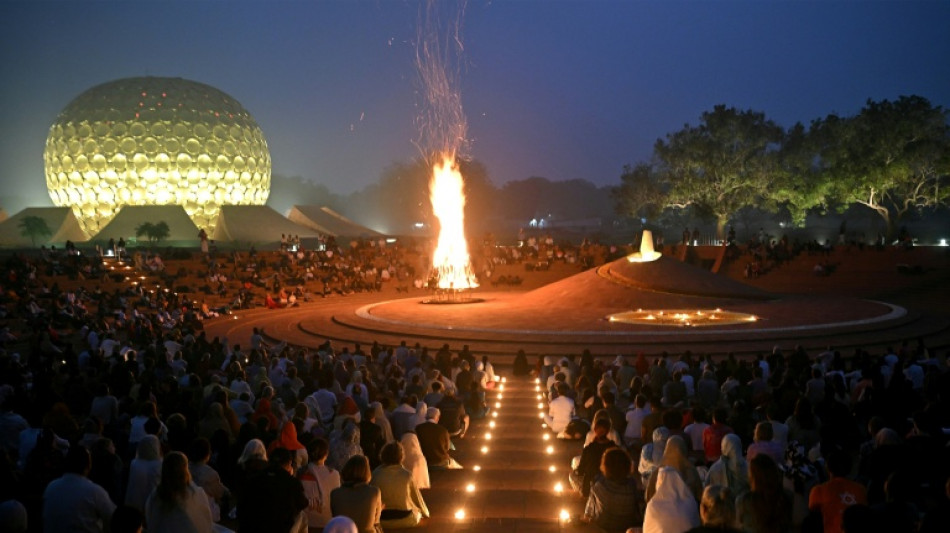
The original idea, called the "Galaxy" drawn up by the French modernist architect Roger Anger, was for a city of 50,000 people, spiralling out from a giant golden sphere, the Matrimandir, the "Temple of the Mother".
But in reality the Auroville that now attracts thousands of tourists and yoga enthusiasts developed in a more organic way in keeping with the minimalist ecological principles of its people.
The Matrimandir -- dedicated to meditation -- is still at its centre, surrounded by a tropical forest scattered with hamlets of huts with palm or tin roofs, postmodern concrete buildings and clusters of white apartment blocks.
Christine Devin, who arrived in 1974 after travelling overland on the hippie trail from Paris, remembers digging wells, irrigating the land and everyone pitching in to build houses and communal buildings like the solar kitchen. It was "an extraordinary adventure", she said.
Like other residents, she is proud of the alternative models of governance, property, education and ecology they developed. "We had that feeling of working for something bigger than ourselves," said the French woman, who runs Auroville's publishing house. "We had the freedom to grow, to make mistakes, to organise things more or less as we wanted."
- 'Absolute authority' -
That is no longer the case since Ravi, an amiable but steely 58-year-old Harvard graduate, became secretary of the governing board.
Despite the Auroville Foundation having an international advisory council and an assembly of residents, her critics accuse her of having "absolute authority" over a community that had been largely self‑managed. They say she has imposed increasingly restrictive rules, dismissed employees and decides who can or cannot obtain a visa to stay.
Having given almost all his life to Auroville, the octogenarian resident -- whose family pleaded with AFP not to reveal his identity -- said he lived in fear of expulsion for two years after his visa extension was rejected without explanation.
"When your life in the country of your soul is threatened, it's very destabilising," he told AFP. "It took its toll. I became sick. But by the grace of God, a visa was finally granted."
Most of his children and his grandchildren live with him, and he does not have the means to return to Europe, where he has "never really felt at home".
Dozens of other residents have had visas denied, four have been expelled and hundreds have to wait many months for the precious document to be renewed, according to several accounts gathered by AFP. Many have ended up leaving in despair, according to one resident.
But Ravi insists she wants "to welcome more and more people, particularly foreign nationals, who aspire to the highest ideals and are determined to live a fully conscious life."
She said "99 percent of people get their visa" and that those that do not are refused for breaking "the law and obstructing the work of the government".
- 'Pressure' -
Auroville is funded by donations, the income generated from the hundreds of thousands of tourists and to a lesser extent government subsidies.
Leaving means abandoning everything you have ever worked for, as there is no such thing as property, with every Aurovillian having to invest between 20,000 and 30,000 euros ($34,800) for a plot or dwelling which they can neither sell nor pass on.
Money does not change hands among residents, not in its cooperative grocery store nor community canteen.
"The houses don't belong to you," said Gilles Guigan, a 79‑year‑old French engineer, who helped build the Matrimandir.
"I've been living here for 45 years, I don't have a pension... and many people are in my situation."
While residents have no salaries or pay no taxes, they do receive a kind of monthly stipend of just over 200 euros in exchange for a minimum of six hours of work per day.
But Ravi has the discretionary power to withhold it, and some 250 residents, including Indians -- who are not allowed to work outside -- no longer receive it, according to Auroville's official community website.
Ravi uses the payment as "a means of putting pressure on people who disagree with her", one resident who asked not to be named told AFP.
"I am worried about my future," Guigan admitted.
- 'Freedom of expression' -
"We wake up wondering what new disaster is going to befall Auroville," its French-language magazine declared in December.
Then earlier this year its English-language monthly Auroville Today said it was closing after 37 years.
"We do not feel we can continue to function... as the focus will have to be upon 'positive' news only," it said, "and we will have to conform to a particular narrative," with new executives likely to be appointed "presumably to ensure compliance with the new media policy".
It also said that a substantial donation made to Auroville Today has not been released to the magazine.
Reporters Without Borders (RSF) has warned that freedom of the press has eroded in India since Modi came to power in 2014.
Some residents began to resist the direction Auroville was taking in 2021, with tens of thousands of trees felled and land traded.
But the promised buildings have never materialised, and Crown Road, a four-kilometre circular road with 12 radial routes is still under construction. In a report published in February, the independent advisory committee Auroville Global Fellowship pointed to "opaque land transactions".
This came after a Tamil Nadu MP C. Ve. Shanmugam had called for an inquiry into the Auroville Foundation's exchange of high‑value land for plots of lesser value in remote areas. He claimed the decision may have cost the city millions of rupees.
A legal bid by some residents to annul all transactions since Ravi's arrival in 2021 was rejected by the Madras High Court last year, but several other cases are ongoing.
Others began to protest or write articles pleading that the experiment be saved.
Prominent Tamil Nadu environmental activist Piyush Manush said the fight to save the community's soul is not just about the city itself.
"If Auroville," which has a big international profile and has been praised by UNESCO, "does not hold out against the plundering and devastation of our natural resources, then we are all doomed," he said.
- Spiritual tourism -
Some see more political motives behind the authorities' takeover.
"There are probably financial goals, but also a desire to develop mass spiritual tourism and turn it into a showcase for spreading certain nationalist ideas," said one Indian Auroville resident.
Since Modi came to power numerous Hindu, Buddhist, Jain and Sikh places of worship have undergone extensive renovation, as have holy sites such as Varanasi, Sarnath and Bodh Gaya.
But Muslim shrines have not seen the same largesse, said analyst and Modi biographer Mukhopadhyay.
The prime minister "wants to appropriate Sri Aurobindo's legacy", he argued, rewriting history "to present him as a figure centered on Hinduism in order to assert that the country's foundational civilisation is Hindu."
In 2022, Modi praised Aurobindo's "unyielding nationalism" while visiting nearby Puducherry, a French colonial outpost till 1954. And in early March, he paid tribute to the philosopher and to "The Mother", who he said brought "a new spiritual vision to the entire world".
Despite the struggle for its soul, Auroville remains "a perfect place", said 58‑year‑old Ecuadorian resident Jorge Ayarza, who has been living there for two decades.
"There's a very strong community. We're together for a dream... India is a spiritual country, and we are blessed by that.
"Auroville is a community that's growing, that is evolving," said the engineer, who founded a FabLab specialising in renewable energy.
But "there is an expectation that it has to be an international community... it is quite unique."
Christine Devin finds it harder to be positive as she waits to see if her visa will be extended.
"I have no regrets," she said. "But if I was the same age today as I was when I arrived, I don't think I would stay," she said.
I.Ko--ThChM